

Most interview analysis focuses on what candidates say. Very few pay attention to how their answers unfold over time. But when you look at interview behavior at scale, timing turns out to be one of the clearest indicators of how someone actually thinks.
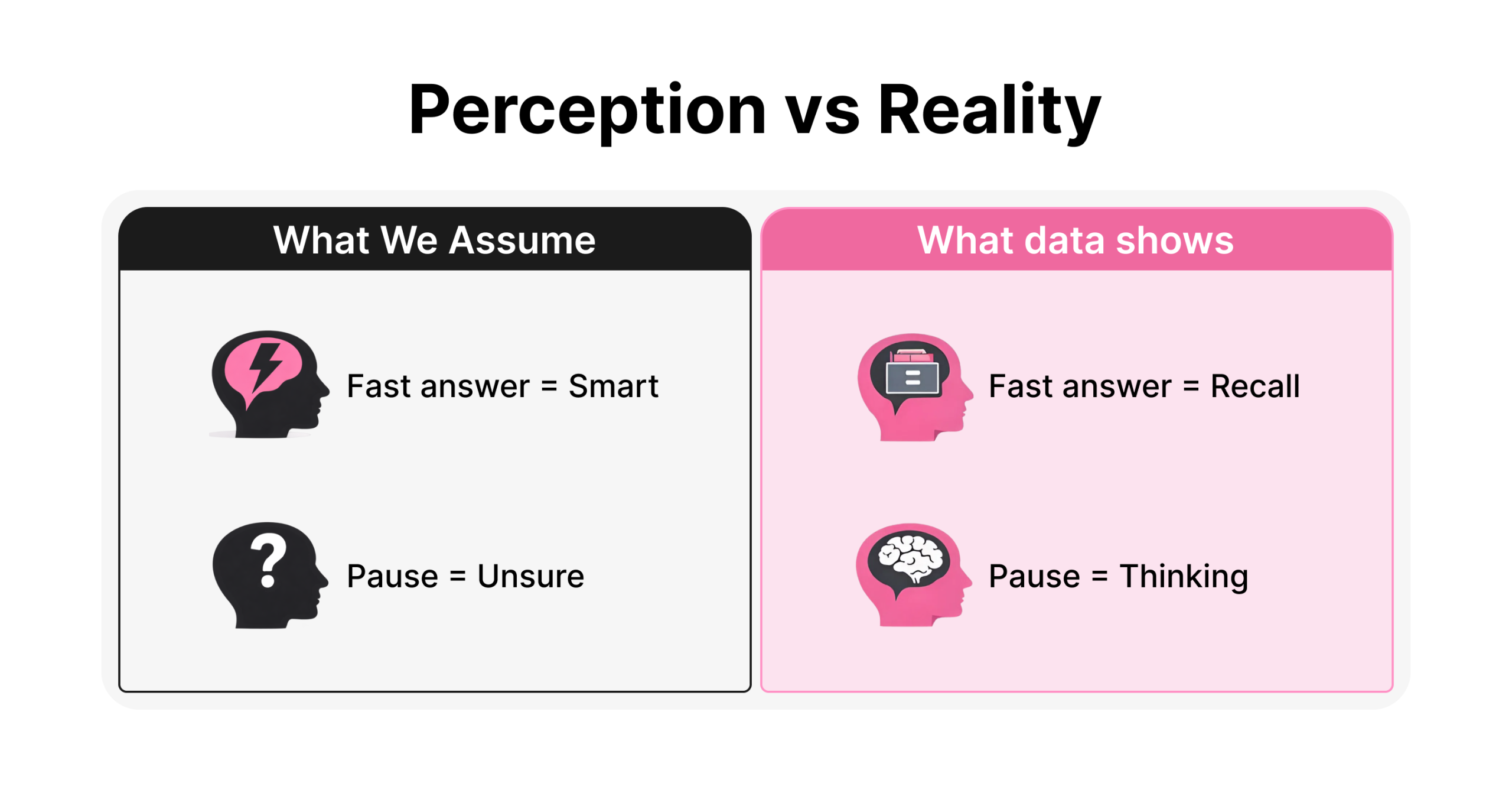
Consider the moment a question is asked. Some candidates respond immediately, almost instinctively, with a smooth and well-formed answer. Others pause briefly before speaking. In most interview settings, this difference is judged quickly and often unfairly. Fast responses are seen as confidence and clarity, while pauses are interpreted as hesitation or lack of preparation.
However, the data—and cognitive science—suggest a different story.
When a response comes instantly, it is often a sign of recall. The candidate is retrieving something familiar, something they have already thought through or practiced. This is not inherently a problem, but it does mean the thinking has already happened earlier. In contrast, when a candidate takes a short pause, it often indicates that they are processing the question, organizing their thoughts, and constructing a response in real time. Research on response latency shows that slightly delayed answers are frequently linked to deeper reasoning, especially in complex tasks (Ratcliff & McKoon, 2008).
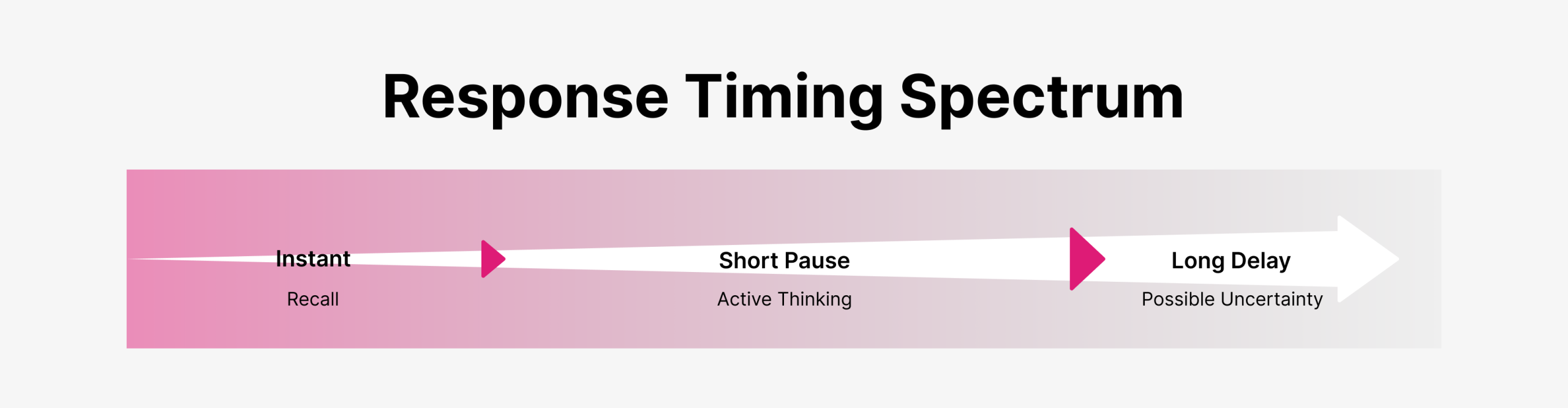
The same pattern continues within the answer itself. Some candidates speak in a continuous, uninterrupted flow. Others slow down, pause mid-sentence, or adjust their answer as they go. In traditional evaluations, these interruptions can feel like a lack of clarity. But in reality, they often reflect something more valuable—the ability to monitor and refine one’s own thinking while speaking. This kind of real-time adjustment is closely tied to metacognition, a critical skill in problem-solving and decision-making (Flavell, 1979).
To understand this better, it helps to look at how common timing patterns are typically interpreted versus what they actually indicate:
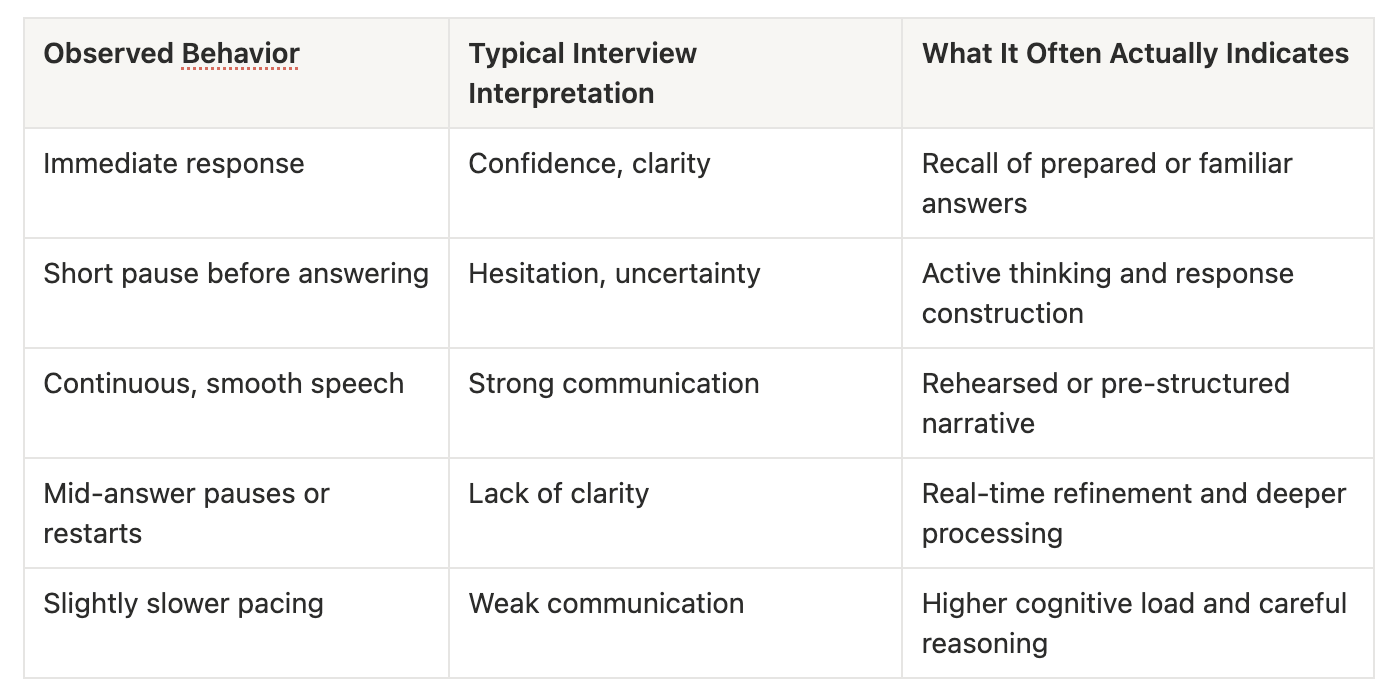
What becomes clear is that interviews tend to reward what is easy to observe, not what is most meaningful. Fast, fluent, uninterrupted answers feel better in the moment. They create a sense of certainty. But that sense can be misleading.
In many roles—especially those involving ambiguity, decision-making, and problem-solving—the ability to think through complexity matters far more than the ability to respond instantly. Candidates who take a moment, reflect, and build their answers often demonstrate stronger judgment and deeper understanding. Yet, because these signals are subtle and sometimes uncomfortable to sit through, they are frequently undervalued.
This creates a consistent bias. Candidates who optimize for speed and polish are more likely to be rated highly, while those who engage in real-time thinking may be seen as less confident or less prepared. Over time, this leads to hiring decisions that favor presentation over processing.
Timing, then, is not just a delivery detail. It is a window into cognition. It shows whether a candidate is recalling something they already know or actively working through something new. And in most real-world situations, especially those that involve uncertainty, it is the latter that truly matters.
How Qallify Interprets Timing Signals
Qallify treats timing as a core signal of how candidates think, not just how they communicate. By analyzing patterns such as response latency, pauses, pacing shifts, and mid-answer corrections, we identify whether a candidate is relying on recall or engaging in real-time reasoning.
These signals are then mapped against actual performance data to understand which patterns consistently lead to better outcomes in the role. This allows us to avoid penalizing candidates for pausing or thinking aloud, and instead recognize these behaviors as indicators of depth.
The result is a more accurate evaluation—one that prioritizes how someone processes information under pressure, not just how quickly they can respond.