

Big Five (OCEAN): Personality-Informed Hiring via Speech
A Research-Driven Reframe of Hiring
For decades, talent acquisition has operated on a narrow premise. If a candidate shows the right experience, skills, and interview performance, they will likely succeed. However, a large body of research in organisational psychology challenges this assumption.
Performance, retention, and leadership are not just functions of capability. Instead, they are deeply shaped by stable behavioural tendencies — or personality.
Among all personality frameworks, the Big Five (OCEAN) model stands out. It covers Openness, Conscientiousness, Extraversion, Agreeableness, and Neuroticism. Furthermore, it remains the most research-validated structure for understanding workplace behaviour.
The Evidence Base: Personality as a Predictor of Hiring Success
The credibility of the Big Five model lies in its consistency across decades of research. A landmark meta-analysis by Murray R. Barrick and Michael K. Mount (1991), later extended in Barrick, Mount & Judge (2001), showed that Conscientiousness predicts job performance across all occupational groups.
Validity coefficients in the range of 0.20–0.38 may look modest. However, in selection science, these effects carry significant weight — particularly at scale.
Further work by Timothy A. Judge and colleagues showed that Big Five trait combinations can explain up to 28% of variance in job performance. This holds especially true in managerial and leadership roles.
Importantly, personality adds incremental predictive power beyond cognitive ability — particularly for contextual performance. This includes how individuals behave in teams, manage stress, and sustain effort over time.
From an economic standpoint, Schmidt & Hunter's selection research suggests that even small improvements in predictive validity can yield substantial gains in productivity and reductions in turnover. This matters most in high-volume hiring environments.
The Measurement Gap: Why Hiring Systems Undervalue Personality
Despite this strong evidence base, most hiring systems still prioritise observable credentials over behavioural predictors. Resumes capture past achievements. Interviews attempt to validate them through structured questioning. Additionally, when organisations assess personality at all, they typically rely on self-report inventories.
This creates two structural limitations.
First, self-report measures are vulnerable to impression management and social desirability bias. Candidates often respond in ways that match perceived expectations rather than their actual tendencies. Second, these assessments are decontextualised. They measure how individuals describe themselves — not how they behave in real-time cognitive and emotional situations.
As a result, a critical component of hiring remains weakly measured: understanding how a candidate is likely to behave once hired.
From Declared to Observed Personality: The Role of Voice AI
Voice-based AI interviewing addresses this gap by shifting the unit of analysis from self-description to behavioural expression.
When candidates respond to open-ended questions in a voice interface, they generate rich, multi-layered data. This includes linguistic content — word choice, sentence structure, narrative framing. It also includes paralinguistic features such as pauses, pitch variation, speaking rate, and response latency.
Research in computational linguistics supports this approach. Studies by Michał Kosinski and others show that language patterns can infer personality traits with significant accuracy. Furthermore, more recent machine learning models applied to speech and text data report classification performance metrics in the range of 0.70–0.80, depending on dataset quality and model design.
Crucially, these signals are difficult to fabricate consistently. While candidates can prepare answers, they cannot easily control micro-patterns of cognition and expression across multiple responses. This makes voice data a more reliable proxy for underlying behavioural tendencies.
Mapping OCEAN Traits to Voice-Derived Signals
The Big Five traits show up in distinct and observable communication patterns.
Openness to Experience often appears in abstract thinking, use of metaphor, and intellectual curiosity. Candidates high in openness explore ideas, entertain alternatives, and move beyond literal interpretations of questions.
Conscientiousness shows through structured, goal-oriented communication. Responses are typically organised, sequential, and grounded in accountability. This reflects an underlying preference for order and execution.
Extraversion is visible in energy levels, conversational pace, and assertiveness. Highly extraverted individuals engage dynamically — often shaping the interaction rather than merely responding to it.
Agreeableness encodes in relational language. It surfaces in how candidates reference collaboration, manage disagreement, and express empathy toward others.
Neuroticism — or its inverse, emotional stability — often infers from hesitation patterns, tonal variability, and markers of stress or cognitive overload.
What voice AI enables is not merely the observation of these traits. Rather, it enables their standardised quantification across large candidate pools — reducing interviewer subjectivity and inconsistency.
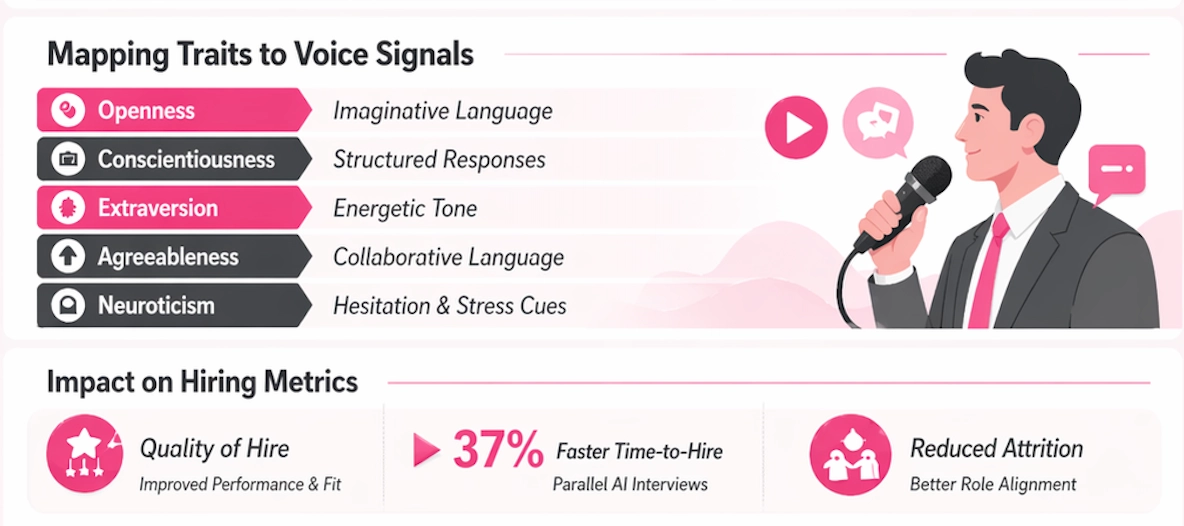
Implications for Core Talent Acquisition Metrics
The integration of personality inference into hiring systems has direct implications for key talent acquisition outcomes.
Quality of hire improves when behavioural alignment joins skills in the evaluation. Research consistently shows that conscientiousness and emotional stability strongly associate with performance and reliability. Moreover, agreeableness and extraversion influence team effectiveness and leadership emergence.
Time-to-hire can reduce without compromising evaluation depth. Voice AI enables asynchronous, parallel interviews. This allows organisations to process large volumes of candidates while simultaneously extracting richer behavioural data at early stages.
Attrition is particularly sensitive to personality-job fit. Studies in organisational behaviour indicate that misalignment between personality traits and role demands significantly predicts early turnover. For instance, individuals high in neuroticism are more susceptible to stress-induced burnout. Similarly, those low in conscientiousness may struggle in execution-intensive roles.
By incorporating personality signals into early screening, therefore, organisations can mitigate these risks proactively.
Validity, Ethics, and the Risk of Pseudoscience
While the potential of voice AI in personality assessment is significant, it is not without risks. Recent audits of AI-based personality systems highlight concerns around model stability, transparency, and construct validity. Systems that do not ground themselves in established psychological frameworks may produce inconsistent or non-replicable results.
For such systems to be credible in enterprise hiring, three conditions are essential:
1. Alignment with validated models such as the Big Five
2. Training on large, diverse, and representative datasets
3. Continuous validation against real-world outcomes — including performance, retention, and progression
2. Training on large, diverse, and representative datasets
3. Continuous validation against real-world outcomes — including performance, retention, and progression
Without these safeguards, the risk is not merely technical failure. Instead, it becomes the institutionalisation of flawed decision-making.
From Screening to Prediction: A Structural Shift in Hiring Logic
Traditional hiring operates on a binary decision framework. Organisations either select or reject candidates based on threshold criteria. Personality-informed systems, in contrast, enable a probabilistic approach.
Instead of asking whether a candidate meets predefined criteria, organisations can estimate the likelihood that a candidate will succeed within a specific role and environment. This aligns hiring more closely with the realities of human behaviour — where outcomes are inherently probabilistic rather than deterministic.
In this context, therefore, voice AI functions not simply as an efficiency tool. Rather, it acts as an analytical layer — one that transforms unstructured human interaction into structured behavioural insight.
Toward Behavioural Intelligence in Hiring
The integration of Big Five personality science with voice AI marks a meaningful evolution in talent acquisition. It shifts focus from static credentials to dynamic behaviour. Moreover, it moves evaluation from retrospective judgment to forward-looking prediction.
Organisations that adopt this approach are not merely optimising hiring processes. Instead, they are redefining what counts as valid evidence in selection decisions. In doing so, they move closer to a hiring model that is not only faster — but fundamentally more aligned with how humans think, act, and perform.
In a landscape where marginal improvements compound rapidly, this shift matters. Consequently, moving from assessing capability to understanding behaviour may well determine which organisations build workforces that are not just competent — but consistently effective.
To know about the Most Dangerous Feedback in Hiring, click here.