

"Something Felt Off": The Most Dangerous Feedback in Hiring
The Most Influential Feedback That No One Defines
In hiring conversations, few phrases carry as much unspoken weight as "something felt off." This phrase rarely appears in formal evaluation sheets. Yet it frequently becomes the final deciding factor — rejecting candidates who look strong on paper and score well in structured assessments.
For talent acquisition leaders, this phrase creates a paradox. On one hand, it reflects interviewer instinct — often built over years of experience. On the other hand, it exposes a critical gap: decisions made without clear reasoning.
The goal is not to eliminate this instinct. Instead, the goal is to decode it.
Why "Something Felt Off" Shows Up More in Final Rounds
Interestingly, this phrase surfaces more often in later interview stages than in early rounds. Earlier rounds are structured. They use defined questions, clear rubrics, and expected answer formats. As a result, decisions feel more grounded.
Final rounds, however, shift the dynamic entirely. Conversations grow more open-ended. Evaluation becomes interpretive rather than structured. Moreover, interviewers no longer just assess what the candidate knows. Instead, they assess how the candidate thinks, responds, and aligns.
This shift, therefore, introduces ambiguity.
Rather than clear signals, interviewers encounter patterns. Rather than measurable answers, they rely on perception. And when something does not align — but cannot be easily named — it gets labelled as "off."
The Psychology Behind the Feeling
Human beings are wired to make rapid judgments. Research in behavioural science shows that we form impressions within seconds of interaction — often based on limited information. While these "thin-slice" judgments can sometimes point in the right direction, they are also highly vulnerable to bias and contextual distortion.
A foundational study in Psychological Science showed that brief observations of behaviour can significantly influence judgments — even when those observations are incomplete or contextually limited (Ambady & Rosenthal, 1992).
In hiring, therefore, interviewers constantly interpret micro-signals — tone shifts, pauses, answer structure, emotional responses — often without consciously processing them.
The result, consequently, is a feeling before a reason.
What "Felt Off" Actually Signals
When unpacked, this phrase is rarely random. It is usually a reaction to specific breaks in expected patterns. Furthermore, these breaks tend to fall into a few key categories.
Narrative inconsistency is one of the most common triggers. Strong candidates typically tell coherent stories — linking past experiences to decisions and outcomes. When responses feel disjointed or lack continuity, interviewers experience cognitive friction. They then label this friction as "off."
Cognitive misalignment is another factor. Some candidates think in structured, step-by-step formats. Others, in contrast, process ideas in a more associative or non-linear way. If the interviewer expects one style but encounters another, a perception gap forms — even if the candidate's thinking is sound.
Emotional and pacing mismatch also plays a role. Subtle variations in tone, hesitation, or response timing can signal discomfort, over-preparation, or low engagement. Additionally, interviewers often interpret these signals intuitively rather than analytically.
Low contextual anchoring can further contribute. Candidates who fail to ground responses in specific contexts or outcomes may appear vague — even if they possess strong underlying capability.
None of these are inherently disqualifying. However, when combined, they create a pattern that interviewers struggle to name.
The Hidden Role of Bias
The biggest risk with "something felt off" is not that it exists. The real risk, instead, is that it often masks bias.
One of the most well-documented biases in hiring is fluency bias — the tendency to equate smooth communication with competence. Research from the Harvard Business Review highlights how candidates who speak confidently often appear more capable — regardless of the actual depth of their thinking.
This creates a distortion. Thoughtful but less polished candidates get undervalued. Confident communicators, on the other hand, get overestimated.
Affinity bias compounds this effect. Interviewers naturally gravitate toward candidates who resemble them in communication style, background, or worldview. Consequently, when a candidate feels unfamiliar, that discomfort gets interpreted as misfit.
First impression anchoring and confirmation bias further reinforce these judgments. Once an initial perception forms, interviewers subconsciously seek evidence to support it — filtering out contradictory signals.
In this context, therefore, "something felt off" becomes less about the candidate and more about the lens through which they are being evaluated.
From Intuition to Signal: The Shift TA Leaders Need
The challenge for talent acquisition leaders is not to remove human judgment. Rather, it is to structure it.
Unstructured intuition does not scale. Moreover, it creates variability across interviewers, reduces fairness, and limits the organisation's ability to learn from hiring decisions.
Decoding "something felt off" means translating subjective impressions into observable signals. Instead of asking interviewers to justify feelings after the fact, organisations need systems that capture and interpret behavioural data in real time.
This means breaking interviews into clear components:
● How candidates structure their responses
● How they handle ambiguity
● How consistently they anchor answers in context
● How they adapt under pressure
● How they handle ambiguity
● How consistently they anchor answers in context
● How they adapt under pressure
When these signals become visible, therefore, the ambiguity starts to reduce.
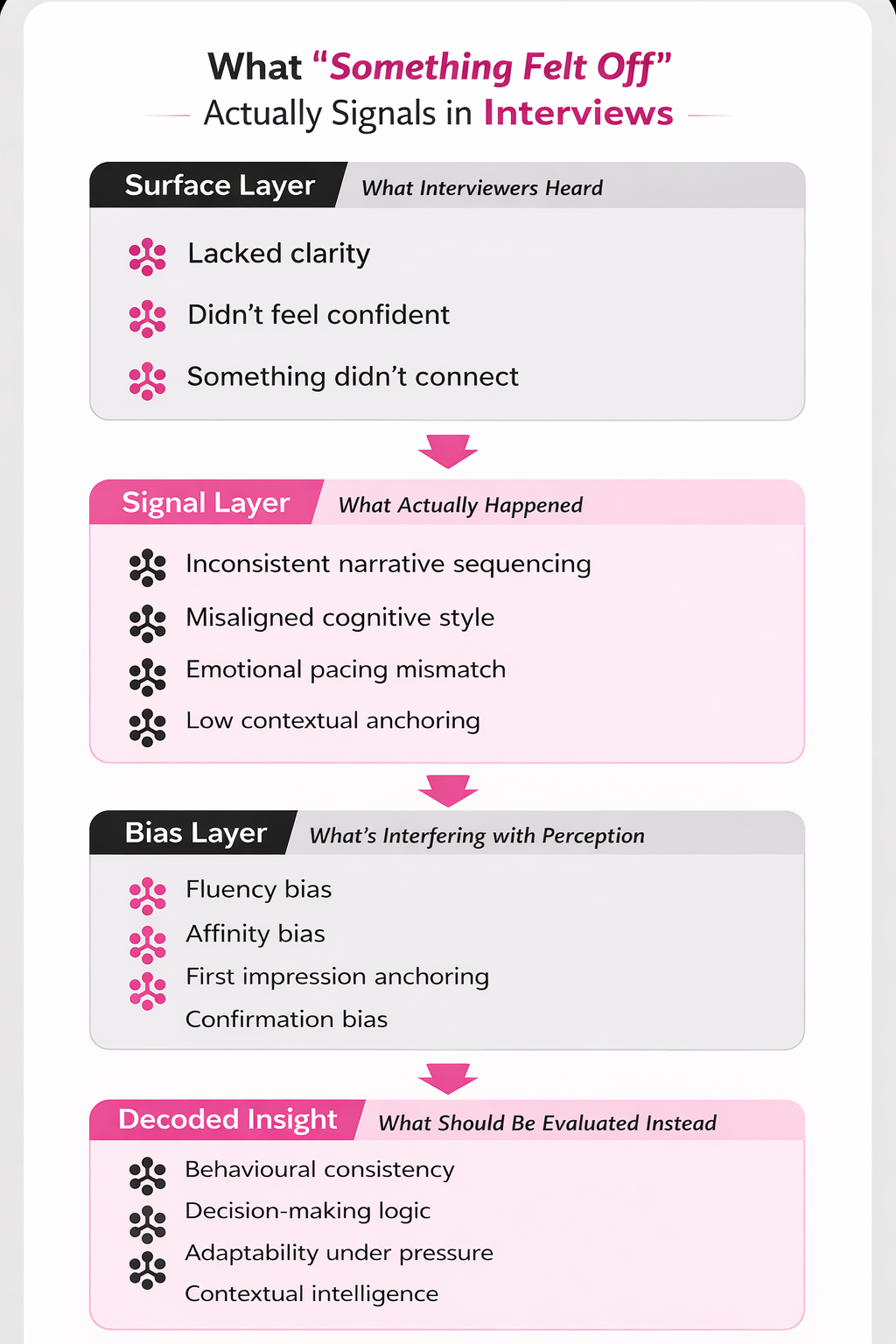
Visualising the Gap Between Perception and Reality
At the surface level, interviewers describe what they felt — lack of clarity, low confidence, or weak connection. Beneath that surface, however, lie actual behavioural signals — inconsistent sequencing, misaligned thinking styles, or pacing mismatches. Overlaying both layers are biases that distort interpretation.
Organisations need a fourth layer — decoded insight. This is where evaluation shifts from perception to structured understanding. Furthermore, it focuses on behavioural consistency, decision-making logic, adaptability, and contextual intelligence.
This layered view, consequently, transforms hiring from subjective judgment into analysable data.
Where Traditional Hiring Breaks Down
Most hiring systems evaluate answers — not thinking patterns. They capture what candidates say. However, they miss how candidates arrive at those responses.
This creates a blind spot.
When interviewers rely on memory and perception to fill that gap, decisions grow inconsistent. As a result, two interviewers can observe the same candidate and reach completely different conclusions — both justified by gut feel.
Over time, furthermore, this inconsistency compounds. Organisations struggle to identify why certain hires succeed while others fail. Consequently, feedback loops stay weak. Interview quality varies widely.
And the phrase "something felt off" continues to operate as an invisible filter.
How Qallify Reframes the Interview
Dr. Chetan Indap, Founder & CEO of Qallify, built the platform to address exactly this gap — transforming interviews into structured signal ecosystems.
Rather than treating interviews as conversations to remember and interpret later, Qallify captures behavioural data as it unfolds. It analyses linguistic patterns, response structure, adaptability, and consistency across interactions.
This, therefore, enables a critical shift.
When an interviewer feels something is "off," Qallify identifies what exactly triggered that perception. Was it narrative inconsistency? Was it a mismatch in cognitive processing style? Or did bias influence the perception?
By making these signals explicit, furthermore, Qallify does not replace human judgment. Instead, it sharpens it.
The Impact on Hiring Quality and Fairness
Decoding intuition has direct implications for both hiring outcomes and organisational equity.
Consistency improves because decisions anchor in shared evaluation criteria rather than individual interpretation.
Fairness increases because bias-driven perceptions separate from genuine performance signals.
Predictive accuracy strengthens because hiring decisions base on behavioural indicators that correlate with real-world performance.
For talent acquisition leaders, therefore, this means moving from reactive hiring decisions to proactive hiring intelligence.
Rethinking the Role of the Interviewer
This shift also redefines what it means to be a good interviewer.
Traditionally, interviewers learn to ask the right questions. However, in a signal-based hiring model, the focus expands to interpreting responses accurately.
Interviewers become observers of patterns rather than judges of impressions. As a result, they learn to recognise when a candidate's communication style differs from their own — and when that difference has no bearing on performance.
This not only improves decision-making but also builds interviewer confidence and alignment across teams.
From "Felt Off" to "Figured Out"
The phrase "something felt off" is not the problem. It is, instead, a starting point.
It signals that the interviewer detected something meaningful — even if they cannot immediately define it. The real risk, therefore, lies in stopping at the feeling rather than investigating the signal.
Organisations that learn to decode this moment gain a significant advantage. Consequently, they reduce noise in hiring decisions, improve quality of hire, and build systems that are both human and structured.
In a world where talent is increasingly complex and roles constantly evolve, relying on undefined intuition is no longer enough.
The future of hiring belongs to organisations that translate instinct into insight.
And when that happens, "something felt off" is no longer a rejection reason. It becomes, ultimately, a question worth answering.
To know about the top reason strong candidates fail after final rounds, click here.