

AI Meets Accountability: Qallify's Ethical Hiring Edge
The Real Fear: When AI in Hiring Goes Off Script
Companies today are not just experimenting with AI in hiring. Increasingly, they are worried about it going wrong. The concern is not theoretical. From biased screening algorithms to intrusive interview flows, real-world AI systems have crossed ethical and legal boundaries.
For CXOs, furthermore, the fallout is multidimensional: regulatory penalties, reputational damage, and erosion of candidate trust.
This is the context in which Qallify built its DeepAssess AI engine — not just as a predictive tool, but as a controlled, compliant, and context-aware system. Because in hiring, intelligence without restraint is not innovation. It is, instead, risk.
Beyond Compliance: Designing for Legal Boundaries
At the heart of DeepAssess lies a critical understanding: hiring is never culture-neutral, and it is certainly not law-neutral. What one geography accepts may be illegal in another — and inappropriate in a third.
In the United States, for instance, frameworks such as Title VII of the Civil Rights Act of 1964 and the Americans with Disabilities Act tightly govern hiring practices. These laws explicitly prohibit discrimination based on gender, race, ethnicity, religion, or disability. Moreover, these regulations extend beyond decision-making into the very structure of interview questions. Even indirect or proxy questions can create compliance risks.
DeepAssess addresses this directly. It eliminates such risks at the source — by preventing the generation or interpretation of any signals related to protected attributes.
Navigating AI-Specific Regulations
This compliance-first approach becomes even more critical with the rise of AI-specific regulations. New York City Local Law 144, for example, mandates bias audits and transparency in automated hiring tools.
DeepAssess aligns with these expectations by ensuring that its outputs are explainable, auditable, and grounded only in job-relevant competencies. This is, consequently, a necessity in high-scrutiny environments.
Cultural Sensitivity: The Philippines
Legal compliance alone, however, does not guarantee fairness. Cultural nuance plays an equally important role. In the Philippines, hiring is shaped by both the Philippine Labor Code and the Data Privacy Act of 2012. Here, candidate experience is deeply influenced by tone, respect, and communication style.
DeepAssess adapts to this by modulating its interaction style — ensuring that interviews are polite, conversational, and culturally aligned. At the same time, it maintains strict data privacy protocols such as informed consent and minimal data capture.
Cultural Sensitivity: India
In India, the challenge is less about formal regulation alone. Instead, it is about informal biases embedded in traditional interview practices. While laws like the Equal Remuneration Act 1976 and the Information Technology Act 2000 provide a legal foundation, real-world interviews often drift into areas like marital status, family plans, or regional identity.
DeepAssess eliminates this ambiguity by enforcing a structured, role-focused evaluation framework — ensuring that only relevant competencies get assessed. Additionally, it accounts for India's linguistic diversity by evaluating intent over accent or fluency, reducing inadvertent bias.
From Bias Risk to Responsible Intelligence
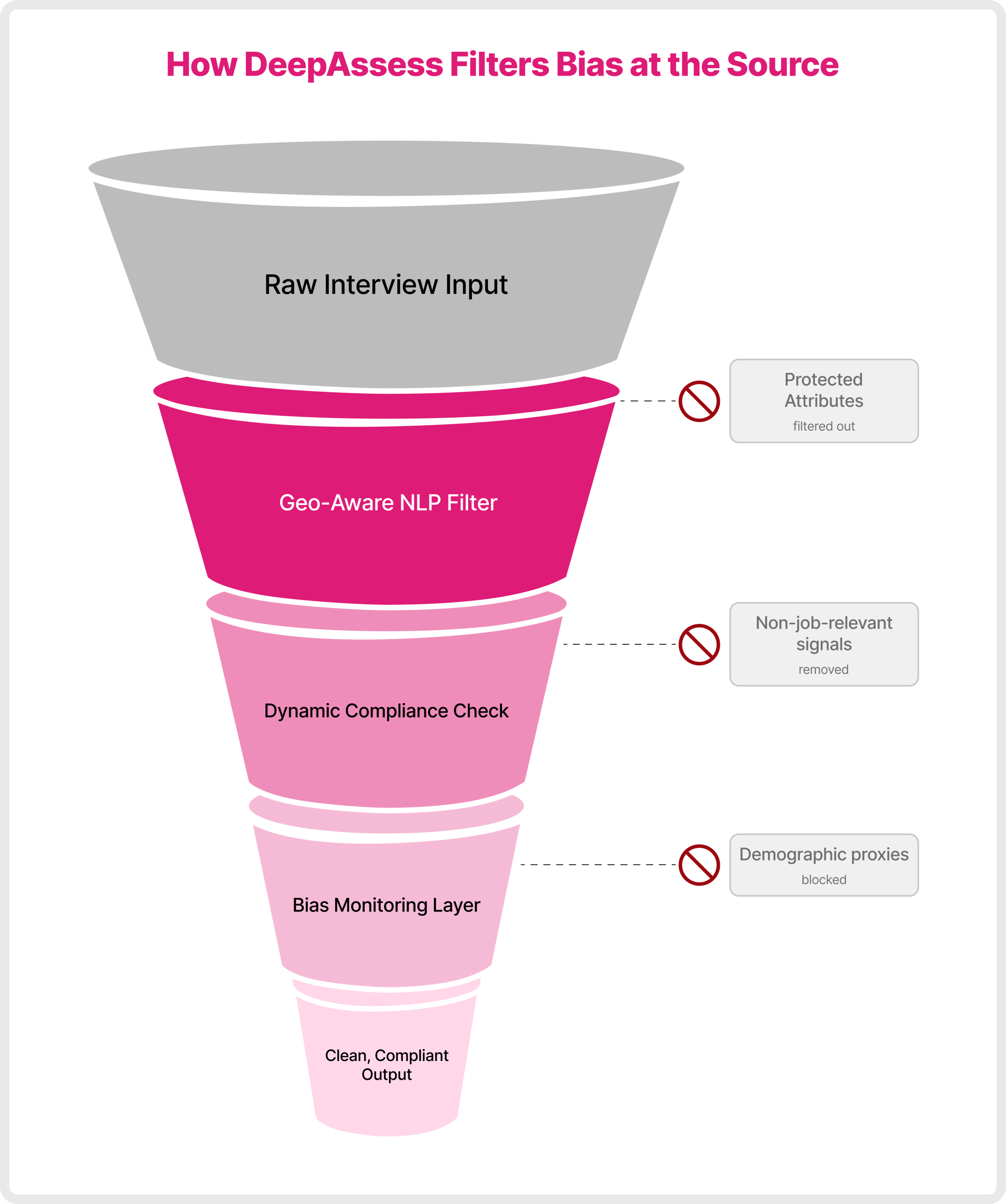
What differentiates Qallify is not just its ability to comply — but its ability to adapt intelligently across contexts. It combines geo-aware NLP models, dynamic compliance filters, and continuous bias monitoring. The result, therefore, is a system that is both globally scalable and locally sensitive.
This approach aligns with broader global research from institutions like the National Institute of Standards and Technology and the World Economic Forum, which emphasise that AI in hiring must be transparent, fair, and context-aware to be sustainable.
The Question Every Business Leader Should Ask
For business leaders, the question is no longer whether AI can make hiring faster. Instead, the real question is whether AI can make hiring safer, fairer, and defensible across markets.
Qallify's DeepAssess answers this directly. Every interaction, every question, and every evaluation grounds itself in legal compliance, cultural sensitivity, and ethical integrity.
Because in today's hiring landscape, the real competitive advantage isn't just better decisions. It is, ultimately, responsible decisions.