

Why Personality Is the Missing Layer in Candidate Screening?
Most hiring processes are built around a straightforward assumption. Find someone with the right skills, the right experience, and the right interview performance — and you have found the right hire.
This assumption is not wrong. It is, however, incomplete.
Because the evidence consistently shows that skills and experience alone do not determine whether someone will thrive in a role, contribute to a team, or stay long enough to create meaningful value. What determines these outcomes — far more than most organisations currently measure — is personality.
Not personality in the casual, intuitive sense of whether someone seems likeable or confident in an interview. Rather, personality in the structured, empirically validated sense of stable behavioural tendencies that shape how people think, communicate, make decisions, handle pressure, and relate to others across every context they encounter.
This is, consequently, the missing layer in most candidate screening processes — and closing this gap may be the single most important improvement a recruitment team can make.
What the Research Actually Says
The case for personality in hiring is not theoretical. It is, instead, one of the most robustly supported findings in decades of organisational psychology research.
A landmark meta-analysis by Barrick and Mount (1991) established that conscientiousness — one of the five core personality traits in the Big Five OCEAN model — is a universal predictor of job performance across occupational groups. Validity coefficients in the range of 0.20–0.38 may appear modest in isolation. However, in selection science, these effects are considered highly meaningful — particularly when applied at scale across large candidate pools.
Further work by Timothy Judge and colleagues demonstrated that combinations of Big Five traits can explain up to 28% of variance in job performance — particularly in managerial and leadership roles. Furthermore, personality adds incremental predictive power beyond cognitive ability alone — especially for contextual performance, which includes how individuals behave within teams, manage stress, and sustain effort over time.
Research by Schmidt and Hunter reinforces this point from an economic perspective. Even small improvements in predictive validity — such as those achieved by incorporating personality assessment alongside structured interviews — can yield substantial gains in productivity and meaningful reductions in turnover. This is especially significant in high-volume hiring environments where the compounding effect of better selection decisions is enormous.
Yet despite this evidence base, most hiring processes continue to prioritise observable credentials over behavioural predictors. Resumes capture past achievements. Interviews attempt to validate them. Personality, when assessed at all, typically enters the process as an afterthought — a self-report questionnaire administered after the shortlist has already formed.
The Five Dimensions That Shape Hiring Outcomes
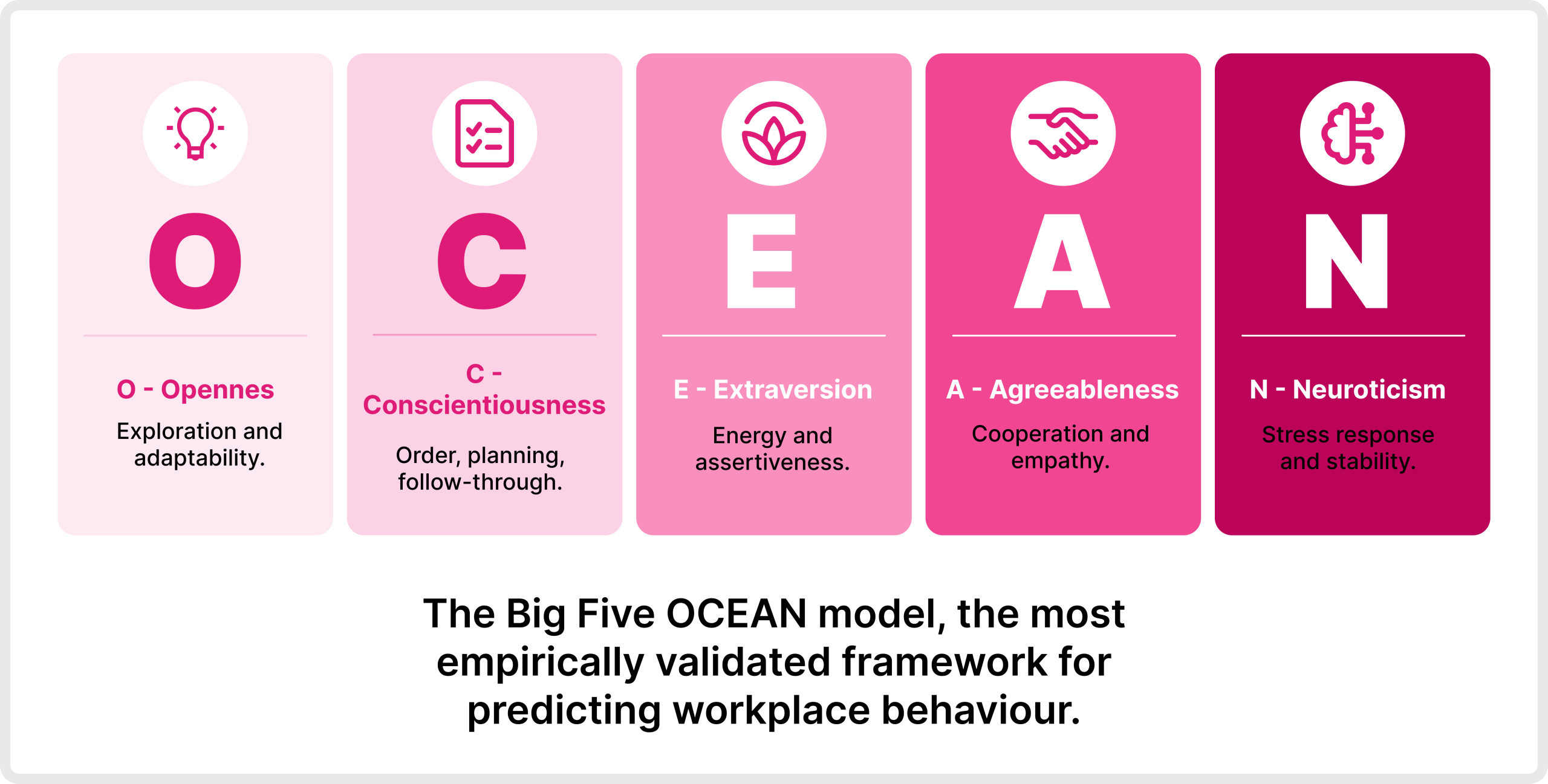
The Big Five OCEAN model — Openness, Conscientiousness, Extraversion, Agreeableness, and Neuroticism — remains the most empirically validated framework for understanding workplace behaviour. Each dimension captures a distinct aspect of how people show up in professional environments — and each has meaningful implications for hiring decisions.
Openness: Hiring for the Unknown
Openness to experience reflects a person's cognitive orientation toward exploration, abstraction, and intellectual engagement. Individuals high in openness tend to expand the solution space rather than narrow it prematurely. They think in abstractions, entertain multiple perspectives simultaneously, and engage naturally with ambiguity and complexity.
Research consistently links openness to creative thinking, learning orientation, and adaptability — making it particularly relevant in roles characterised by ambiguity, innovation, and continuous change. In contrast, its relationship with performance is less pronounced in highly structured or repetitive roles where consistency and adherence to established processes matter more.
What makes openness especially valuable in modern hiring is its connection to future-oriented capability. While experience reflects what a candidate has already done, openness provides insight into how they are likely to respond to new challenges, unfamiliar environments, and evolving role demands. In a world where the World Economic Forum estimates that nearly 44% of workers' core skills will change by 2027, this forward-looking signal matters enormously.
Conscientiousness: The Most Reliable Predictor
If there is one personality trait that every hiring team should understand and measure, it is conscientiousness. It reflects a preference for order, planning, and follow-through — and it is, consequently, the most consistent predictor of job performance identified across decades of research.
Conscientiousness shows up in structured, goal-oriented communication. Responses are typically organised, sequential, and grounded in accountability. In interview contexts, conscientious candidates tend to provide specific examples with clear sequencing, demonstrate ownership of outcomes, and articulate plans rather than vague intentions.
For recruitment agencies sending candidate profiles to decision-makers, candidates high in conscientiousness represent lower placement risk — because the very traits that make them strong performers also make them more likely to follow through on commitments, show up on Day 1, and sustain performance beyond the initial onboarding period.
Extraversion: Matching Energy to Environment
Extraversion is visible in energy levels, conversational pace, and assertiveness. Highly extraverted individuals engage dynamically — often shaping interactions rather than merely responding to them.
However, extraversion is not universally advantageous — and treating it as such is one of the most common sources of bias in candidate screening. Roles that require sustained individual focus, deep analysis, or careful written communication may be better suited to candidates with lower extraversion scores. Roles in sales, customer experience, business development, and client management, in contrast, often benefit significantly from high extraversion.
The key, therefore, is not to treat extraversion as inherently positive or negative — but to understand how it aligns with the specific demands of the role being filled. An extraverted candidate screened for a highly collaborative, client-facing role is a strong fit signal. The same candidate screened for a deep analytical or technical role may represent a mismatch that only becomes visible after joining.
Agreeableness: The Foundation of Team Dynamics
Agreeableness reflects how individuals position themselves in relation to others — whether they approach interactions cooperatively or competitively, and whether they prioritise collective or individual outcomes.
Research consistently shows that agreeableness plays a critical role in shaping team dynamics. According to studies published in SAGE Journals, individuals high in agreeableness are more likely to engage in helping behaviour, resolve conflicts constructively, and maintain positive working relationships. These behaviours are, furthermore, essential for sustaining team effectiveness over time — even though they are rarely captured in traditional skills-based screening.
At the same time, agreeableness is not universally advantageous. In roles that require assertiveness, negotiation, or decision-making under conflict, excessively high agreeableness may lead to avoidance of necessary confrontation. This underscores the importance of contextualising personality within specific role requirements — rather than treating any single trait as uniformly desirable.
Neuroticism: The Signal Most Agencies Miss
Neuroticism — or its inverse, emotional stability — is often the most sensitive and least discussed dimension of personality in hiring contexts. It reflects susceptibility to stress, anxiety, and emotional volatility.
Individuals high in neuroticism are more susceptible to stress-induced burnout and performance degradation under pressure. In high-pressure roles — such as customer support in BPO environments, sales in competitive markets, or operations in time-sensitive functions — neuroticism represents a meaningful attrition risk signal that most traditional screening processes never capture.
According to research published in PMC, emotional stability is among the strongest personality predictors of sustained performance in demanding work environments. For recruitment agencies placing candidates in roles with high interpersonal or operational pressure, incorporating neuroticism assessment into early screening can, consequently, significantly reduce early attrition — one of the most expensive outcomes in high-volume hiring.
Why Traditional Screening Misses Personality Almost Entirely
Understanding the importance of personality is one thing. Understanding why traditional screening fails to capture it is another — and equally important.
The primary reason is measurement. Skills can be tested with assignments. Credentials can be verified. Experience can be validated through reference checks. Personality, in contrast, requires either longitudinal observation or sophisticated inference — neither of which traditional hiring processes are designed to support.
Self-report personality questionnaires — the most common approach — suffer from two structural limitations. First, they are vulnerable to impression management. Candidates respond in ways that align with perceived expectations rather than their actual tendencies — particularly in high-stakes hiring contexts where the incentive to present favourably is strongest. Second, they are decontextualised. They measure how individuals describe themselves rather than how they actually behave under real cognitive and emotional conditions.
As a result, a critical component of candidate screening — understanding how someone is likely to behave once hired — remains, consequently, weakly measured by most agencies and organisations.
Voice AI: From Self-Description to Behavioural Expression
The most significant recent development in personality assessment for hiring is the ability to infer personality traits from natural voice interactions — without relying on self-report at all.
When candidates respond to open-ended questions in a voice-based interview, they generate rich, multi-layered data. This includes linguistic content — word choice, sentence structure, narrative framing — as well as paralinguistic features such as pauses, pitch variation, speaking rate, and response latency. Together, these signals form a behavioural fingerprint that reflects underlying personality traits far more reliably than any questionnaire response.
Research in computational linguistics supports this approach directly. Studies by Michał Kosinski and colleagues demonstrated that language patterns can infer personality traits with significant accuracy. Furthermore, more recent machine learning models applied to speech and text data report classification performance metrics in the range of 0.70–0.80 — a level of reliability that makes voice-based personality inference genuinely meaningful for hiring decisions.
Crucially, these signals are difficult to fabricate consistently. While candidates can prepare answers, they cannot easily control the micro-patterns of cognition and expression that emerge across multiple responses. This makes voice data a more reliable proxy for underlying behavioural tendencies than either self-report questionnaires or structured interview performance.
Personality and the Integrity Index
For recruitment agencies building competitive advantage around candidate profiling quality, personality assessment integrates naturally with the integrity and authenticity signals discussed in the context of AI-powered screening.
Personality traits such as conscientiousness and agreeableness are strongly associated with commitment indicators, transparency markers, and behavioural stability — the same signals that form the basis of an integrity index. A candidate who scores high on conscientiousness tends to provide consistent, accountable, specific responses. A candidate high in agreeableness tends to frame experiences in relational terms, acknowledge others' contributions, and communicate with moderated, balanced language.
When personality signals and integrity signals align, the resulting candidate profile gives decision-makers a level of confidence that goes significantly beyond competency assessment alone. It answers not just whether a candidate can do the job — but whether they are likely to approach it with the consistency, reliability, and collaborative spirit that sustained performance requires.
The Team Composition Dimension
Beyond individual placement decisions, personality data has a broader application that most recruitment agencies have not yet begun to explore — team composition.
Teams are not simply aggregates of individual performers. They are systems of interaction. The distribution of personality traits within a team shapes how ideas generate, how decisions get made, how conflicts resolve, and how the team adapts to change. A team composed entirely of high-openness, low-conscientiousness individuals may generate creative ideas but struggle with execution. A team skewed toward high agreeableness may maintain harmony at the cost of necessary challenge and debate.
According to research published in PMC on personality and team dynamics, team-level personality composition predicts team performance outcomes beyond individual-level trait effects. For recruitment agencies advising clients on talent strategy rather than simply filling vacancies, this insight opens a significantly more valuable conversation — one that positions the agency as a strategic talent partner rather than a transactional placement service.
What This Means for the Candidate Profile You Send
For recruitment agencies committed to speed, quality, and client trust — as discussed throughout the context of modern agency competitive dynamics — personality assessment changes the nature of the candidate profile fundamentally.
A profile that includes personality signals alongside competency assessment and integrity verification gives decision-makers a genuinely three-dimensional view of each candidate. Not just what they have done. Not just how they performed in a structured evaluation. But how they are likely to think, behave, and relate to others in the specific environment they are joining.
This is, therefore, the level of insight that builds the kind of client relationships that generate repeat business, preferred supplier arrangements, and long-term commercial partnerships. Because decision-makers who receive personality-informed profiles do not just make faster decisions — they make more confident ones. And confident decisions that lead to successful placements are, ultimately, the foundation of every successful recruitment agency.
How Qallify Captures Personality in Screening
Qallify's approach to personality assessment is built directly into the candidate evaluation process — not as a separate psychometric tool, but as an integrated layer of behavioural intelligence derived from natural voice interactions.
During AI-led candidate conversations, the platform simultaneously captures linguistic content, paralinguistic signals, and behavioural patterns — mapping these against Big Five personality dimensions in real time. The result is a structured personality profile that forms part of the candidate's overall assessment — alongside competency alignment, communication quality, integrity signals, and joining probability.
For recruitment agencies operating on pay-per-use pricing, this capability is accessible at the moment it creates value — scaling proportionally with placement volumes and requiring no upfront investment in separate psychometric platforms or assessment infrastructure.
The candidate profiles that result are richer, more predictive, and more trustworthy than anything traditional screening can produce. Because they capture not just what candidates have done — but who they are, how they think, and how they are likely to perform in the specific role, team, and environment they are being placed into.
And in a hiring landscape where the cost of a wrong placement can reach 30% to 200% of annual salary — that depth of insight is, ultimately, not a luxury.
It is the difference between a placement that works and one that does not.
To know about Can AI Detect When Candidates Use AI in Interviews, click here.