

Can AI Detect When Candidates Use AI in Interviews?
There is a new tension sitting quietly at the centre of modern hiring.
On one side, recruiters are increasingly using AI to screen candidates faster, assess competencies more consistently, and predict joining and performance outcomes with greater accuracy. On the other side, candidates are increasingly using AI to prepare sharper answers, generate polished responses, and navigate interviews with a level of articulation that may not reflect their actual thinking.
For a while, both sides operated in parallel without directly confronting each other. However, that dynamic is, consequently, changing.
AI can now detect when candidates use AI-generated responses during interviews. And for recruitment agencies, talent acquisition leaders, and hiring organisations, this capability is beginning to reshape what authentic evaluation actually means — and why it matters more than ever.
The Problem Nobody Wanted to Name
For the past two years, a growing number of recruiters have noticed something difficult to articulate.
Candidates arrive at interviews — particularly AI-led or asynchronous video interviews — with answers that feel unusually polished. The structure is perfect. The language is precise. The examples are relevant and well-framed. Yet something feels, as many hiring professionals describe it, slightly off.
The answer does not quite sound like the person giving it. The vocabulary does not match the conversational tone. The narrative is too clean, too rehearsed, too structured for a spontaneous response. And when the interviewer probes deeper — asks a follow-up question that the prepared answer did not anticipate — the quality drops sharply.
This is not a new phenomenon. Candidates have always prepared for interviews. However, there is a meaningful difference between a candidate who has prepared their thinking and a candidate who has outsourced their thinking entirely to an AI tool — typing the question into a language model and reading the generated response during the interview itself.
According to research from Stanford University's Human-Centered AI Institute, AI-generated text has become increasingly difficult for humans to detect reliably — particularly when the generated content is edited or lightly personalised before use. Consequently, the gap between authentic candidate responses and AI-assisted ones has become invisible to the human eye — but not, importantly, to AI detection systems trained specifically to identify it.
Why This Matters More Than It Might Seem
The immediate reaction from some quarters is that this is not a significant problem. Candidates have always used resources to prepare. Coaching, mock interviews, and structured preparation have always existed. Why should AI-assisted preparation be treated differently?
The answer lies in what interviews are actually designed to measure — and what AI-generated responses systematically obscure.
Interviews, at their best, are designed to capture authentic thinking. How does this person approach a problem they have not encountered before? How do they handle ambiguity? How do they communicate under pressure? What does their reasoning process actually look like when they are working through a challenge in real time?
These are the signals that predict job performance. According to Gartner, traditional interviews already predict only about 26% of actual on-the-job performance — largely because even authentic interview responses are a limited proxy for real-world behaviour. When AI-generated responses replace authentic ones entirely, this predictive validity drops further. The interview becomes, consequently, a performance of competence rather than a demonstration of it.
For recruitment agencies sending candidate profiles to decision-makers — profiles that include competency assessments, communication scores, and integrity indices — the presence of AI-generated responses fundamentally undermines the credibility of every evaluation made. If the responses were not authentic, the scores are not meaningful. And if the scores are not meaningful, the profile is not trustworthy.
This is, therefore, not a marginal concern. It is a direct threat to the integrity of the hiring process itself.
How AI Detection Actually Works
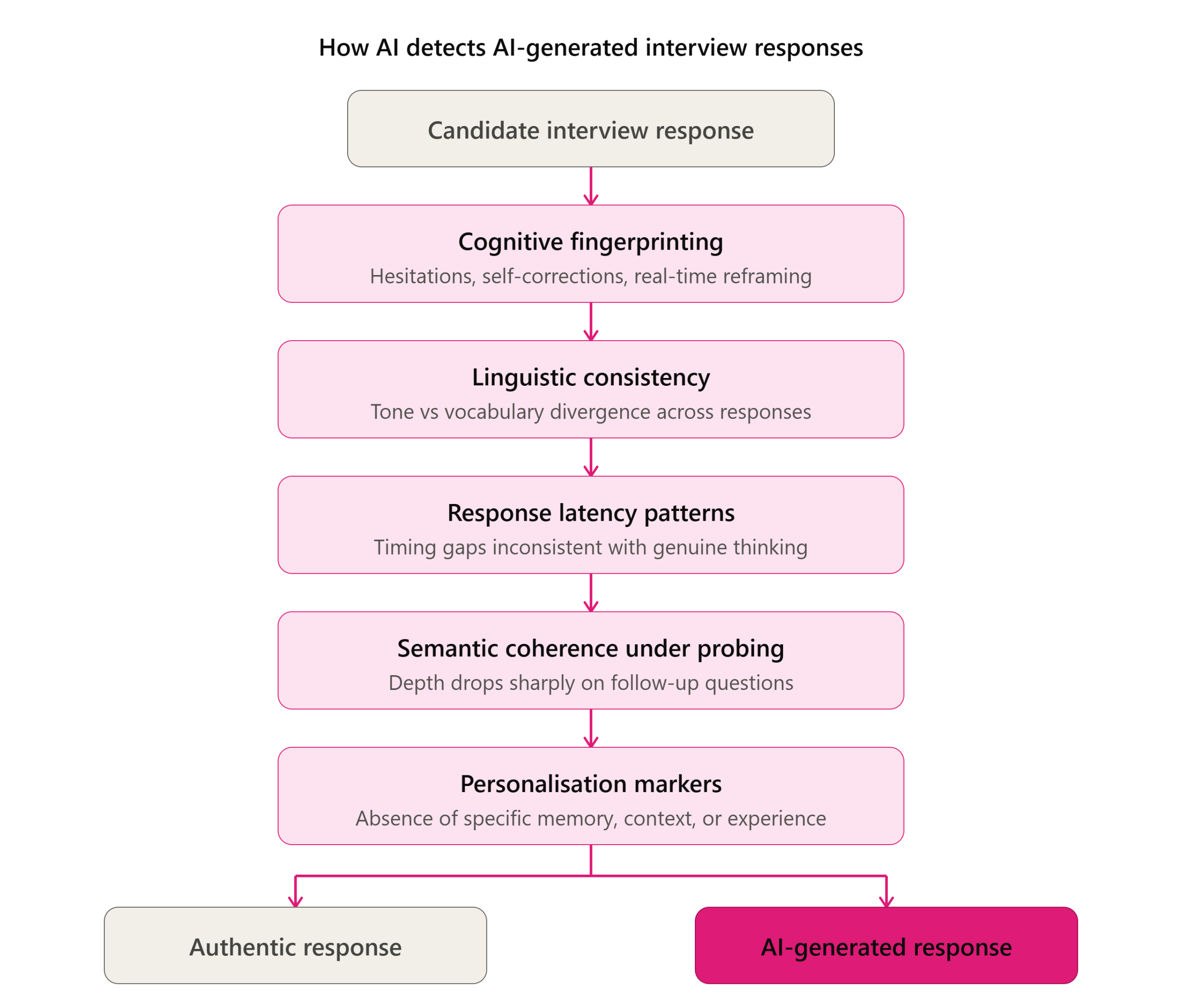
Understanding why AI can detect AI-generated responses requires understanding what makes human communication distinctive.
Human speech and writing carry patterns that are, in many ways, impossible to consistently replicate artificially — even with the most sophisticated language models currently available. These patterns emerge from the way individual people think, process information, and express ideas naturally. They include:
Cognitive fingerprinting — the unique way a person structures their thinking process. Humans naturally include hesitations, self-corrections, partial thoughts, and real-time reframings that reflect active cognition. AI-generated responses, in contrast, tend to present complete, polished thoughts without the micro-patterns of genuine reasoning.
Linguistic consistency — the relationship between how a person speaks conversationally and how they respond formally. When a candidate's casual conversational tone diverges sharply from the vocabulary and sentence structure of their formal interview answers, this inconsistency becomes a detectable signal.
Response latency patterns — the timing between question and response. Human thinking takes time that varies naturally based on question complexity and personal processing speed. Candidates who are reading AI-generated responses — either from a screen or from memory after rapid generation — display latency patterns that differ measurably from those of candidates constructing authentic answers in real time.
Semantic coherence under probing — how well the ideas in an initial response hold up when follow-up questions explore the same territory from different angles. AI-generated responses optimise for the question asked, not for the broader context the candidate would need to understand to answer follow-up questions authentically. Consequently, depth and coherence tend to drop sharply when interviewers probe beyond the initial question.
Personalisation markers — the presence or absence of genuinely personal detail. Authentic responses naturally include idiosyncratic references, specific memories, personal reactions, and contextual detail that AI-generated content — which has no access to the candidate's actual experience — cannot reliably replicate.
Research in computational linguistics published in Nature Scientific Reports demonstrates that machine learning models trained on large-scale speech and text datasets can detect AI-generated content with classification accuracy in the range of 0.70–0.80 — a level of reliability that, when combined with multiple signal types, provides meaningful detection capability in hiring contexts.
What Detection Looks Like in Practice
For recruitment agencies and talent acquisition teams, AI detection does not present itself as a binary alarm — a red light that flashes when a candidate uses AI. It is, instead, a layer of structured intelligence that surfaces specific signals for recruiter review.
A well-designed AI detection system flags combinations of signals rather than individual data points. A single polished response is not inherently suspicious. A candidate who consistently displays high linguistic sophistication in formal responses but low sophistication in casual conversational exchanges, combined with unusually uniform response latency and limited personalisation across multiple answers, represents, consequently, a pattern that warrants closer evaluation.
This is important because it protects candidates from false accusations. The goal is not to penalise candidates for being well-prepared or articulate. It is, instead, to distinguish between candidates who have done genuine preparation — and whose authentic thinking is strong — and candidates who are using AI as a real-time proxy for thinking they cannot demonstrate independently.
Furthermore, detection works most effectively when combined with structured follow-up probing. When AI signals suggest potential assisted responses, well-designed systems prompt interviewers or AI interviewers to ask follow-up questions that move beyond the prepared territory — exploring the reasoning behind the answer, the specific context in which an experience occurred, or the candidate's personal reaction to a described situation.
Authentic candidates with genuine preparation handle these probes naturally. Candidates relying on AI-generated responses, in contrast, tend to struggle — because the AI cannot anticipate the follow-up and the candidate has no authentic experience to draw from.
The Integrity Index Gets Sharper
For recruitment agencies already using integrity indices as part of their candidate profiling — capturing behavioural signals that indicate honesty, consistency, and genuine commitment — AI detection adds a powerful new dimension.
The integrity index, as discussed in the context of AI-powered candidate screening, captures signals such as response consistency, commitment indicators, transparency markers, and behavioural stability. These signals are designed to give decision-makers confidence that a candidate's profile reflects their authentic capability and character — not a curated performance.
AI detection of generated responses strengthens this index by adding an authenticity verification layer. A candidate whose responses are flagged as potentially AI-assisted receives a lower authenticity score — not as a punishment, but as a structured signal that the competency assessment and communication evaluation may not accurately reflect their genuine capability.
Consequently, the candidate profile sent to a decision-maker becomes richer and more trustworthy. It does not just say this candidate has strong competencies. It says this candidate demonstrated those competencies authentically — without AI assistance — and the signals captured during the interaction reflect genuine thinking rather than generated content.
For decision-makers who have experienced the frustration of hiring candidates who performed brilliantly in interviews but struggled significantly in the role, this authenticity layer is, therefore, directly addressing one of the most persistent and costly gaps in the hiring process.
The Candidate Experience Perspective
It is important, at this point, to address the candidate's perspective — because AI detection, if implemented poorly or communicated transparently, risks creating a hiring environment that feels adversarial and untrusting.
The goal of AI detection in hiring is not to catch candidates out or create a surveillance environment. It is, instead, to create a level playing field — ensuring that candidates who invest in genuine preparation and authentic self-presentation are not disadvantaged by those who outsource their thinking to a language model.
Research consistently shows that candidates value fairness and consistency in hiring processes. According to Forrester, candidate experience is not a moment but a continuum — and the perception of fairness throughout that continuum directly influences whether strong candidates complete the process, accept offers, and join organisations.
When AI detection is implemented transparently — where candidates are informed that authenticity signals form part of the evaluation — it actually enhances the perception of fairness rather than undermining it. Candidates who are confident in their genuine capability welcome a process that rewards authentic thinking over polished performance. Furthermore, the structured, consistent nature of AI-led evaluation removes many of the subjective biases that make human-led interviews feel unfair.
The message to candidates, therefore, is not "we are watching for AI use." It is, instead, "we are evaluating your genuine thinking — and our process is designed to recognise and reward it."
What This Means for Recruitment Agencies
For recruitment agencies building competitive advantage around speed, profile quality, and client trust, AI detection capability changes the commercial proposition significantly.
An agency that sends a decision-maker a candidate profile verified for authentic competency demonstration is offering something fundamentally more valuable than an agency sending a profile based on unverified interview responses. The decision-maker gains confidence that the assessment reflects reality — that the candidate who scored highly on communication, problem-solving, and integrity signals actually demonstrated those qualities through their own thinking, not through a language model's output.
This confidence, consequently, accelerates decision-making. Decision-makers who trust the screening move faster to interviews, faster to offers, and faster to placements. For recruitment agencies competing on speed — as discussed throughout the context of modern agency commercial dynamics — this acceleration directly translates into higher closure rates and stronger client relationships.
Furthermore, as AI-generated responses become more sophisticated and more widespread, the agencies that have built authenticity verification into their screening process will have a structural advantage that compounds over time. Clients who experience the difference between verified authentic profiles and unverified ones do not easily return to accepting the latter.
The Broader Shift: From Performance to Authenticity
The rise of AI detection in hiring reflects a broader shift in what the hiring process is fundamentally trying to achieve.
For decades, hiring has inadvertently rewarded performance over authenticity. The best interviewees — those who could structure compelling answers, project confidence, and navigate evaluator expectations — consistently outperformed candidates who were more capable but less polished in formal evaluation settings.
AI-generated responses have pushed this dynamic to its logical extreme. If interview performance can be entirely outsourced to a language model, then the interview — already an imperfect proxy for job performance — becomes almost entirely disconnected from the capability it is designed to assess.
AI detection, therefore, is not just a technical capability. It is, instead, a correction — a way of bringing hiring back toward what it was always intended to be. An authentic evaluation of how a person actually thinks, communicates, and approaches challenges. A genuine signal of how they will perform when they are in the role, without a language model available to construct their responses.
According to Harvard Business Review, up to 80% of employee turnover stems from bad hiring decisions or mismatched expectations. When interviews capture authentic signals rather than generated performances, hiring decisions improve. When hiring decisions improve, placements succeed. When placements succeed, agencies build the client relationships that drive long-term commercial growth.
How Qallify Integrates Authenticity Verification
Qallify's approach to AI detection is built directly into the candidate evaluation framework — not as a separate tool or bolt-on feature, but as an integrated layer of the screening and profiling process.
During AI-led candidate interactions, the platform simultaneously evaluates competency alignment, communication quality, integrity signals, and authenticity markers. Response patterns are analysed across multiple dimensions — linguistic consistency, latency variation, personalisation depth, and coherence under follow-up probing — to generate a structured authenticity assessment alongside the competency and integrity scores.
The result is a candidate profile that gives recruitment agencies and decision-makers a complete picture. Not just who appears qualified. Not just who scored well on competency frameworks. But who demonstrated genuine capability, authentic integrity, and real thinking — the combination of signals that most reliably predicts whether a candidate will join, perform, and stay.
For recruitment agencies operating on pay-per-use pricing — accessing this capability at the moment it creates value rather than through expensive fixed subscriptions — the commercial case is, consequently, straightforward. Every profile sent with authenticity verification is a stronger profile. Every stronger profile builds more client trust. Every trust-building interaction, therefore, generates more briefs, more placements, and more revenue.
Because in the end, the most valuable thing a recruitment agency can offer a decision-maker is not just speed. It is not just competency assessment. It is, ultimately, confidence — the confidence that the candidate sitting across from them in the final interview is exactly who the screening said they were.
And in a world where AI can now generate the perfect interview answer in seconds, that confidence has never been more valuable — or more difficult to earn without the right technology behind it.
To know about Fast, Verified Profiles Are Winning Agency Clients With AI, click here.