

Why More People Now Choose AI Over Human Conversations
For years, the assumption was simple: humans trust humans. Especially in moments that matter — customer support, financial decisions, job interviews — people believed they preferred a real person on the other end of the line. However, that assumption is quietly breaking.
Across industries, a growing number of users are not just accepting AI-led calls. Instead, they are actively preferring them.
This shift draws support from evolving user behaviour and research across conversational AI, customer experience, and behavioural psychology. As digital-native users grow and expectations around speed, fairness, and control increase, AI is no longer a compromise. It is, instead, increasingly seen as an upgrade.
Why Users Prefer AI Calls Over Human Interactions
At the heart of this change is predictability. Human conversations, while rich, are often inconsistent. Tone varies, energy fluctuates, and biases — both conscious and unconscious — can influence outcomes. AI, in contrast, delivers structured, consistent interactions every single time.
Research in CX and behavioural science highlights that users value clarity and efficiency over emotional nuance in transactional interactions. When people know what to expect, their cognitive load reduces. As a result, there is no need to interpret tone, manage impressions, or anticipate reactions.
Another major driver is the removal of perceived judgment. In human-to-human conversations — especially in evaluative scenarios — individuals often feel assessed beyond their actual responses. Accent, fluency, pauses, or confidence levels can unintentionally influence outcomes. AI, therefore, eliminates many of these subjective layers.
Users consistently report that AI calls feel:
● Less intimidating
● More objective
● Easier to navigate
● Free from social pressure
● More objective
● Easier to navigate
● Free from social pressure
Speed and responsiveness also play a crucial role. AI systems do not interrupt, rush, or lose patience. Furthermore, they allow users to process information and respond at their own pace — creating a balance between efficiency and comfort.
The Psychology of Trust: Why AI Feels More Fair
One of the most surprising drivers of AI preference is trust. Not emotional trust — but systemic trust.
AI systems, when well designed, operate on clearly defined parameters. Users increasingly understand that their responses are evaluated based on structured criteria rather than subjective impressions. Consequently, this aligns with global expectations around fairness, accountability, and bias reduction.
In contrast, human interactions — especially in evaluation scenarios — can feel opaque. Decisions may seem influenced by intangible factors, making outcomes harder to trust.
AI, therefore, changes this narrative by offering:
● Consistency in questioning
● Standardised evaluation frameworks
● Reduced scope for bias
● Perceived auditability of decisions
● Standardised evaluation frameworks
● Reduced scope for bias
● Perceived auditability of decisions
This shift — from "Who is judging me?" to "How am I being evaluated?" — is fundamentally altering user comfort levels.
AI in Hiring: Redefining the Candidate Experience
This behavioural shift becomes even more significant in recruitment and hiring.
Job interviews have traditionally been high-pressure, high-uncertainty interactions. Research in organisational psychology shows that unstructured interviews are among the least reliable predictors of job performance. Factors like interviewer mood, first impressions, and unconscious bias often influence outcomes more than actual capability.
AI-led interviews are, consequently, emerging as a powerful alternative.
Candidates are beginning to view AI interviews as more fair, consistent, and merit-driven. Every candidate receives the same questions, in the same format, and evaluation uses the same benchmarks. This creates a level playing field — especially for introverts, non-native speakers, and candidates from non-traditional backgrounds.
Many candidates report feeling that AI interviews allow them to focus on what they say rather than how they appear. This reduces anxiety and, furthermore, shifts the evaluation toward skills, thinking, and clarity.
Reducing Bias in Interviews: A Key Advantage of AI
Bias in hiring has long been a documented challenge. From affinity bias to confirmation bias, human-led interviews are inherently susceptible to subjective influence. Research from Harvard Business Review consistently highlights how these biases shape hiring outcomes.
AI-driven interviews help mitigate this by:
● Removing visual and social cues that trigger bias
● Standardising question delivery
● Evaluating responses against consistent benchmarks
● Ensuring uniformity across candidate experiences
● Standardising question delivery
● Evaluating responses against consistent benchmarks
● Ensuring uniformity across candidate experiences
While AI is not entirely bias-free, it offers a significantly more controlled environment. Consequently, hiring decisions become more equitable and defensible.
Where Qallify Gets It Right: A Subtle but Powerful Shift
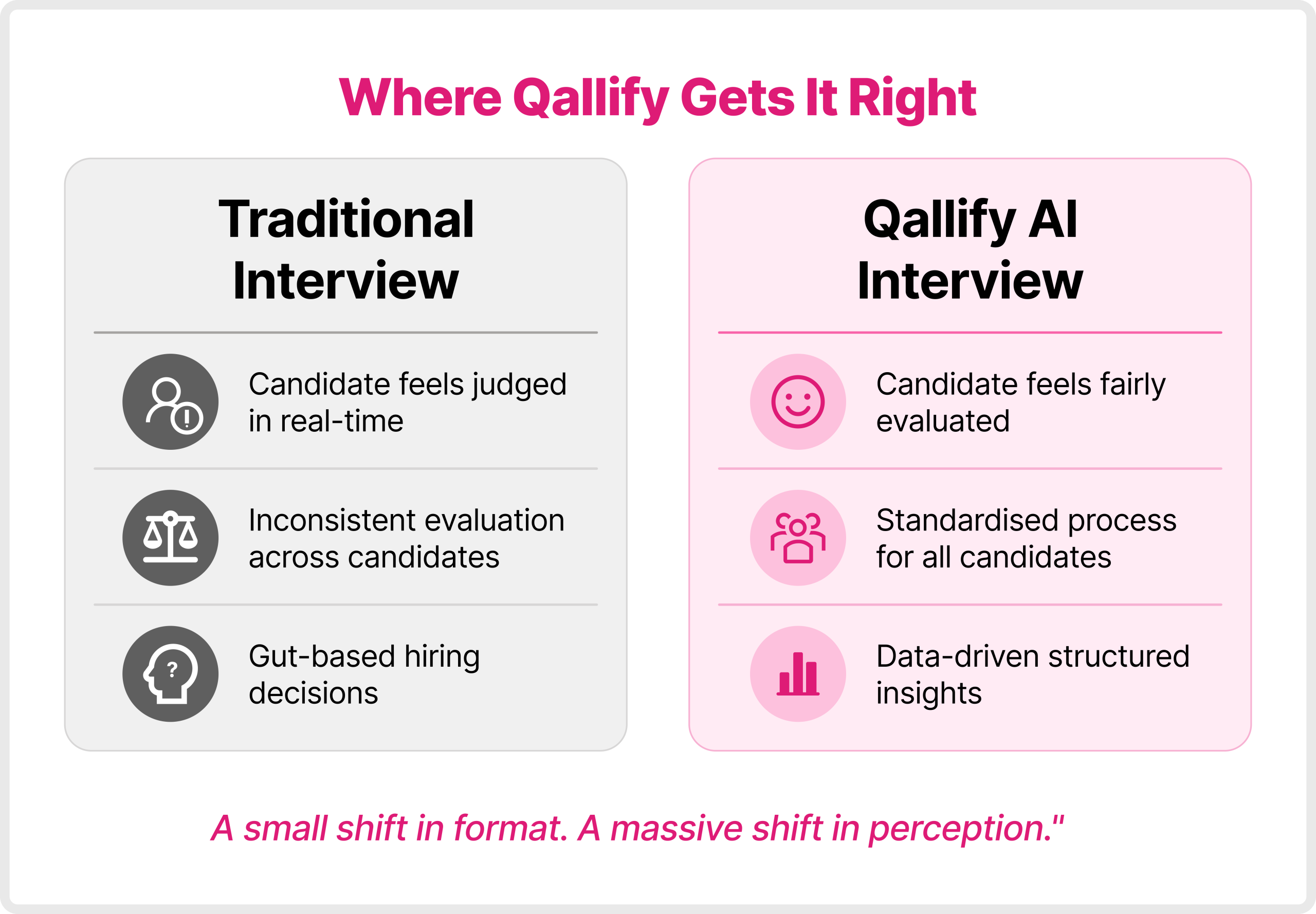
What makes this shift real — not just theoretical — is how some platforms are putting it into practice.
Take Qallify, for instance. Rather than treating AI interviews as a simple automation layer, Qallify builds its approach around structured fairness and behavioural consistency.
In high-volume hiring environments — like customer support roles in markets such as the Philippines — candidates often drop off or underperform in traditional interviews due to anxiety, bias, or inconsistency in evaluation. Qallify's AI-led conversations standardise the experience while quietly capturing deeper response signals — such as clarity of thought, response stability, and intent consistency — without making the candidate feel scrutinised.
The result is clear. Candidates report feeling more comfortable completing interviews because:
● They are not being judged in real-time by a human
● They know every applicant goes through the same process
● They can focus on answering, not impressing
● They know every applicant goes through the same process
● They can focus on answering, not impressing
At the same time, furthermore, employers gain structured, comparable insights — reducing reliance on gut-based decisions. It is a small shift in format, but a massive shift in perception: from "Am I being liked?" to "Am I being fairly evaluated?"
Efficiency Meets Experience: Why Companies Are Adopting AI Interviews
From an organisational perspective, the benefits extend beyond fairness.
As hiring volumes fluctuate globally and cost-per-hire increases, companies face pressure to make faster, better decisions. According to SHRM, rising cost-per-hire is one of the most pressing challenges in talent acquisition today. AI-led interviews, therefore, enable:
● Scalable candidate screening
● Faster turnaround times
● Data-driven hiring decisions
● Consistent candidate experience across geographies
● Faster turnaround times
● Data-driven hiring decisions
● Consistent candidate experience across geographies
More importantly, they allow recruiters to focus on high-value human interactions — like final conversations and cultural alignment — rather than repetitive screening.
The Future of Conversations: Human + AI, Not Human vs AI
The growing preference for AI calls does not signal the end of human interaction. Instead, it marks a redefinition of roles.
Humans will continue to lead in areas that require empathy, creativity, and strategic thinking. In structured, repetitive, and evaluative conversations — where consistency, fairness, and clarity are critical — however, AI is becoming the preferred interface.
We are moving from a world where trust built on human connection to one where trust increasingly builds on system integrity. And in hiring, that shift is, consequently, transformative.
Candidates are no longer just preparing to impress an interviewer. They are stepping into processes they believe are fairer, more transparent, and more aligned with their actual capabilities.
AI is not just changing how conversations happen. Ultimately, it is changing how people feel about being evaluated.
To know about Qallify’s Ethical Hiring Edge, click here.