

Fast, Verified Profiles Are Winning Agency Clients With AI
In recruitment, speed has always mattered. But there is a specific kind of speed that most agencies have not yet mastered — and it is the one that clients care about most.
Not the speed of sourcing. Not the speed of scheduling. Not even the speed of screening.
It is the speed of sending the right candidate profile — the first time.
Because in the world of recruitment agency relationships, the agency that lands a strong, pre-qualified, integrity-verified candidate profile on a decision-maker's desk within hours of receiving a brief does not just win the placement. It wins the client's trust, their next brief, and frequently their long-term business.
This is, consequently, the competitive advantage that AI-powered screening — built on skills, competencies, and an integrity index — is beginning to deliver for the agencies that have chosen to move first.
The Brief Arrives. The Clock Starts.
Every recruitment agency knows this moment.
A client sends a hiring brief. Sometimes it arrives as a detailed job description. Sometimes it is a two-line WhatsApp message. Regardless of format, the expectation is the same — fast, relevant candidates.
The agency that responds within hours with three strong, well-screened profiles wins the shortlist. The agency that responds two days later with five mediocre ones loses the relationship — regardless of how long they have worked with that client.
Speed, therefore, is not just a metric. It is a commercial differentiator.
However, here is the problem that most agencies quietly acknowledge. Speed and quality have traditionally been in tension. Moving fast meant less screening. Less screening meant weaker profiles. Weaker profiles meant client frustration. Client frustration meant eroding trust.
AI-powered candidate screening is, consequently, ending this trade-off — allowing agencies to move fast and send the right candidate at the same time.
Why Traditional Screening Slows Everything Down
To understand the opportunity, it is important to understand the bottleneck.
Traditional candidate screening in recruitment agencies is a largely manual process. A recruiter receives a brief, searches the database, reviews CVs, makes calls, conducts initial conversations, assesses fit, and eventually compiles a shortlist. In high-volume environments, this process can take anywhere from twenty-four hours to several days — depending on recruiter workload, candidate availability, and role complexity.
According to SHRM, recruiters traditionally spend nearly 60% of their time on administrative tasks — including manual screening activity that AI can now handle in minutes. This means that in most agencies, the majority of recruiter time is consumed before a single meaningful conversation with a qualified candidate even begins.
Furthermore, manual screening introduces inconsistency. Two recruiters evaluating the same candidate against the same brief may reach different conclusions — based on different interpretations of the job requirements, different levels of experience, or simply different amounts of time available that day.
The result, consequently, is a screening process that is slow, inconsistent, and heavily dependent on individual recruiter judgment rather than structured evaluation criteria.
What AI-Powered Screening Actually Does
AI-powered screening changes this equation fundamentally — not by replacing recruiter judgment, but by accelerating and structuring it.
When a brief arrives, AI screening systems analyse the role requirements and immediately evaluate the candidate pool against defined skills and competency frameworks. Rather than relying on keyword matching — which, as discussed in broader industry research, is a shallow proxy for genuine capability assessment — well-built AI systems evaluate candidates against structured competency models such as the SHL Universal Competency Framework and communication standards such as the Council of Europe CEFR scale.
This means that within minutes of a brief arriving, the system has already evaluated the candidate pool against the specific skills, competencies, and communication requirements of the role — surfacing the strongest matches for recruiter review rather than requiring recruiters to find them manually.
According to Gartner, organisations adopting data-driven hiring models see improvements in quality of hire and reductions in early attrition — particularly when behavioural and communication signals inform decision-making. For recruitment agencies, this means that AI-screened profiles are not just faster — they are, consequently, more accurate and more likely to result in successful placements.
The Integrity Index: The Signal Most Agencies Are Missing
Speed and competency screening alone, however, are not enough to differentiate a recruitment agency in a crowded market.
Decision-makers at client organisations are not just looking for candidates who can do the job. They are looking for candidates who will do the job — consistently, reliably, and with integrity. They want to know that the person joining their team will show up, follow through, communicate honestly, and operate with the values the organisation expects.
This is where the integrity index becomes a critical differentiator.
Traditional screening processes have no reliable way to assess candidate integrity during early-stage evaluation. Reference checks are curated and biased. Interview responses are rehearsed and optimised. CV details can be embellished or difficult to verify quickly.
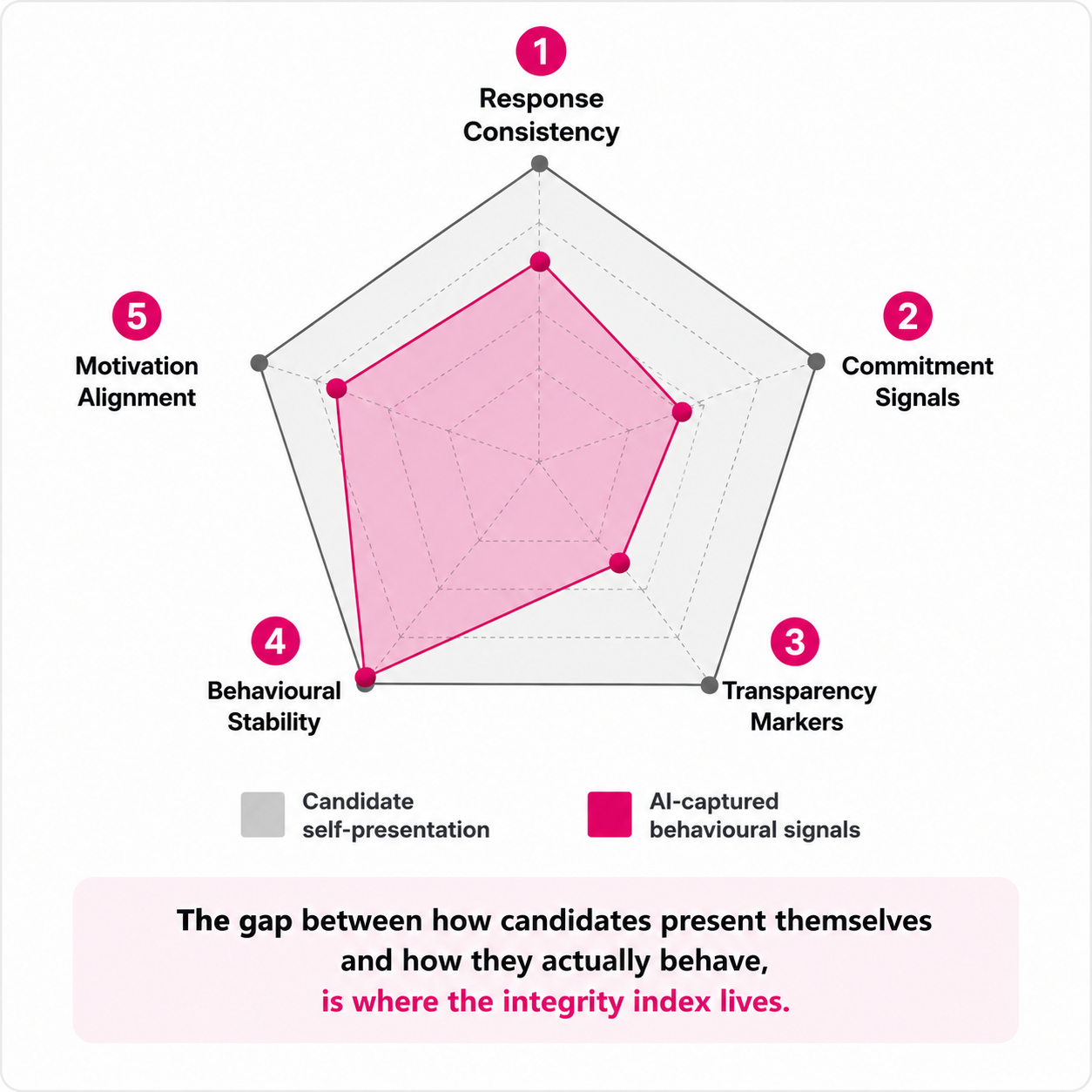
AI-powered screening systems, however, can capture behavioural signals that correlate strongly with integrity and honesty — signals that emerge naturally during structured voice interactions and are difficult to fabricate consistently across multiple responses.
These signals include:
Response consistency — whether a candidate's answers remain coherent and aligned across different questions and contexts, or shift and contradict depending on what they perceive the interviewer wants to hear.
Commitment indicators — whether the language a candidate uses reflects genuine intent and ownership, or hedges, deflects, and avoids clear statements of commitment.
Transparency markers — whether candidates acknowledge gaps, challenges, and uncertainties honestly, or present an artificially polished narrative that avoids any admission of difficulty.
Behavioural stability — whether a candidate's communication style, energy level, and engagement remain consistent throughout an interaction, or fluctuate in ways that suggest performance rather than authenticity.
Research in computational linguistics and personality computing supports the validity of these signals — demonstrating that language patterns captured during natural conversation can reliably infer underlying behavioural tendencies, including those associated with honesty and integrity.
When these signals aggregate into a structured integrity index, recruitment agencies gain something genuinely new — a way to tell decision-makers not just that a candidate has the right skills, but that they are likely to be the right person.
The Candidate Profile That Wins Clients
This combination — speed, competency screening, and an integrity index — transforms what a recruitment agency sends to a decision-maker.
Instead of a CV with a brief covering note, the agency sends a structured candidate profile that includes:
• Skills and competency alignment — how the candidate maps against the specific requirements of the role, evaluated against validated frameworks rather than keyword matching
• Communication assessment — how the candidate performs against the communication standards required for the role, including clarity, structure, and language proficiency
• Integrity index score — a structured summary of the behavioural signals captured during screening, providing the decision-maker with confidence in the candidate's honesty, reliability, and commitment
• Joining probability — an AI-generated likelihood score indicating whether the candidate is likely to accept an offer, join on the agreed date, and remain engaged through the onboarding process
• Communication assessment — how the candidate performs against the communication standards required for the role, including clarity, structure, and language proficiency
• Integrity index score — a structured summary of the behavioural signals captured during screening, providing the decision-maker with confidence in the candidate's honesty, reliability, and commitment
• Joining probability — an AI-generated likelihood score indicating whether the candidate is likely to accept an offer, join on the agreed date, and remain engaged through the onboarding process
This is, therefore, not just a faster profile. It is a fundamentally richer one — giving decision-makers the confidence to move quickly because the screening has already been done rigorously and transparently.
According to Deloitte, companies that leverage data-driven recruitment platforms are 2x more likely to improve hiring quality and 1.5x more likely to enhance recruiter effectiveness. For recruitment agencies, this improvement in profile quality translates directly into faster client decision-making, higher offer rates, and stronger placement outcomes.
Speed Without Integrity Is Just Noise
It is worth pausing here to address a concern that many agency leaders raise when AI screening is discussed.
Speed alone does not build client relationships. In fact, sending fast but weak profiles is worse than sending slower but stronger ones — because it trains decision-makers to expect mediocrity and erodes the trust that drives repeat business.
This is precisely why the integrity index matters as much as the speed.
Decision-makers have become deeply sceptical of recruitment agencies that send large volumes of loosely matched profiles and call it a shortlist. They have been burned by candidates who performed well in interviews but struggled in the role. They have experienced the frustration of a candidate who accepted an offer, served their notice period, and then declined on Day 1 without explanation.
The integrity index directly addresses these concerns. It gives decision-makers a structured, evidence-based reason to trust the profiles they receive — not because the agency says the candidate is strong, but because the AI has captured specific behavioural signals that support that assessment.
Consequently, agencies that combine speed with integrity-verified profiling are not just winning individual placements. They are building the kind of client relationships that generate repeat business, exclusivity agreements, and long-term commercial partnerships.
What This Looks Like at Operational Scale
For recruitment agencies operating at scale — managing dozens of client accounts, hundreds of open roles, and thousands of candidate interactions simultaneously — the operational impact of AI-powered screening extends beyond individual placement quality.
Consider the workflow transformation. A brief arrives from a client at 9am. The AI screening system immediately evaluates the relevant candidate pool against the role requirements — surfacing the top matches based on skills, competency alignment, communication assessment, and integrity signals. By 11am, the recruiter has a structured shortlist of pre-screened, integrity-verified candidates ready for review. By midday, three strong profiles are on the decision-maker's desk — complete with competency maps, communication scores, and integrity index summaries.
This is, therefore, a fundamentally different operating rhythm from the traditional model — where the same process might take two to three days and yield profiles of inconsistent quality.
Furthermore, the pay-per-use pricing model that underpins platforms like Qallify means that this capability scales proportionally with agency activity. During high-volume campaigns, AI screening processes hundreds of candidates simultaneously — something no manual recruiter team could replicate at comparable speed or consistency. During quieter periods, costs reduce automatically. There are no wasted licence fees, no unused seats, and no fixed commitments that bear no relationship to actual placement volumes.
According to McKinsey & Company, organisations embedding AI properly into HR processes can improve decision accuracy by up to 25%. For recruitment agencies, this improvement compounds across every brief received, every candidate screened, and every profile sent — consequently building a measurable and growing competitive advantage over agencies still relying on manual screening workflows.
The Recruiter's Role in an AI-Screened World
A common concern among recruitment professionals when AI screening is introduced is that it reduces their role to one of administrative oversight — monitoring outputs rather than applying judgment.
The reality, however, is the opposite.
AI screening handles the volume, the consistency, and the structured evaluation. It surfaces the strongest candidates, flags integrity signals, and generates competency maps. However, it is the recruiter who contextualises these outputs — understanding the nuances of client culture, the unspoken dynamics of a specific team, and the subtleties of candidate motivation that even well-built AI cannot fully capture.
In this model, recruiters spend less time on manual screening and more time on the conversations that actually build placement relationships. They engage with pre-qualified candidates who have already demonstrated skills alignment and integrity signals. They speak with decision-makers armed with structured evidence rather than gut-feel assessments. Furthermore, they focus their expertise on the areas where human judgment remains irreplaceable — final evaluation, offer negotiation, and notice period management.
This is, consequently, not a threat to recruiter capability. It is, instead, an amplification of it — giving recruitment professionals the intelligence layer they need to perform at a significantly higher level without increasing their workload.
Why the Agencies Moving First Will Be Hardest to Displace
The recruitment agency market is, in many ways, a relationship business. Clients stay with agencies they trust. They trust agencies that consistently deliver strong candidates quickly. They give preferred supplier status to agencies that make their hiring process easier rather than more complicated.
AI-powered screening backed by an integrity index creates a structural advantage that compounds over time. Every brief processed builds more data. Every placement made validates the screening model. Every client relationship strengthened generates more briefs — and more opportunity to demonstrate the speed and quality advantage that AI enables.
For agencies that adopt this capability early, therefore, the competitive moat deepens with every placement. Clients who experience the difference between receiving an integrity-verified, competency-mapped candidate profile within hours and waiting days for a loosely assembled shortlist from a competitor do not easily switch back.
Ultimately, the agencies that move first are not just winning individual mandates. They are redefining what clients expect from a recruitment partner — and in doing so, making themselves, consequently, very difficult to displace.
How Qallify Powers This for Recruitment Agencies
Qallify was built precisely around this model — giving recruitment agencies the AI-powered screening infrastructure they need to send the right candidate, fast, with the evidence to back it up.
Rather than requiring agencies to overhaul existing workflows or commit to expensive annual subscriptions, Qallify operates on a pay-per-use model — meaning agencies access AI screening capability at the moment it creates value and pay only for what they actually use.
The platform evaluates candidates against role-specific skills and competency frameworks, captures integrity and honesty signals through structured voice interactions, generates joining probability scores, and delivers structured candidate profiles that give decision-makers genuine confidence rather than requiring them to do their own screening.
For recruitment agencies and staffing companies competing in markets like India, the Philippines, and LATAM — where hiring volumes are high, client expectations are rising, and the margin for error is thin — this capability is, therefore, not a luxury.
It is, ultimately, the difference between being the agency that sends the right candidate first — and the agency that sends the second-best candidate too late.
To know about How Recruitment Agencies Are Doubling Closure Rates With AI, click here.