

How Recruitment Agencies Are Doubling Closure Rates With AI ?
There is a number that keeps appearing in conversations with recruitment agency leaders across markets like India, the Philippines, and LATAM.
Two times.
Not two times the headcount. Not two times the technology budget. Not two times the sourcing investment.
Two times the closure rate — using the same recruiters, the same candidate pools, and a fraction of the cost most agencies assume AI requires.
This is not a theoretical outcome. It is, instead, the practical result of a shift that a growing number of staffing companies are quietly making — from traditional hiring workflows to AI-powered engagement models built on pay-per-use pricing. And for agencies operating on thin margins in high-volume markets, this shift is, consequently, proving to be one of the most significant commercial decisions they have made in years.
The Problem Every Recruitment Agency Knows Too Well
Before understanding the opportunity, it is important to understand the pain.
Recruitment agencies and staffing companies operate in one of the most margin-sensitive businesses in the world. They pay for job board access, candidate database licences, recruiter salaries, sourcing tools, and client management systems — often before a single placement fee arrives. Every day a role remains unfilled is a day revenue does not materialise.
Yet despite this pressure, the core inefficiencies of recruitment have remained stubbornly persistent. Strong candidates go unreached because calls go unanswered. Promising profiles disappear into databases because notice periods create hesitation. Offer-to-joining conversion rates remain unpredictable because agencies have no structured way to maintain engagement between offer acceptance and Day 1. Recruiters spend the majority of their time on administrative activity rather than meaningful conversations.
According to SHRM, the average cost-per-hire already exceeds $4,000 in many organisations. For recruitment agencies managing dozens of open roles simultaneously, the compounding cost of these inefficiencies is significant. Furthermore, Gartner research highlights that nearly 1 in 4 new hires leave within the first year — often due to misalignment that better engagement and screening could have prevented.
The result is a sector that works extremely hard — but converts a fraction of what it could.
Why Traditional AI Adoption Has Not Helped Most Agencies
When AI entered the recruitment technology market, most agencies approached it with cautious optimism. The promise was compelling — faster screening, smarter matching, reduced bias, better candidate experience.
However, the reality that followed was, in many cases, disappointing.
Most AI hiring platforms were built for large enterprise talent acquisition teams — not for lean, margin-conscious staffing agencies. They required significant upfront investment, long implementation cycles, complex integrations, and annual subscription commitments that bore no relationship to actual usage. An agency placing fifty candidates one month and two hundred the next was expected to pay the same fixed fee regardless.
Furthermore, as discussed in broader industry research, many of these platforms suffered from what can only be described as feature fatigue — attempting to be sourcing engine, CRM, assessment platform, and analytics suite all at once. The result was shallow capability across multiple functions rather than deep expertise in the areas that mattered most to agencies — candidate engagement, joining probability, and offer-to-onboarding conversion.
For most recruitment agencies, therefore, the conclusion was understandable — AI was for enterprise companies with large technology budgets, not for agencies operating on placement fees and tight timelines.
That conclusion, however, is increasingly being proven wrong.
The Pay-Per-Use Shift That Changed the Economics
The turning point for many staffing companies has not been a new AI capability. It has been, instead, a new pricing model.
Pay-per-use — also known as consumption-based or usage-based pricing — fundamentally changes the economics of AI adoption for recruitment agencies. Rather than committing to an annual subscription regardless of placement volumes, agencies pay only for what they actually use. When hiring activity is high, technology spend scales accordingly. When activity slows, costs reduce automatically.
According to OpenView Partners' SaaS Benchmarks Report, usage-based pricing is becoming an increasingly important differentiator as organisations seek greater financial flexibility and stronger alignment between technology investments and business outcomes. For recruitment agencies, this alignment is not just commercially attractive — it is, consequently, operationally transformative.
Consider what this means in practice. An agency managing a surge in BPO hiring for a client in the Philippines can activate AI-led candidate engagement at scale during that period — paying only for the interactions that take place. When the campaign concludes, costs return to baseline automatically. There are no wasted licence fees, no unused seats, and no contractual commitments tied to projected volumes that never materialise.
This is, therefore, the model that is enabling agencies to adopt AI without the financial risk that previously made adoption feel unviable.
Where AI Is Actually Moving the Needle for Agencies
Once the cost barrier removes, the operational impact becomes visible quickly. And it is, consequently, appearing in three specific areas where recruitment agencies have historically lost the most value.
First - candidate engagement at scale.
The CV graveyard problem — where potentially valuable candidates accumulate in databases because recruiters cannot maintain consistent outreach — has been one of the most expensive inefficiencies in agency recruitment for decades. Recruiters make a call, receive no answer, and move on. The candidate is neither rejected nor engaged — they simply disappear.
AI-powered engagement systems address this directly. Rather than treating a missed call as a closed opportunity, these systems maintain structured outreach until a clear outcome is reached — interested, not interested, available after notice period, or open to future opportunities. Consequently, agencies are reconnecting with candidates they would previously have abandoned after two attempts — and converting a meaningful proportion of them into active placements.
Second - notice period tracking and timing intelligence.
As highlighted throughout industry research, the notice period timing mismatch is one of the most overlooked inefficiencies in recruitment. A strong candidate with a sixty-day notice period gets tagged and archived. Six weeks later, when timing would be perfect, nobody resurfaces the profile. The recruiter starts sourcing again from scratch — spending money to rediscover talent they already found.
AI systems that track candidate availability over time — automatically increasing profile visibility as notice periods approach completion — are, therefore, directly reducing the cost of repeated sourcing. Agencies that have implemented this capability report significant reductions in redundant sourcing activity and meaningful improvements in the quality of candidates entering final stages.
Third - Offer-to-joining conversion.
The notice period is not just a timing problem. It is also the most fragile phase of the entire hiring journey. Research from Forrester consistently shows that candidate experience must extend beyond offer acceptance to ensure successful onboarding. Counter-offers from current employers, alternative opportunities from competitors, and simple disengagement from a silent new employer all contribute to offer reneges and Day 1 no-shows.
AI-led engagement during the notice period — maintaining structured, contextual communication between offer acceptance and joining — is, consequently, proving to be one of the highest-impact interventions available to recruitment agencies. Agencies implementing this capability are reporting measurable improvements in offer-to-joining conversion rates. For high-volume BPO and CX hiring in markets like the Philippines and India, where early attrition can exceed 30–40% annually according to industry data, even a modest improvement in conversion rates translates into significant revenue impact.
What Doubling Closure Rates Actually Looks Like
The headline number — doubling closure rates — deserves explanation. It does not mean every agency doubles every metric overnight. It means, instead, that agencies implementing AI engagement across these three areas — candidate reconnection, timing intelligence, and notice period conversion — are recovering value that was previously being lost invisibly.
Consider a straightforward example. An agency sources one hundred strong candidates for a client campaign. Under a traditional workflow, perhaps thirty reach meaningful conversation, fifteen enter the interview process, and eight result in placements. The remaining seventy candidates are partially or fully lost to unanswered calls, notice period hesitation, or post-offer disengagement.
With AI-powered engagement operating across the same candidate pool — maintaining outreach, tracking availability, and sustaining post-offer communication — the same one hundred candidates yield significantly more meaningful conversations, a higher proportion entering interviews, and materially better offer-to-joining conversion. Furthermore, the candidates who are not ready today remain visible and re-engage automatically when timing changes.
This is, therefore, not magic. It is, instead, the compounding effect of eliminating three predictable leakage points that traditional workflows have accepted as unavoidable.
For agencies operating at scale — managing hundreds of open roles across multiple clients — the commercial impact of recovering this lost value is, consequently, substantial.
The Role of Behavioural Intelligence in Better Placements
Beyond engagement and timing, AI is also beginning to help agencies make better placement decisions — not just faster ones.
Platforms built on large-scale behavioural data — capturing patterns across millions of interview interactions — can identify signals that predict whether a candidate will join, perform, and stay. This is meaningfully different from keyword matching or CV scoring. It involves analysing response consistency, communication patterns, decision-making tendencies, and adaptability under ambiguity — the invisible data that traditional screening misses entirely.
According to Deloitte, companies that leverage advanced people analytics are 2.5 times more likely to outperform their peers in talent outcomes. For recruitment agencies, this translates directly into better placements, stronger client relationships, and reduced replacement hiring — all of which contribute to revenue growth and margin improvement.
Furthermore, McKinsey & Company notes that top performers are up to 400% more productive than average performers in complex roles. When agencies consistently place higher-quality candidates — because AI helps identify behavioural fit rather than just surface-level qualification — client satisfaction improves, repeat business increases, and referral pipelines strengthen.
These outcomes compound over time. Consequently, the commercial case for behavioural AI in agency recruitment is not just about efficiency — it is about building a fundamentally stronger placement business.
Why This Model Works Specifically for Lean Agency Teams
One of the most common objections to AI adoption among recruitment agencies is the assumption that it requires dedicated technology teams, complex implementation projects, and ongoing maintenance resources that lean agencies simply do not have.
Pay-per-use AI platforms designed for recruitment agencies address this directly. They integrate into existing workflows without requiring system overhauls. Recruiters interact with AI-generated insights through familiar interfaces. Candidate engagement happens automatically in the background — maintaining outreach, tracking responses, and surfacing insights without adding to recruiter workload.
In fact, the opposite occurs. Rather than adding complexity, well-designed AI removes it. Recruiters spend less time on administrative outreach and more time on meaningful conversations. They spend less time re-sourcing candidates they already found and more time converting the ones already in their pipeline. Furthermore, they spend less time managing notice period anxiety and more time onboarding candidates who actually show up on Day 1.
According to SHRM research, recruiters traditionally spend nearly 60% of their time on administrative tasks. AI-powered automation, therefore, redirects this time toward the high-value human interactions that actually drive placement revenue — final conversations, relationship building, and client management.
For lean agency teams operating under placement pressure, this time reallocation is, consequently, as valuable as the improvement in conversion rates.
The Compounding Commercial Impact
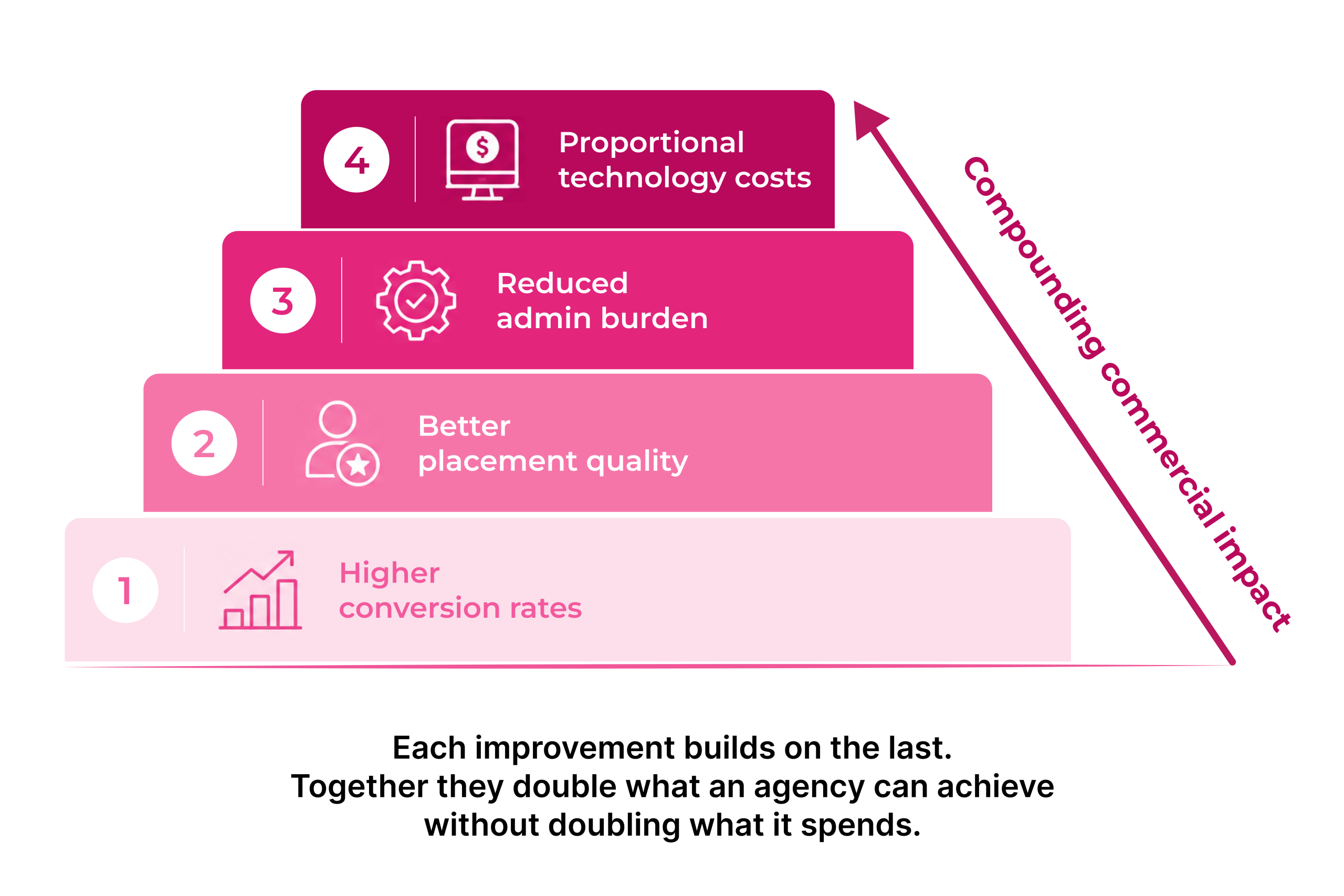
When the three improvements — candidate reconnection, timing intelligence, and notice period conversion — combine with better placement quality and reduced administrative burden, the commercial impact for recruitment agencies is significant and compounding.
Higher conversion rates mean more placements from the same candidate pool — without increasing sourcing investment. Better placement quality means fewer replacement requests from clients and stronger long-term relationships. Reduced administrative burden means recruiters can manage more roles simultaneously without sacrificing engagement quality. Furthermore, pay-per-use pricing means technology costs scale proportionally with revenue — eliminating the fixed cost risk that previously made AI adoption feel financially dangerous.
This is, therefore, the model that is enabling agencies to double closure rates without doubling investment. It is not about working harder. It is, instead, about eliminating the predictable inefficiencies that have always existed in recruitment — but were previously accepted as unavoidable costs of doing business.
How Qallify Enables This for Agencies
Type your paragraph hereQallify was built precisely at this intersection — where recruitment agency economics meet AI-powered hiring intelligence.
Rather than offering a monolithic platform that attempts to replace existing agency workflows, Qallify adds an intelligent engagement and prediction layer on top of what agencies already do. It tracks candidate interactions, maintains structured outreach until clear outcomes are reached, surfaces candidates at precisely the right moment as notice periods approach completion, and provides joining probability scores that help recruiters prioritise their effort where conversion is most likely.
All of this operates on a pay-per-use model — meaning agencies invest only when the platform creates value, and scale naturally as placement volumes grow.
The result, consequently, is a commercial partnership rather than a technology commitment — one where Qallify's success is directly tied to the agency's placement outcomes.
For recruitment agencies and staffing companies navigating an increasingly competitive market, that alignment is, ultimately, exactly what AI was always supposed to deliver.
Not just faster hiring.
Not just cheaper hiring.
But smarter hiring — at a price that makes sense from the very first placement.
To know about Why AI Is Failing Hiring Teams And What They're Missing, click here.