

How AI Platforms Elevate Recruiters to Strategic Advisors
The Shift from Execution to Intelligence
The narrative around hiring platforms has quietly shifted. What began as tools to reduce recruiter workload has evolved into systems that actively sharpen decision-making and elevate Talent Acquisition (TA) into a strategic business function.
This transformation is not just anecdotal. It draws support from measurable productivity gains, changing recruiter behaviours, and broader shifts in how organisations perceive hiring.
At the core of this evolution is the rise of intelligent hiring platforms — powered by AI, automation, and predictive analytics. According to the LinkedIn Talent Solutions Global Talent Trends report, 72% of talent professionals say that TA has become more strategic over the past few years — largely due to increased access to data and insights. Similarly, Gartner highlights that organisations using advanced hiring technologies see up to 30–40% improvement in recruiter productivity — primarily because routine tasks such as screening, scheduling, and initial assessments are now automated.
From Task Automation to Capability Building
Productivity is only the surface-level benefit. The deeper shift, however, lies in capability building.
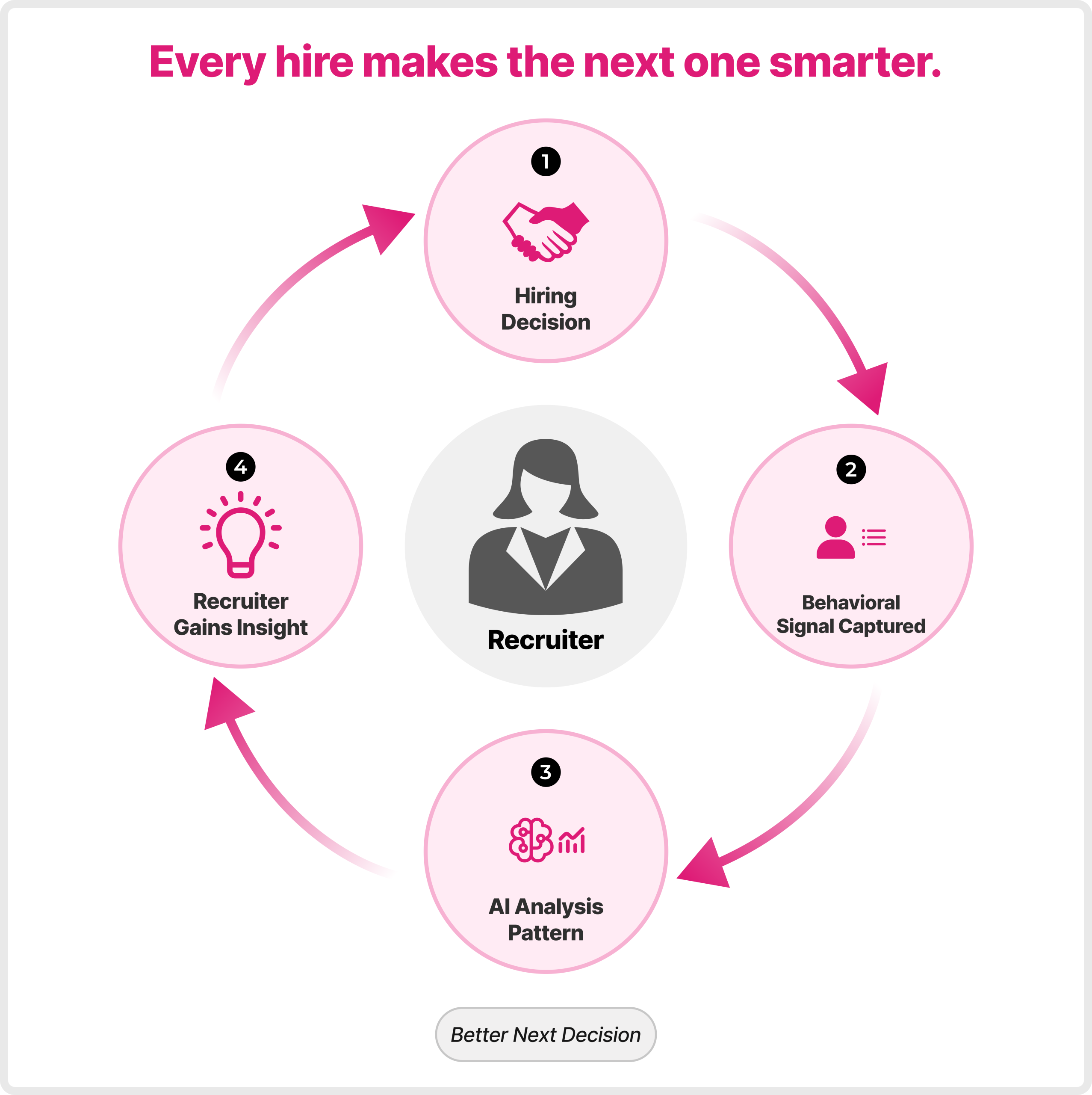
Modern hiring platforms don't just execute tasks. Instead, they coach recruiters in real time. AI-driven systems analyse past hiring decisions, candidate success rates, and behavioural signals — guiding recruiters toward better judgment. This effectively turns every hiring interaction into a learning loop.
McKinsey & Company notes that organisations embedding AI in HR processes can improve decision accuracy by up to 25% — particularly in complex areas like candidate fit and retention prediction. Consequently, recruiters become smarter with every hire they make.
Democratising High-Quality Hiring Decisions
Another important dimension is the democratisation of hiring intelligence. Traditionally, strong hiring decisions depended heavily on the experience of senior recruiters or hiring managers. Today, however, platforms encode this expertise into workflows — making high-quality hiring accessible across teams.
According to Deloitte, companies that leverage data-driven recruitment platforms are 2x more likely to improve hiring quality and 1.5x more likely to enhance recruiter effectiveness. This means even relatively junior recruiters can perform at a significantly higher level. As a result, organisations reduce dependency on a few "star" performers.
Reclaiming Time for Strategic Work
Furthermore, hiring platforms are reshaping how recruiters spend their time. A study by SHRM indicates that recruiters traditionally spent nearly 60% of their time on administrative tasks. With automation, this time redirects toward candidate engagement, employer branding, and strategic workforce planning — areas that directly impact business outcomes.
This shift is critical. It aligns TA with broader organisational goals rather than limiting it to operational execution. Consequently, recruiters gain a seat at the strategy table.
Redefining Metrics: From Speed to Impact
The strategic elevation of TA is also visible in how organisations measure hiring outcomes. Earlier, success metrics were largely transactional — time-to-fill, cost-per-hire, or number of hires. Today, however, advanced platforms enable tracking of quality-of-hire, performance correlation, and attrition risk.
This data-centric approach allows TA leaders to have more meaningful conversations with CXOs. Boston Consulting Group reports that companies with mature TA analytics functions are 3.5 times more likely to outperform their peers in revenue growth. This underscores, therefore, the direct link between hiring quality and business success.
The Rise of the Talent Advisor
An interesting behavioural shift accompanies this technological advancement. Recruiters are no longer just "process managers." Instead, they are becoming talent advisors.
With access to predictive insights — such as candidate success probability or cultural alignment scores — recruiters can guide hiring managers with greater confidence. This advisory role strengthens the influence of TA within organisations. Furthermore, it positions TA as a partner in business strategy rather than a support function.
Platforms as Continuous Learning Engines
Platforms like Qallify exemplify this shift. By capturing deep behavioural signals during candidate interactions and translating them into actionable insights, such systems not only improve hiring outcomes — they also train recruiters implicitly.
Over time, recruiters begin to recognise patterns — what makes a candidate succeed, what signals indicate risk, and how to balance speed with quality. This continuous feedback loop is, therefore, what truly drives upskilling at scale.
The Business Case: Cost, Quality, and ROI
From an economic standpoint, the impact is substantial. Poor hiring decisions are expensive. The U.S. Department of Labor estimates that a bad hire can cost up to 30% of the employee's annual salary. By improving decision accuracy and reducing mis-hires, hiring platforms deliver significant ROI — while simultaneously enhancing recruiter capability.
Consequently, the financial case for investing in intelligent hiring platforms is not just compelling. It is, increasingly, undeniable.
Hiring Better Is the New Competitive Edge
Hiring platforms are no longer just efficiency tools. They are, instead, capability engines.
They transform recruiters into data-driven decision-makers, enable consistent high-quality hiring, and elevate TA into a strategic function that directly influences business performance. As organisations continue to compete for talent in increasingly complex markets, the ability to hire better — not just faster — will ultimately define success.
To know about Why More People Now Choose AI Over Human Conversations, click here.