

Why Openness and Agreeableness Matter Most in Hiring
Within the Big Five framework — Openness, Conscientiousness, Extraversion, Agreeableness, and Neuroticism — each trait captures a distinct dimension of human behaviour. Some traits have traditionally been easier to connect to performance outcomes. Openness and agreeableness, however, have often been treated as abstract or secondary variables in hiring. This is not because they lack predictive value. Rather, it is because they have been difficult to observe and measure with consistency.
Recent advances in behavioural data analysis — particularly through voice-based AI — are beginning to change that. What was once considered intangible — how a person thinks, explores, relates, and collaborates — can now be inferred through patterns in natural conversation. As a result, talent acquisition teams can move beyond static credentials and begin evaluating how candidates are likely to function in real-world environments.
The Research Basis: Contextual Predictors of Performance
A large body of research in organisational psychology confirms that personality traits contribute meaningfully to job performance. However, not all traits operate in the same way. Openness and agreeableness are best understood as context-sensitive predictors. Specifically, their impact depends heavily on the nature of the role, the structure of the work, and the social environment in which performance occurs.
Openness to experience links consistently to cognitive flexibility, creativity, and learning orientation. Studies show that individuals high in openness are more likely to think abstractly, generate novel solutions, and adapt to unfamiliar situations. This makes the trait particularly relevant in roles defined by ambiguity, complexity, and continuous change. In such contexts, furthermore, openness is not merely beneficial — it becomes a key driver of effectiveness.
Agreeableness, in contrast, operates through interpersonal mechanisms. It associates with cooperation, empathy, and a tendency to prioritise social harmony. Research shows that agreeable individuals contribute to team cohesion, reduce interpersonal conflict, and are often perceived as more effective collaborators. While the direct link between agreeableness and individual task performance may be modest, its influence on team-level outcomes is substantial.
Together, therefore, these traits extend our understanding of performance beyond individual output. They shape how individuals learn, adapt, communicate, and influence others — dimensions that are, consequently, increasingly central to modern work.
Openness: A Signal of Cognitive Style and Adaptability
Openness is often misunderstood as a proxy for creativity alone. In reality, however, it reflects a deeper cognitive orientation toward exploration, abstraction, and intellectual engagement. Individuals high in openness tend to expand the solution space rather than narrow it prematurely. Additionally, they are more comfortable with ambiguity and more willing to entertain multiple perspectives at once.
Research suggests that openness becomes a strong predictor of performance in roles requiring problem-solving, innovation, and strategic thinking. Its relationship with performance is less pronounced, however, in highly structured or repetitive roles — where consistency may matter more than exploration.
What makes openness particularly valuable in hiring is its connection to future-oriented capability. While experience reflects what a candidate has already done, openness, in contrast, provides insight into how a candidate is likely to respond to new challenges, unfamiliar environments, and evolving role demands.
Detecting Openness Through Voice: From Content to Cognition
The challenge with openness has never been its relevance — it is its measurement. Traditional interviews tend to capture outcomes and experiences, not the underlying cognitive processes that produce them. Voice-based interactions, however, offer a window into how candidates think in real time.
Openness shows up in speech through patterns that reflect exploratory thinking. Candidates high in openness often extend their responses beyond the immediate question. Furthermore, they introduce alternative perspectives, hypothetical scenarios, or conceptual connections. Their language tends to be richer, more abstract, and less constrained by rigid structure. Additionally, they may use analogies, frame ideas in broader contexts, or explicitly acknowledge uncertainty.
These are not rehearsed behaviours. Instead, they emerge naturally from how individuals process information. When analysed across multiple responses, such patterns form a consistent signal of cognitive style. Voice AI systems can detect and quantify these signals by examining semantic complexity, narrative expansion, and conceptual variation. Consequently, openness can now be inferred with far greater reliability than through self-report measures alone.
Agreeableness: The Behavioural Foundation of Collaboration
Agreeableness represents a fundamentally different dimension of behaviour. Where openness is cognitive, agreeableness is relational. Specifically, it reflects how individuals position themselves in relation to others — whether they approach interactions cooperatively or competitively, and whether they prioritise individual or collective outcomes.
Research consistently shows that agreeableness plays a critical role in shaping team dynamics. Individuals high in agreeableness are more likely to engage in helping behaviour, resolve conflicts constructively, and maintain positive working relationships. These behaviours, while often overlooked in individual performance metrics, are nonetheless essential for sustaining team effectiveness over time.
At the same time, agreeableness is not universally advantageous. In roles that require assertiveness, negotiation, or decision-making under conflict, excessively high agreeableness may lead to avoidance of necessary confrontation. This underscores the importance, therefore, of contextualising the trait within specific role requirements rather than treating it as uniformly positive.
Detecting Agreeableness Through Voice: Language as Social Signal
Agreeableness is particularly well-suited to detection through voice because it embeds deeply in language use. Unlike cognitive traits — which may require deeper analysis of content — interpersonal orientation is often visible in subtle linguistic choices.
Candidates high in agreeableness tend to use language that reflects inclusion and collaboration. They are more likely to reference collective effort, acknowledge others' perspectives, and frame experiences in relational terms. Furthermore, their tone tends to be moderated, with an emphasis on maintaining balance and reducing friction. Even when describing conflict, moreover, they often use softened language that signals an attempt to preserve relationships.
These patterns extend beyond word choice to include vocal tone, pacing, and emotional modulation. Voice AI systems can capture these dimensions by analysing pronoun usage, sentiment distribution, and conversational alignment. Over multiple responses, consequently, these signals converge into a stable indicator of interpersonal orientation.
Because these cues distribute across natural speech rather than concentrate in specific answers, they are difficult to manipulate deliberately. This makes them, therefore, a more reliable indicator of underlying traits than direct questioning.
From Trait Detection to Hiring Decisions
The ability to infer openness and agreeableness from voice data has significant implications for hiring decisions. Specifically, it allows talent acquisition teams to move beyond generalised assessments and toward role-specific behavioural alignment.
Openness becomes particularly relevant in roles where the environment is fluid and problems are not fully defined. In such cases, therefore, hiring individuals who can navigate ambiguity and generate novel approaches becomes a strategic advantage. Conversely, in roles where consistency and adherence to established processes are critical, high levels of openness may need balancing with other traits.
Agreeableness, on the other hand, becomes central in roles that depend on collaboration, stakeholder management, and customer interaction. It provides insight into how individuals are likely to function within teams, how they will handle disagreement, and how they will contribute to the overall social fabric of the organisation.
Beyond individual roles, furthermore, these traits also inform team composition. Teams are not simply aggregates of individual performers — they are systems of interaction. Understanding the distribution of openness and agreeableness within a team, therefore, allows organisations to anticipate how ideas will generate, how decisions will be made, and how conflicts will resolve.
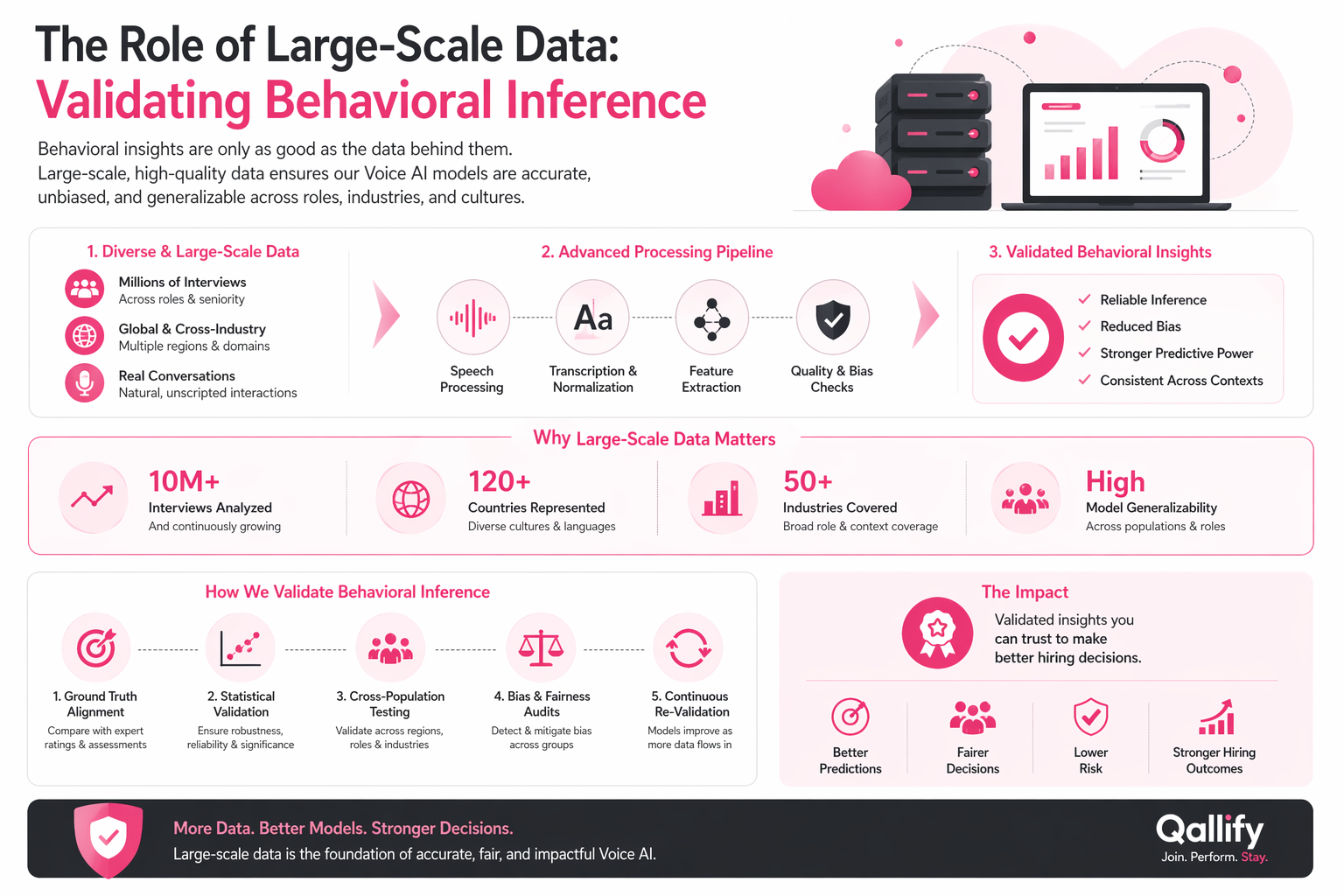
The Role of Large-Scale Data: Validating Behavioural Inference
The credibility of any personality inference system depends on its ability to move from theoretical constructs to empirically validated signals. This is where, consequently, large-scale datasets become critical.
Dr. Chetan Indap, Founder & CEO of Qallify, has built a platform grounded in a dataset of over 14 million interviews. At this scale, linguistic and vocal signals that may appear noisy in isolation begin to stabilise when aggregated across millions of interactions. As a result, this enables more accurate mapping between observed behaviour and underlying traits.
More importantly, such datasets allow for outcome-linked validation. By correlating inferred traits with downstream variables — such as hiring decisions, performance indicators, and retention patterns — it becomes possible to test whether the signals being captured are not only consistent, but also predictive.
This addresses a longstanding limitation in personality assessment. Traditional methods often assume that traits are relevant based on theoretical models. However, they do not always validate them against real-world outcomes. Large-scale behavioural datasets, therefore, enable a shift from assumption to evidence.
Implications for Volume Hiring Environments
In high-volume hiring, the challenge is not simply identifying strong candidates. Rather, it is doing so with consistency and speed while minimising bias. Voice-based inference of openness and agreeableness, therefore, introduces a new layer of behavioural intelligence into early-stage screening.
Instead of relying solely on resumes or structured responses, organisations can evaluate how candidates think and interact at scale. Consequently, this allows for the identification of individuals who may not stand out on traditional metrics — but who demonstrate strong cognitive flexibility or interpersonal effectiveness.
It also enables more nuanced decision-making. Rather than filtering candidates based on rigid criteria, hiring systems can incorporate probabilistic assessments of how well a candidate is likely to perform within a specific role and team context.
A Broader Shift in Hiring Logic
The integration of openness and agreeableness into hiring systems reflects a broader shift in how talent is understood. Work is increasingly defined by complexity, interdependence, and continuous change. In such environments, therefore, performance is not determined solely by what individuals know. Instead, it depends on how they think and how they relate to others.
Openness captures the capacity to navigate the unknown. Agreeableness, in contrast, captures the ability to navigate the social.
Together, therefore, they extend the scope of hiring from evaluating capability to understanding behaviour. When these traits are measured through real-time voice interactions, they move from abstract concepts to observable, quantifiable signals.
This shift does not replace traditional hiring criteria. Instead, it rebalances them. It recognises that in modern organisations, success is not just a function of execution — but of adaptation and collaboration. And both, ultimately, are deeply rooted in personality.
To know about the big five (OCEAN) traits, click here.