

The Thinking Style Bias Hiding in Every Interview
One of the clearest patterns across interview data is a quiet preference for a certain type of thinking — structured, linear, and easy to follow.
Why Interviews Favour Structure
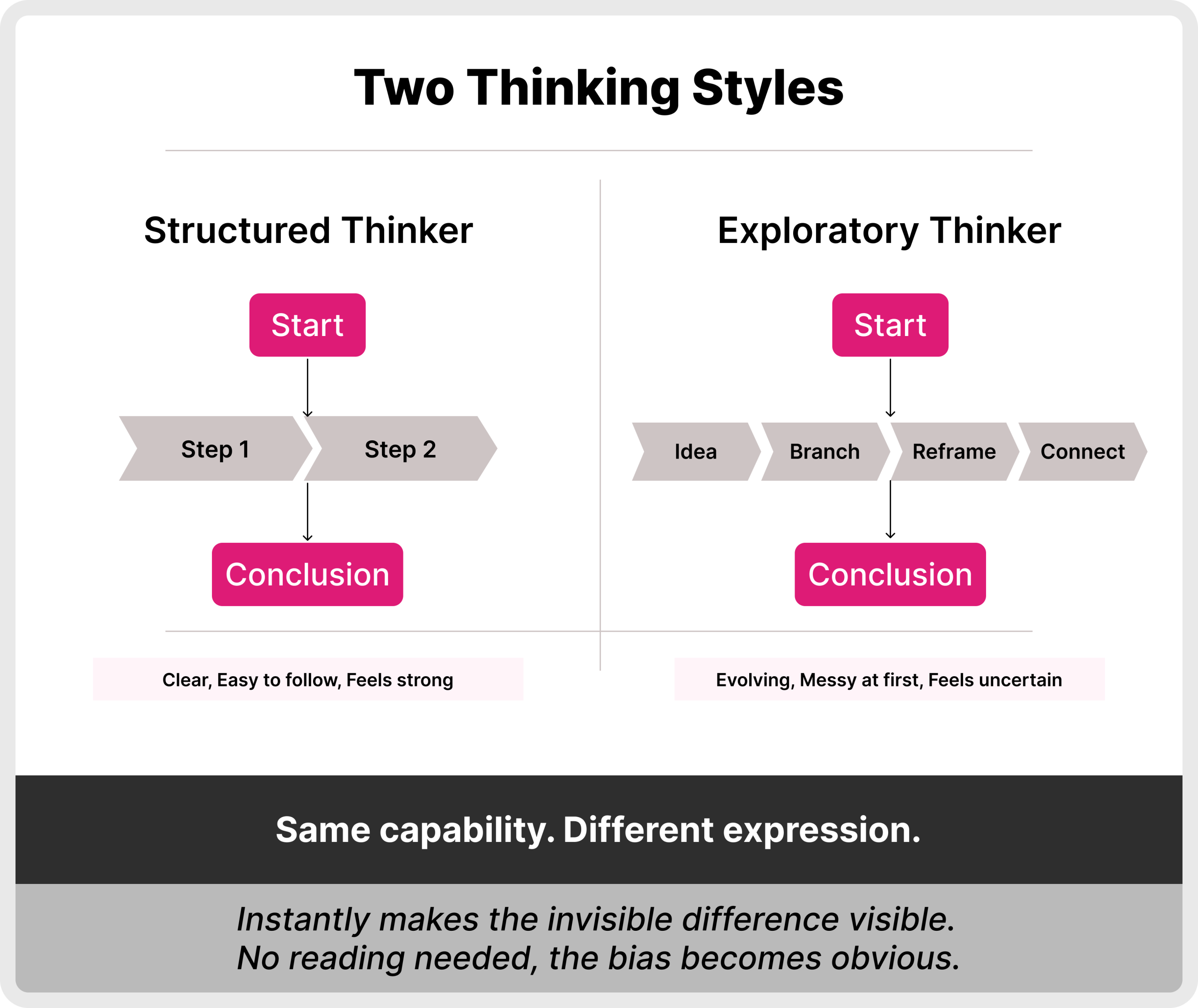
Most interviews reward candidates who present thoughts in a neat sequence. They set context, walk through steps, and arrive at a clear conclusion. This works well because it reduces effort for the interviewer. As a result, the answer feels complete, easy to process, and therefore more convincing.
This isn't accidental. Research in cognitive psychology shows that when information is easier to process, we tend to judge it as more intelligent and more credible. Researchers call this the fluency effect (Alter & Oppenheimer, 2009).
The Other Kind of Strong Thinker
However, not all strong thinkers operate this way. Some candidates think in a more exploratory, non-linear manner. They work through ideas as they speak, test possibilities, and refine their answers in real time. Their clarity emerges gradually, not instantly.
In an interview, this can feel less polished. The answer may seem scattered at first, or slower to land. But what's actually happening is active thinking in motion.
Additionally, this style closely links to associative and creative thinking — where ideas connect, reshape, and expand dynamically (Mednick, 1962; Beaty et al., 2016). It becomes especially valuable in roles that involve ambiguity, problem-solving, and innovation. Unfortunately, interviews are not designed to recognise this easily.
The Bias Towards Early Clarity
Interviewers tend to reward answers that feel clear early, even if those answers are shallow. In contrast, they penalise answers that take time to unfold, even when those answers lead to deeper insight. Decision-making research shows that people prefer quick clarity over complexity, especially under time pressure (Tversky & Kahneman, 1974). Over time, therefore, this creates a pattern.
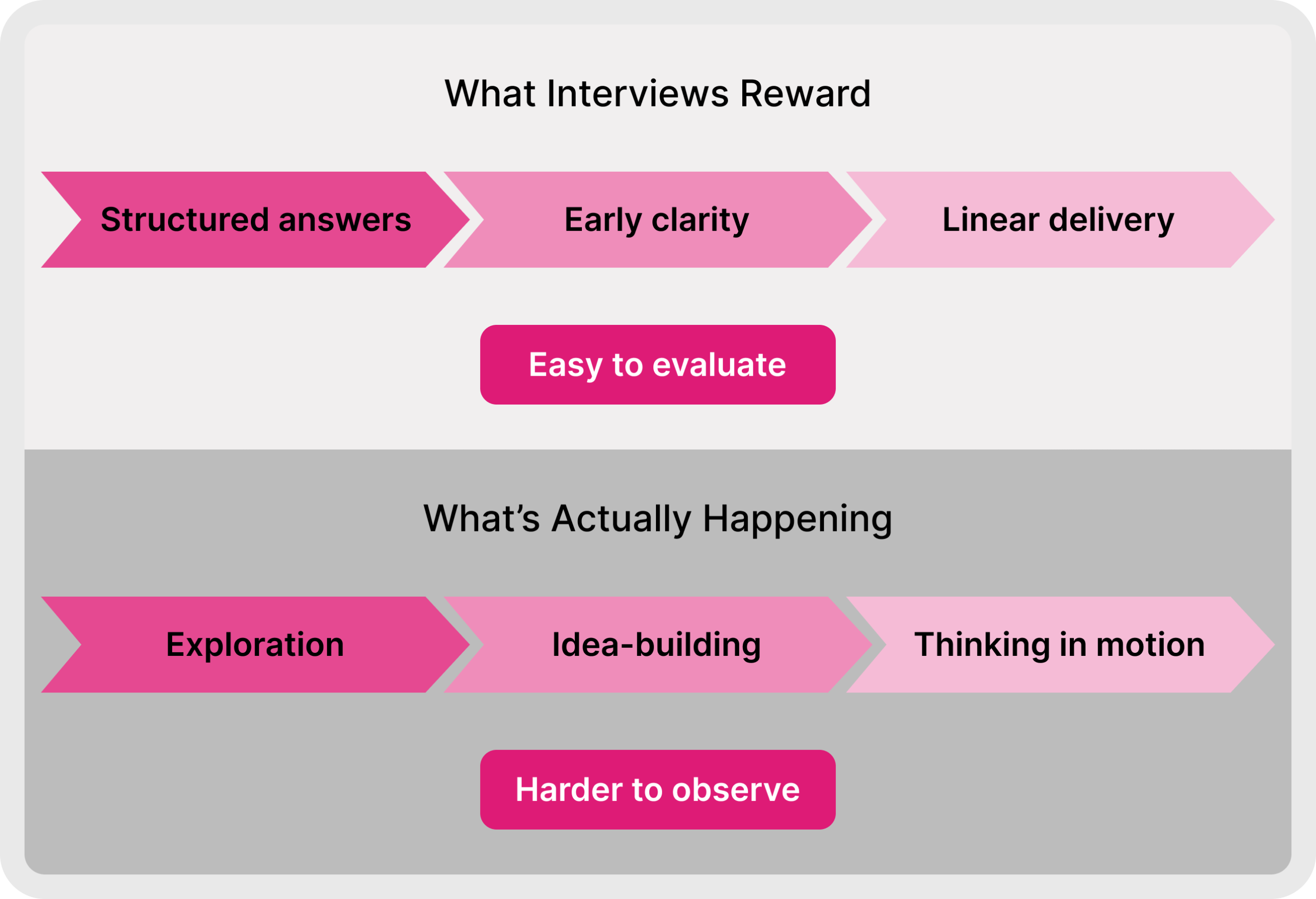
Candidates who present structured answers receive consistently higher ratings. Those who think out loud, explore, and refine are more likely to get underrated — even when their eventual answers are stronger.
What This Bias Actually Costs
This isn't just a minor bias. It shapes who gets hired.
When interviewers consistently reward structured delivery, they end up selecting people who are good at organising thoughts — not necessarily those who are best at generating them under uncertainty. For simpler roles, this may not matter as much. But in complex environments — where problems are unclear and answers are not predefined — the ability to explore, adapt, and build thinking in real time becomes critical.
How Qallify Addresses This
Ultimately, the gap is not in talent. It is in what the system is trained to recognise. Neha Valecha, Chief Business Officer of Qallify, has been instrumental in shaping how Qallify looks beyond how neatly an answer is presented and focuses instead on how it is formed. By analysing how responses evolve — whether ideas are explored, refined, or restructured in real time — Qallify distinguishes between polished delivery and actual thinking.
This, therefore, helps surface candidates who may not sound perfect immediately, but demonstrate stronger problem-solving ability as they think through complexity. The goal is simple: to ensure that hiring decisions reflect how well someone thinks, not just how clearly they package it.
To know why Top Candidates Fail in the Final Round, click here.