

What Really Happens in Final Round Interviews
Dr. Chetan Indap, Founder & CEO of Qallify, has consistently identified a pattern across large-scale interview datasets — what he calls a late-stage inversion.
Candidates who perform strongly across multiple structured rounds often fail to convert in the final interview.
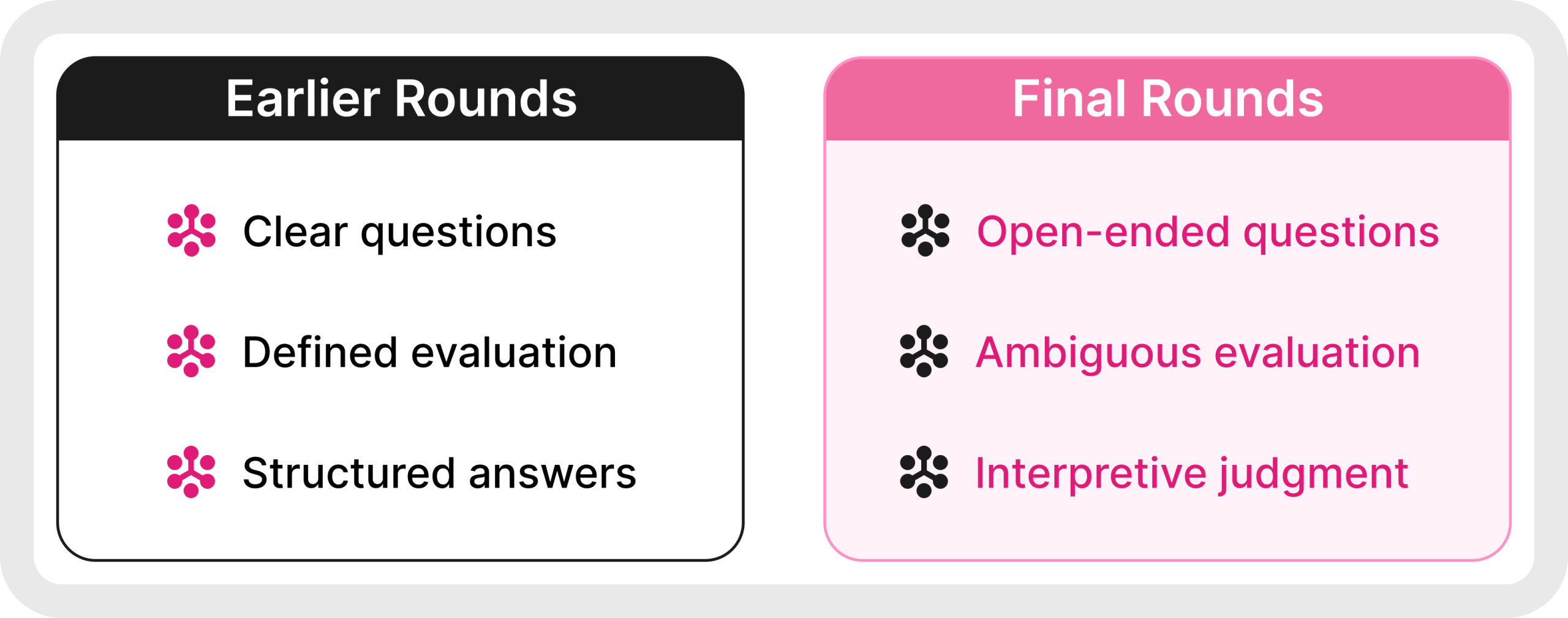
On the surface, most attribute this to "fit," "executive presence," or "leadership alignment." These explanations point in the right direction, but they hide a more fundamental shift. The final round is not simply a continuation of earlier assessments. It is a change in signal type.
How Earlier Rounds Work
Earlier interviews evaluate defined competencies. Questions are scoped. Criteria are clear. Interviewers measure performance against stable benchmarks. Candidates who succeed here show clarity of thought, role-relevant knowledge, and the ability to work within known frameworks.
What Changes in the Final Round
As candidates reach the final stage, the structure loosens. Conversations grow more open-ended. Questions become broader and often vague. Evaluation criteria shift toward interpretation — how the candidate frames problems, handles uncertainty, and whether their thinking resonates with senior stakeholders.
This creates variability that neither the interviewer nor the candidate always sees.
The Real Problem: A Mismatch, Not a Skill Gap
The data shows no drop in candidate capability. Instead, it reveals a mismatch between demonstrated strengths and newly introduced evaluation signals.
Candidates who excel in structured settings rely on precision. They define problems clearly, scope answers carefully, and avoid overgeneralising. These traits win in earlier rounds. But in final rounds, the same behaviours can work against them.
When evaluators ask abstract or loosely framed questions, these candidates may pause to seek clarity. They anchor answers in specifics rather than expanding into broader narratives. Meanwhile, evaluators are looking for synthesis, pattern recognition, and comfort with ambiguity. The mismatch is subtle — but costly.
Two Different Evaluative Modes
The candidate experiences the final round as a continuation of the process. In reality, it is a shift into a different evaluative mode — less about correctness, more about cognitive range and narrative alignment.
Large-scale analysis confirms this. Candidates who perform consistently in earlier rounds but show narrow variance in response style — meaning they maintain the same structured approach even under vague questioning — score lower in final-stage interviews more often.
Candidates who show adaptive response behaviour — the ability to expand, abstract, and reframe in less structured contexts — perform better in final evaluations. This holds true even when their earlier round performance was only comparable, not superior.
Final round outcomes do not purely reflect overall candidate quality. They reflect the candidate's ability to shift cognitive modes when interview conditions change.
The Subjectivity of Senior Interviewer Judgment
Senior interviewers ask forward-looking questions:
● "Can I see this person operating in complex, high-stakes environments?"
● "Does their thinking complement or challenge our existing leadership?"
● "Does their thinking complement or challenge our existing leadership?"
These are subjective, but not arbitrary. Evaluators base them on perceived signals — how a candidate handles abstraction, trade-offs, and incomplete information.
The problem is that interviewers rarely calibrate these signals consistently. As a result, highly capable but less expressive candidates get undervalued. Candidates who project high-level thinking — regardless of actual depth — get over-indexed. This creates a structural inefficiency in hiring systems.
The System Shifts Without Warning
Strong candidates are not failing because they lack qualification. They fail because the system changes what it rewards without saying so.
This raises an important design question: if final rounds assess strategic thinking, ambiguity navigation, and executive communication, why do these dimensions not appear earlier in the process?
Without that alignment, the final round becomes less of a confirmation stage and more of a filter for adaptability under unannounced conditions. It systematically screens out candidates who are precise, consistent, and capable — but who do not recalibrate their style without clear signals.
In high-stakes hiring, this is not a marginal issue. It is a recurring pattern with measurable impact on selection outcomes.
How Qallify Interprets These Signals
At Qallify, our models track how candidates adapt when interviews shift from structured to ambiguous. We analyse signals such as abstraction level, response flexibility, narrative range, and the ability to reframe under open-ended questioning.
This helps distinguish between:
● Consistency within structure and adaptability beyond it
● Precision in defined problems and comfort with ambiguity
● Prepared responses and situational synthesis
● Precision in defined problems and comfort with ambiguity
● Prepared responses and situational synthesis
We map these behaviours against real performance data to identify which candidates can extend their thinking when conditions change — not just perform within predictable formats.
In practice, this reduces late-stage drop-offs driven by misaligned evaluation — and ensures strong candidates are not filtered out simply because the system changed what it was looking for.
To know about the Fluency Bias, click here.