

The Great Hiring Slowdown: Better Decisions Matter
Over the past two years, global hiring has not simply slowed. Instead, it has structurally tightened. Organisations are opening fewer roles, extending hiring cycles, and scrutinising every headcount decision more than ever before.
According to the International Labour Organization, global employment growth has moderated post-pandemic. Meanwhile, productivity pressures and cost optimisation have intensified across sectors. This is not a cyclical dip. Rather, it reflects a deeper shift toward precision hiring.
At the same time, research by McKinsey & Company highlights that organisations increasingly prioritise role criticality over role volume — fewer hires, but with disproportionately higher expectations of performance and retention. The implication is stark. Every hiring decision now carries amplified business risk.
The Philippines: A High-Volume Market Under Pressure
Nowhere is this shift more visible than in the Philippines — one of the world's largest talent hubs for customer experience (CX), IT-BPM, and shared services.
The IT & Business Process Association of the Philippines reports that while the sector continues to grow, hiring velocity has become more selective — driven by automation, AI augmentation, and global demand fluctuations. Additionally, data from the Asian Development Bank indicates that digital transformation across Southeast Asia is reshaping skill requirements faster than supply can adjust.
This creates a paradox. On one hand, there is high availability of candidates. On the other hand, there is increasing mismatch in job readiness, communication ability, and role fit. In high-volume hiring environments like CX operations, furthermore, even a small inefficiency in selection compounds into millions in attrition cost, training leakage, and lost productivity.
Fewer Hires, Higher Stakes
Research from Harvard Business School suggests that a single bad hire can cost up to 5–7x the role's annual salary — factoring in productivity loss, replacement cost, and team disruption. In constrained hiring environments, this cost is not just financial. It is, instead, strategic.
Moreover, studies by the Society for Human Resource Management show that nearly 1 in 3 new hires leave within the first 90 days — often due to misaligned expectations rather than capability gaps. This points to a systemic issue. Traditional hiring processes optimise for selection, not prediction.
The Shift from Selection to Prediction
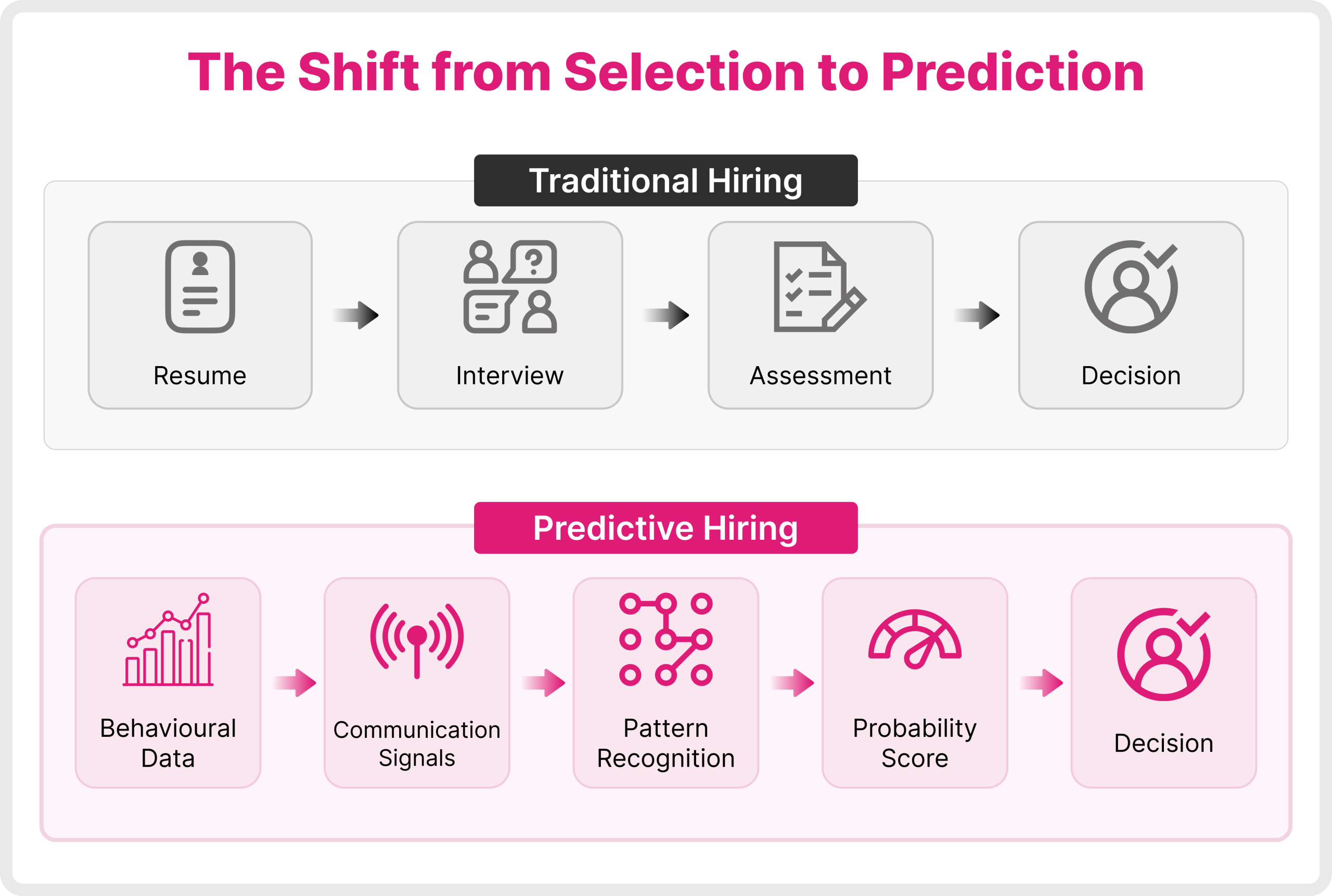
Legacy hiring systems — resumes, interviews, and even assessments — operate as static filters. They evaluate what a candidate has done, not what they are likely to do next in a specific organisational context.
This is where predictive hiring frameworks are gaining traction. According to Gartner, organisations adopting data-driven hiring models see improvements in quality of hire and reductions in early attrition — particularly when behavioural and communication signals inform decision-making. Consequently, more organisations are moving away from intuition-led processes toward structured, data-backed approaches.
How Qallify Reframes Hiring Decisions
Qallify builds on a fundamentally different premise: hiring is not a yes/no decision — it is a probability outcome.
Leveraging insights from 14+ million interview interactions, Qallify evaluates candidates across three critical dimensions:
1. Join Probability — Will the candidate actually show up and onboard?
2. Perform Probability — Will they meet role-specific performance benchmarks?
3. Stay Probability — Are they likely to sustain beyond early attrition windows?
2. Perform Probability — Will they meet role-specific performance benchmarks?
3. Stay Probability — Are they likely to sustain beyond early attrition windows?
This reframing aligns directly with what constrained hiring environments demand: certainty over volume.
Unlike traditional tools, furthermore, Qallify captures live conversational data — decoding communication patterns, intent signals, and behavioural consistency. These then map against role success benchmarks, creating a predictive fit score rather than a descriptive profile.
Why This Matters More in Markets Like the Philippines
In high-throughput hiring ecosystems such as the Philippine BPO sector, attrition rates can exceed 30–40% annually in some roles. Additionally, training investments are front-loaded and client SLAs depend heavily on early-stage agent performance.
A marginal improvement in hiring accuracy can, therefore, translate into significant reduction in early drop-offs, faster time-to-productivity, and improved client satisfaction scores.
Qallify's predictive layer directly addresses the offer-to-joining gap — a widely under-optimised stage in hiring. By identifying candidates with high join probability, organisations can reduce ghosting, reneges, and onboarding volatility — a persistent challenge in the region.
From Hiring Efficiency to Hiring Intelligence
The future of hiring is not about faster pipelines. It is, instead, about smarter decisions within tighter pipelines.
As global hiring continues to contract, organisations that rely on intuition-heavy or resume-led processes will face increasing inefficiencies. In contrast, those adopting predictive, data-backed frameworks will gain a disproportionate advantage — not by hiring more, but by getting each hire right.
Qallify sits at the centre of this shift. It transforms hiring from a transactional process into a decision science — enabling CXOs to align talent acquisition with measurable business outcomes.
Because in a world where you hire less, you cannot afford to hire wrong.
To know about Performance in LATAM: A Wider, Ongoing Challenge, click here.