

Why AI Is Failing Hiring Teams And What They're Missing?
Walk into any talent acquisition meeting today, and you will hear the same complaint in different words. The AI tool was supposed to fix hiring. Instead, it created new problems nobody anticipated.
This frustration is not imagined. It is, in fact, well documented and increasingly widespread.
The Promise That Hasn't Delivered
When AI entered hiring at scale, the pitch was simple. Faster screening. Smarter matching. Less bias. Better decisions. Vendors promised that algorithms would outperform tired recruiters working through their hundredth resume of the week.
For many organisations, however, reality looked different.
According to Gartner, only 14% of organisations feel confident in their ability to assess future performance effectively during hiring — even with AI tools in place. This is a striking number. It suggests that adding AI to a broken process did not fix the process. It simply automated the same flaws at greater speed.
Where AI Is Actively Making Hiring Worse
The first failure is the illusion of intelligence. Many platforms market themselves using terms like "predictive hiring" or "deep behavioural analysis," yet rely on shallow signals — keyword matching disguised as semantic understanding, or facial expression analysis with no proven link to job performance. Consequently, these tools appear sophisticated while delivering little real predictive value.
The second failure is bias amplification, not bias removal. AI models trained on historical hiring data inherit the biases embedded in that data. If an organisation historically favoured certain universities, communication styles, or backgrounds, the algorithm learns to replicate that pattern — often at greater scale and with less visibility than a human recruiter would have. Research from Harvard Business Review has repeatedly shown that unstructured, opaque evaluation processes — even automated ones — remain highly susceptible to bias.
The third failure is feature fatigue. Many platforms try to be sourcing engine, CRM, assessment tool, and analytics dashboard all at once. The result is shallow capability spread thin across too many functions, rather than deep expertise in any one area. TA leaders end up with bloated systems that automate activity without improving outcomes.
The fourth failure is the candidate experience problem. Poorly designed AI interviews feel robotic, impersonal, and disconnected from the role being assessed. Candidates increasingly report frustration with systems that ask generic questions, fail to adapt to context, and provide no clarity on how decisions are made. This damages employer brand at precisely the moment organisations are trying to attract top talent.
The fifth failure, and perhaps the most consequential, is measuring the wrong things. Most AI hiring tools still optimise for time-to-fill and cost-per-hire — the same transactional metrics that defined hiring a decade ago. They tell you how quickly a role was filled. They rarely tell you whether the person who filled it will actually join, perform, and stay.
Why This Keeps Happening?
These failures are not really about AI being a bad technology. They are about AI being deployed to automate broken assumptions rather than to challenge them.
Most hiring systems were built around a simple, flawed premise: that hiring is a single, solvable problem. In reality, hiring is a sequence of distinct decisions — who to reach out to, who is worth engaging, who will actually join, and who will perform and stay. Each of these requires different data, different models, and different expertise. Trying to solve all of them with one generic AI layer is, consequently, a recipe for shallow results.
Furthermore, many organisations adopted AI reactively — under pressure to modernise, reduce headcount costs, or keep pace with competitors — without first rethinking what good hiring actually requires. The technology arrived before the strategy did.
The Real Cost of Getting This Wrong
The consequences are not abstract. According to SHRM, the cost of a bad hire can range from 30% to 200% of the employee's annual salary, depending on role complexity. When AI tools fail to predict fit accurately, this cost compounds across every hire made through a flawed system.
Meanwhile, McKinsey & Company notes that top performers can be up to 400% more productive than average performers in complex roles. Every mis-hire driven by shallow AI screening, therefore, represents a significant lost opportunity — not just a wasted recruitment budget.
The frustration TA leaders feel is legitimate. They were promised intelligence. What they often received was automation without insight.
But the Failure Is Not in the Concept — It's in the Execution
Here is where the conversation needs to shift. The problem with AI in hiring today is not that prediction is impossible. It is that most platforms have not been built with the depth, data, or discipline required to do it well.
There is a meaningful difference between AI that pattern-matches keywords and AI that captures genuine behavioural signals — response consistency, decision-making style, communication patterns, and adaptability under ambiguity. There is a meaningful difference between AI trained on a few thousand interviews and AI trained on tens of millions. And there is a meaningful difference between AI that optimises for speed and AI that optimises for outcomes — whether a candidate will actually join, perform, and stay.
This is precisely where most organisations have not yet caught up.
Hiring Teams Are Sitting on Untapped Potential
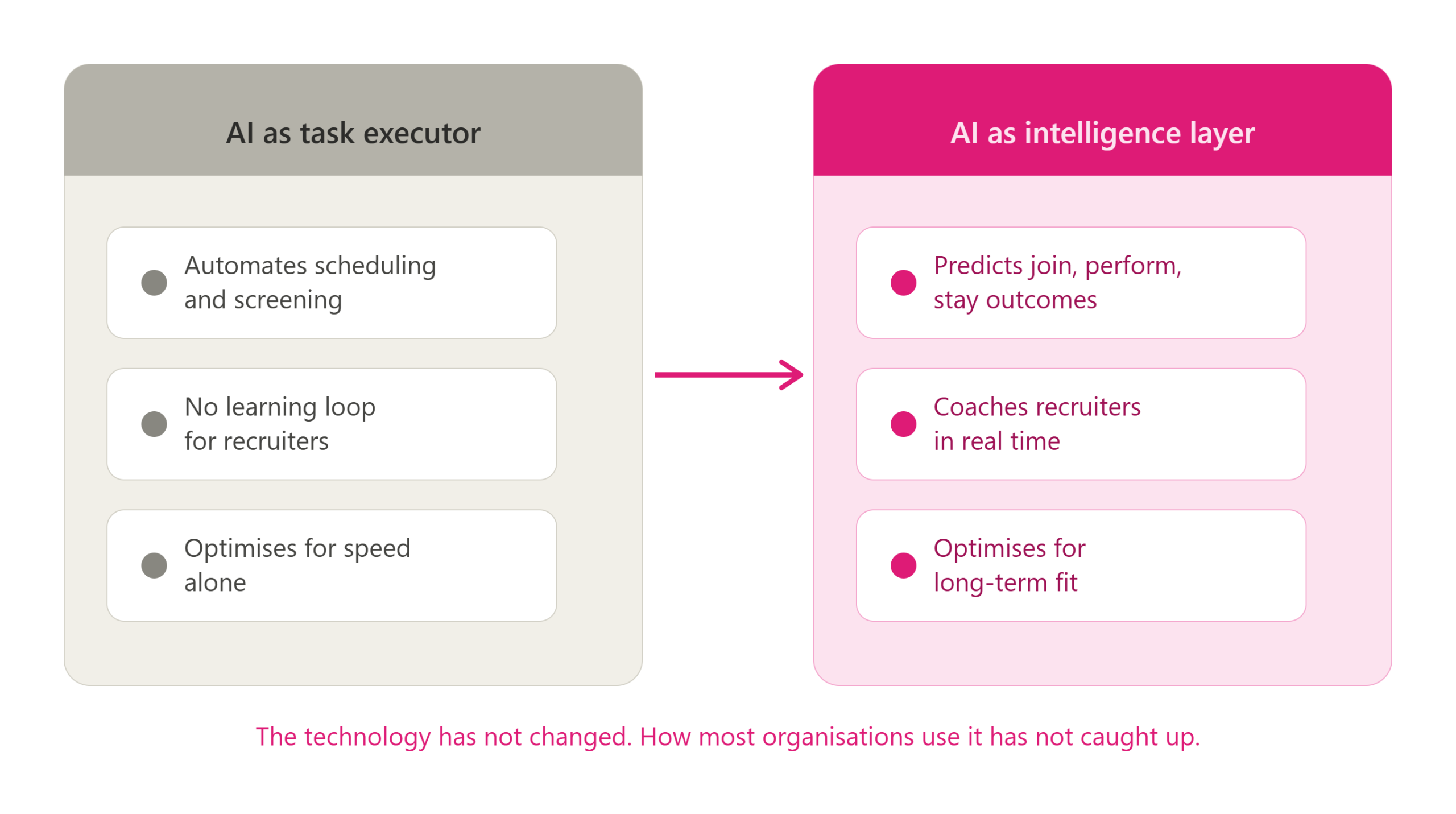
The uncomfortable truth is that most hiring teams are using a fraction of what well-built AI can actually offer. They have adopted the automation layer — faster scheduling, automated screening, chatbot-driven sourcing — without adopting the intelligence layer that makes AI genuinely transformative.
Consider what is possible but rarely used today.
Predictive outcomes, not just present-state evaluation. Most AI tools answer "Is this candidate qualified?" Few answer "Will this candidate join, perform, and stay?" Platforms built on large-scale behavioural data — capturing patterns across millions of interviews — can move hiring from descriptive evaluation to genuine forecasting. According to Deloitte, companies that leverage advanced people analytics are 2.5 times more likely to outperform their peers in talent outcomes. Yet most organisations have not integrated this capability into their core hiring workflow.
Continuous engagement intelligence. Strong candidates regularly disappear simply because a call went unanswered or a notice period created hesitation. AI capable of tracking engagement signals over time — rather than treating every contact attempt as isolated — can keep promising candidates visible until a clear outcome is reached. Few organisations have operationalised this, despite the technology existing.
Bias detection that actually works. Properly designed AI can standardise question delivery, eliminate visual and social cues that trigger bias, and create auditable, explainable evaluation criteria. This is fundamentally different from AI that silently replicates historical bias. According to the World Economic Forum, skills-based and behaviour-based hiring — when implemented through properly designed systems — can significantly improve diversity and inclusion outcomes. The capability exists. Adoption lags behind.
Recruiter upskilling through embedded intelligence. The best AI systems do not just execute tasks — they coach recruiters in real time, surfacing patterns about what predicts candidate success. McKinsey & Company notes that organisations embedding AI properly into HR processes can improve decision accuracy by up to 25%. This transforms every recruiter, not just senior ones, into a more capable decision-maker. Most organisations, however, still use AI purely as a task-execution tool rather than a learning system.
Why Closing This Gap Is No Longer Optional
The hiring market has fundamentally changed. Headcount budgets are tighter. Every hiring decision carries amplified business risk. According to research from Harvard Business School, a single bad hire can cost up to 5–7x the role's annual salary when factoring in productivity loss, replacement cost, and team disruption.
In this environment, organisations cannot afford to keep using AI as a faster version of a flawed process. They need to use it as what it was always capable of being — a genuine intelligence layer that improves the accuracy, fairness, and predictive power of every hiring decision.
This is not about adopting more tools. It is about adopting deeper ones — platforms built on real behavioural data, designed around outcome prediction rather than activity tracking, and focused on the full lifecycle of a hire, not just the moment an offer gets signed.
Organisations that make this shift will not just hire faster. They will hire candidates who actually join, perform, and stay — turning AI from a source of frustration into the strategic advantage it was always meant to be.
Because the technology was never the problem.
The way most organisations have chosen to use it was.
To know about Why Enterprises Are Ditching Fixed Software Pricing, click here