

Why Enterprises Are Ditching Fixed Software Pricing
For years, enterprise technology has evolved at an incredible pace. Artificial intelligence is transforming workflows. Cloud computing has redefined infrastructure. Automation is eliminating repetitive tasks. Furthermore, data analytics is enabling faster, more informed decisions.
Yet despite these technological advances, one aspect of enterprise software has remained surprisingly unchanged — the way organisations pay for it.
The Problem With How Enterprises Pay for Software
Most enterprise software still uses pricing models designed decades ago. Annual subscriptions, user licences, seat-based pricing, and fixed contracts continue to dominate procurement decisions across industries. Regardless of whether an organisation actively uses a platform every day or only during peak demand, the financial commitment often remains the same.
Businesses estimate future usage, purchase capacity in advance, and hope their investment aligns with actual operational needs. This model made perfect sense when enterprise software installed on physical servers, scaling required expensive infrastructure, and technology deployments took months to complete.
However, today's business environment is fundamentally different. Enterprises must be agile, respond quickly to market shifts, embrace digital transformation, and continuously optimise costs. In such an environment, paying for software that sits idle for weeks or months is increasingly difficult to justify.
What Is Pay-Per-Use — and Why Does It Matter?
This changing reality has led to the rapid rise of pay-per-use — also known as usage-based or consumption-based pricing. Instead of paying for access, organisations pay for actual consumption. Rather than purchasing capacity they may never fully utilise, businesses invest in technology only when it creates value.
While this pricing philosophy has been a cornerstone of cloud computing for years, it is now extending across artificial intelligence, communications, analytics, recruitment technology, automation platforms, and numerous other enterprise solutions. According to OpenView Partners' SaaS Benchmarks Report, usage-based pricing is becoming an increasingly important differentiator as organisations seek greater financial flexibility and stronger alignment between technology investments and business outcomes.
Pay-per-use is not merely another pricing option. It represents, instead, a broader shift in how enterprises think about technology itself.
The Limitations of Traditional Enterprise Pricing
Traditional software pricing has always prioritised predictability. Vendors benefit from recurring annual revenue. Customers, in contrast, appreciate knowing exactly how much they will spend over the course of a financial year. However, predictability does not necessarily translate into efficiency.
Modern enterprises rarely operate in a predictable manner. Hiring requirements fluctuate throughout the year. Customer service volumes increase during product launches and seasonal campaigns. Furthermore, marketing teams experience bursts of activity around major initiatives. Yet the pricing of many enterprise software platforms assumes that business activity remains constant.
Organisations often purchase hundreds of software licences based on projected growth — only to discover months later that a significant percentage remain unused. In other situations, companies underestimate demand and are forced to upgrade contracts midway through the year, renegotiate pricing, or purchase additional licences at premium rates. Both situations create inefficiencies. One leads to paying for capacity that generates no value. The other, consequently, introduces unnecessary friction precisely when business growth should be encouraged.
The fundamental challenge lies in the disconnect between technology pricing and business activity. Fixed subscriptions treat software as a static asset. Today's enterprises, however, require technology that expands and contracts alongside operational demand.
Technology Has Become Dynamic — Pricing Should Too
One of the defining characteristics of modern business is variability. Organisations scale rapidly, enter new markets, launch new products, hire aggressively during growth phases, and optimise operations during economic uncertainty. Very few enterprises operate at exactly the same level of activity throughout the year.
Technology has evolved to support this flexibility. Cloud infrastructure can provision in minutes. Artificial intelligence models can process millions of interactions one month and significantly fewer the next. Digital platforms can scale globally without requiring major infrastructure investments.
Pricing, however, has often lagged behind.
Pay-per-use addresses this gap by ensuring that technology costs directly link to actual utilisation rather than anticipated demand. Instead of asking organisations to predict how much software they might need twelve months in advance, consumption-based models allow spending to naturally follow business activity.
This creates a fundamentally different relationship between enterprises and technology providers. Rather than purchasing theoretical capacity, organisations purchase measurable outcomes. Costs increase when business activity increases and decrease when activity slows. Consequently, for many finance leaders, this alignment makes technology spending resemble other operational expenses — such as electricity, cloud infrastructure, logistics, or telecommunications — resources that organisations consume as needed rather than purchase in fixed quantities.
How Cloud Computing Changed Enterprise Expectations
The widespread acceptance of pay-per-use pricing can largely trace back to the rise of cloud computing.
Before cloud platforms became mainstream, organisations invested heavily in physical infrastructure. Servers were purchased based on projected peak demand — often resulting in expensive hardware sitting underutilised for much of its lifespan. Scaling required lengthy procurement cycles, significant capital expenditure, and ongoing maintenance.
Cloud computing fundamentally changed this equation. Instead of buying servers, organisations purchased computing power only when required. Storage, processing capacity, databases, networking, and analytics became services that organisations could consume on demand. Businesses no longer needed to estimate infrastructure requirements years in advance — they simply paid for what they actually used.
This consumption-based model enabled startups to compete with established enterprises while allowing large organisations to optimise infrastructure costs and improve scalability. According to Gartner's Cloud Pricing Report, usage-based billing has become the norm across cloud services — creating an expectation that enterprise technology should be as financially flexible as it is operationally. Having experienced the benefits of cloud economics, furthermore, enterprises are naturally beginning to expect similar pricing models across other categories of business software.
How Artificial Intelligence Is Accelerating the Shift
The rapid adoption of artificial intelligence has made the limitations of traditional software pricing even more apparent.
Unlike conventional applications, AI workloads are rarely consistent. A recruitment team may conduct thousands of AI-assisted interviews during campus hiring — but significantly fewer during quieter months. Customer support organisations may process millions of AI interactions during holiday seasons while requiring far less capacity during routine operations. Furthermore, marketing teams often generate substantial amounts of AI-created content around campaign launches before returning to normal production levels.
Charging identical subscription fees across such dramatically different workloads often creates an imbalance between cost and value.
This explains why many AI providers have adopted consumption-based pricing. Instead of charging organisations for access alone, they increasingly bill based on tokens processed, API requests, images generated, compute consumed, or AI interactions completed. According to McKinsey's State of AI Report, these pricing mechanisms more accurately reflect the computational resources used and the value delivered. As AI becomes embedded across enterprise operations, therefore, usage-based pricing is likely to become even more common — because it mirrors the inherently variable nature of AI workloads.
Financial Flexibility as a Strategic Advantage
For enterprise finance teams, technology is no longer viewed solely as a support function. It is, instead, a strategic investment. Every software purchase must demonstrate measurable business value, contribute to operational efficiency, and justify ongoing expenditure.
Pay-per-use aligns particularly well with this expectation because it creates a clearer relationship between spending and outcomes.
Instead of paying a fixed amount regardless of utilisation, organisations invest in technology according to business activity. During periods of expansion, increased software consumption typically reflects increased productivity, higher transaction volumes, or stronger customer engagement. During slower periods, technology expenditure naturally declines — reducing unnecessary operational costs.
This flexibility becomes especially valuable in industries where demand fluctuates significantly throughout the year. Consequently, enterprises are no longer forced to choose between overinvesting in unused capacity or limiting growth because existing software licences have reached their limits. More importantly, finance leaders gain greater confidence that technology spending directly connects to operational performance rather than contractual commitments alone.
Lower Barriers Encourage Innovation
Another significant advantage of pay-per-use is the reduction of adoption barriers.
Traditional enterprise software often requires organisations to make substantial financial commitments before they experience meaningful value. Procurement cycles can be lengthy, annual contracts may involve considerable negotiation, and forecasting future usage often becomes an exercise in educated guesswork.
Consumption-based pricing changes this dynamic. Organisations can begin with relatively small workloads, validate outcomes, measure return on investment, and expand usage only when business value has been demonstrated. Rather than making large upfront commitments based on assumptions, enterprises allow real operational demand to determine future investment.
This approach encourages experimentation and innovation. Departments are more willing to explore new technologies when financial risk is reduced. Furthermore, vendors are incentivised to deliver products that customers continue to use — because ongoing consumption directly ties to customer satisfaction.
The conversation shifts, consequently, from purchasing software to continuously creating value.
How Pay-Per-Use Reshapes Vendor Relationships
Perhaps one of the less discussed but most meaningful aspects of pay-per-use is the way it reshapes the relationship between software providers and their customers.
Traditional licensing models often emphasise acquisition. Once licences have been sold, revenue is largely secured regardless of whether customers actively engage with the platform. While customer success remains important, the pricing model itself does not always directly connect to ongoing usage.
Consumption-based pricing changes these incentives. When customers pay according to actual usage, vendors become naturally motivated to improve adoption, simplify user experiences, increase product reliability, and continuously demonstrate measurable value. Software that sits unused generates little or no revenue. Software that becomes deeply embedded in everyday operations, in contrast, creates sustainable growth for both provider and customer.
This creates a healthier commercial relationship built around long-term engagement rather than one-time procurement decisions.
Will Pay-Per-Use Replace Subscriptions Entirely?
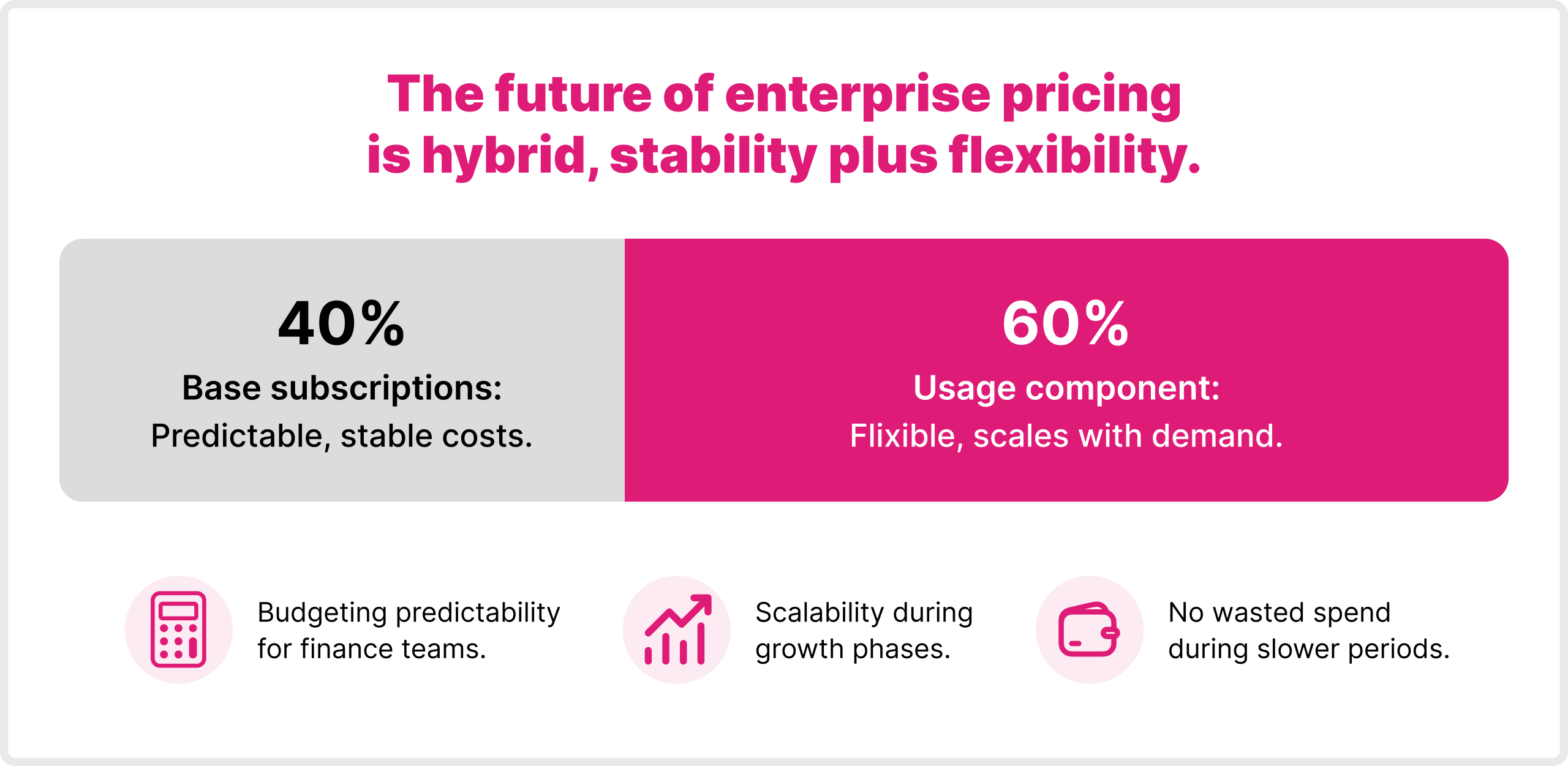
Although pay-per-use is gaining momentum, it is unlikely to completely replace subscriptions. Enterprise software serves diverse use cases. Consequently, different pricing models suit different types of products.
Applications that deliver consistent, daily value to a stable user base may continue to benefit from traditional subscriptions. Conversely, technologies with highly variable workloads — particularly AI, cloud services, communications platforms, analytics, and recruitment solutions — suit consumption-based pricing well.
Increasingly, industry analysts at Forrester expect hybrid pricing models to become the norm. These combine predictable base subscriptions with flexible usage components — allowing organisations to maintain budgeting stability while still benefiting from scalability when demand increases. Such hybrid approaches offer enterprises, therefore, the best of both worlds: financial predictability alongside operational flexibility.
A Pricing Model That Reflects Modern Business
The growing interest in pay-per-use is about much more than reducing software costs. It reflects a broader shift in enterprise thinking — from owning technology to consuming capability, from purchasing capacity to investing in outcomes.
Businesses today operate in environments defined by constant change. Hiring needs fluctuate. Customer demand evolves rapidly. Furthermore, artificial intelligence introduces entirely new patterns of technology consumption. Organisations require software that can adapt as quickly as their operations do.
Usage-based pricing acknowledges this reality. It recognises that value creates through utilisation — not merely through access. By linking technology expenditure to actual business activity, pay-per-use offers enterprises a pricing philosophy that better aligns with the demands of modern digital transformation.
As organisations continue to prioritise agility, efficiency, and measurable return on investment, pricing models will inevitably evolve alongside the technologies they support. Pay-per-use is not simply a trend driven by software vendors. It is, instead, a reflection of how enterprises increasingly expect to consume technology — flexibly, transparently, and in proportion to the value they receive.
For enterprises navigating an increasingly dynamic business landscape, that alignment may ultimately prove to be as important as the technology itself.
To know about "Why Your Best Hire This Year Hasn't Happened Yet", click here.