

Why Your Best Hire This Year Hasn't Happened Yet
There is a candidate in your database right now who could change the trajectory of your team.
They have the right skills. The right experience. The right behavioural profile. They align with your culture, your pace, and your growth trajectory. They are, by almost every measure, exactly what you have been looking for.
But you haven't spoken to them yet.
Not because they don't exist. Not because your sourcing team hasn't found them. Instead, somewhere between identification and conversation, the system lost them. A missed call. A long notice period. A busy week. A recruiter who moved on to the next profile under pressure to fill the role faster.
This is, consequently, the quiet crisis at the heart of modern hiring.
We Have Confused Activity With Outcomes
The recruitment industry has spent decades optimising for speed. Faster sourcing. Quicker screening. Shorter time-to-fill. Leaner cost-per-hire. These are not bad goals. However, in the relentless pursuit of efficiency, something fundamental has been lost.
We have confused hiring activity with hiring outcomes.
A recruiter who contacts fifty candidates in a week is not necessarily better than one who has ten meaningful conversations. A pipeline with two hundred profiles is not more valuable than one with twenty candidates who are genuinely aligned, engaged, and ready to join.
Yet most hiring systems reward volume. They measure activity. They track calls made, profiles sourced, and stages completed. Consequently, they rarely measure what actually matters — whether the right person joined, performed, and stayed.
This is, therefore, where modern hiring is quietly breaking down.
The Three Gaps Nobody Talks About
Across every industry, every geography, and every hiring volume, three gaps consistently undermine hiring quality. Furthermore, these gaps rarely appear on executive dashboards or talent acquisition reports.
Gap One: The Engagement Gap
This is the space between a candidate being identified and a meaningful conversation actually taking place. Unanswered calls, ignored emails, and missed messages fill this gap. Most recruitment systems treat silence as rejection. In reality, however, silence is often just timing.
A candidate who does not answer on Tuesday may be highly responsive on Friday. A professional who ignores an unknown number may immediately respond to a structured message that evening. Research in behavioural science consistently shows that non-response rarely signals disinterest. Instead, it signals unavailability — a temporary state that most recruitment systems treat as permanent.
The engagement gap is, consequently, where some of the best candidates quietly disappear.
According to Gartner, only 14% of organisations feel confident in their ability to assess future performance effectively during hiring. Furthermore, a significant portion of this confidence gap stems directly from candidates who were never properly engaged in the first place.
Gap Two: The Timing Gap
This is the space between when a candidate is available and when a recruiter needs them. A sixty-day notice period does not make a candidate unsuitable. It makes them temporarily unavailable. Yet most hiring systems treat these two states as identical — archiving strong profiles simply because the timing does not align today.
According to a Foundit study highlighted by the Times of India, nearly 58% of employers now prioritise immediate joiners. This preference, however, creates a structural inefficiency. Organisations filter candidates based on timing rather than capability. As a result, a moderately qualified candidate who can join immediately often wins over an exceptional candidate serving a sixty-day notice period.
The timing gap is, therefore, where great talent gets buried under the pressure of immediacy.
What makes this particularly wasteful is that the solution is not difficult. A candidate with a ninety-day notice period should not disappear from visibility. Instead, their profile should grow more relevant as their joining date approaches. Their availability should update automatically. Consequently, they should re-enter recruiter workflows at precisely the right moment.
Gap Three: The Signal Gap
This is the space between what a candidate shows in an interview and what they will actually do on the job. Traditional hiring captures surface-level performance — articulate answers, confident delivery, and polished narratives. It rarely captures the deeper signals that predict long-term success — behavioural consistency, decision-making patterns, adaptability under ambiguity, and alignment with team dynamics.
Research from Harvard Business Review highlights that hiring decisions are heavily influenced by first impressions, confirmation bias, and perceived cultural fit — often within the first few minutes of an interview. Furthermore, Gartner research shows that traditional interviews predict only about 26% of actual on-the-job performance.
The signal gap is, consequently, where hiring feels rigorous but remains fundamentally imprecise.
Psychologists refer to one key driver of this gap as the fluency bias — the tendency to equate smooth, confident communication with competence. As research published in Psychological Science demonstrates, brief observations of behaviour significantly influence judgments — even when those observations are incomplete or contextually limited. In hiring, therefore, this means that thoughtful but less polished candidates consistently get undervalued while confident communicators get overestimated.
The Compounding Cost of Getting It Wrong
Each of these gaps carries a cost. And these costs do not exist in isolation — they compound.
When the engagement gap allows strong candidates to disappear, organisations restart sourcing. Restarting sourcing increases cost-per-hire, extends time-to-fill, and stretches recruiter bandwidth. According to SHRM, the average cost-per-hire already exceeds $4,000 in many organisations. Furthermore, studies estimate that a bad hire can cost between 30% and 200% of the employee's annual salary — depending on role complexity.
When the timing gap causes organisations to overlook the best-fit candidate in favour of a merely available one, performance gaps emerge. Performance gaps increase manager burden, reduce team productivity, and elevate attrition risk. According to McKinsey & Company, top performers are up to 400% more productive than average performers in complex roles. Consequently, every timing-driven mis-hire carries an outsized cost.
When the signal gap causes organisations to hire based on interview performance rather than job performance, attrition follows. According to Work Institute, voluntary turnover costs U.S. businesses over $600 billion annually — with a significant portion attributable to preventable causes rooted in hiring misalignment.
The financial impact is significant. However, the strategic impact is even greater. Every mis-hire delays team performance. Every lost candidate, furthermore, strengthens a competitor. Every restarted search consumes resources that could redirect toward growth.
The Shift That Changes Everything
The organisations closing these gaps are not necessarily spending more on hiring. They are, instead, thinking differently about what hiring is.
They have moved away from treating recruitment as a transactional function — find a candidate, assess a candidate, hire a candidate. Instead, they treat it as a predictive, continuous, intelligence-driven process.
This shift has three dimensions.
From reactive to proactive. Rather than sourcing when a vacancy opens, these organisations maintain active talent ecosystems. Strong candidates stay visible. Notice periods become timelines rather than barriers. Furthermore, engagement continues until a clear outcome is reached — not until a recruiter runs out of time.
From evaluation to prediction. Rather than assessing what a candidate has done, these organisations focus on what a candidate is likely to do. They analyse behavioural signals, communication patterns, and decision-making tendencies across interactions. As a result, they build a richer, more accurate picture of how a candidate will perform in a specific role, team, and environment.
From intuition to intelligence. Rather than relying on gut feel, first impressions, and subjective panel discussions, these organisations leverage structured data. Every interaction becomes a signal. Every signal contributes to a pattern. Every pattern informs a decision. Consequently, hiring becomes less of a gamble and more of an evidence-based investment.
What This Looks Like in Practice
This shift is not theoretical. Organisations that embed these principles into their hiring processes see measurable outcomes.
According to Deloitte, companies that leverage data-driven recruitment platforms are 2x more likely to improve hiring quality and 1.5x more likely to enhance recruiter effectiveness. Furthermore, Boston Consulting Group reports that companies with mature talent analytics functions are 3.5 times more likely to outperform their peers in revenue growth.
These are not marginal improvements. They reflect, instead, a fundamental reorientation of how talent decisions are made.
Platforms like Qallify.ai operate at precisely this intersection. Rather than focusing only on what candidates say, Qallify.ai analyses how they communicate, how they build responses, how they handle unclear questions, and how their behavioural patterns shift across interactions. By tracking engagement signals, notice period timelines, and behavioural consistency, Qallify.ai ensures that strong candidates never fall through the gaps — regardless of whether the gap is one of engagement, timing, or signal interpretation.
The result is a shift from reactive hiring to proactive conversion management. Recruiters spend less time repeatedly searching for new candidates and more time speaking with people who are genuinely qualified and ready. Consequently, organisations gain better returns on sourcing investments, reduce repetitive hiring effort, and improve the likelihood of connecting with the right candidate at precisely the right moment.
The Question That Should Define Your Next Hire
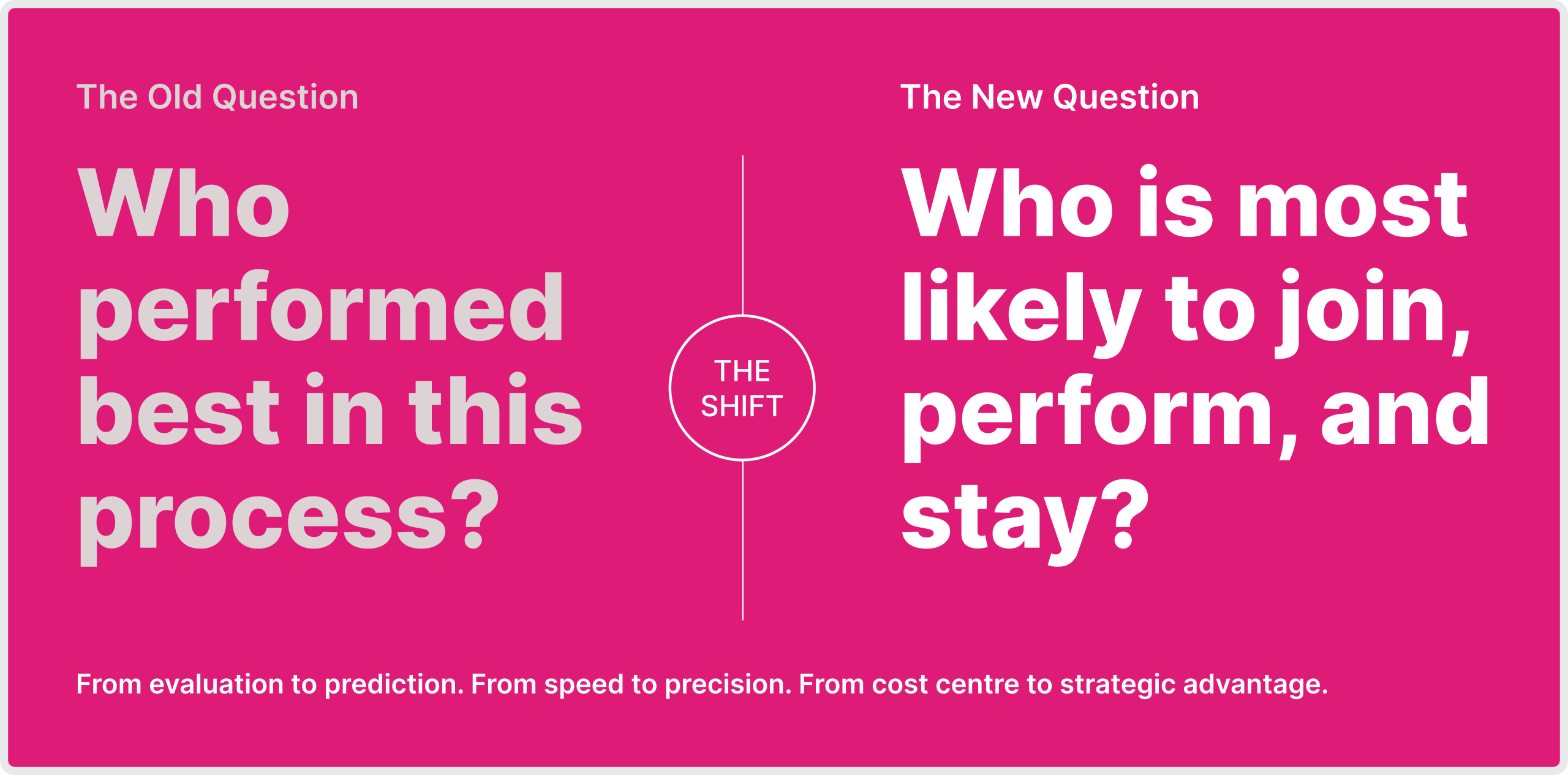
Most hiring processes ask: "Who performed best in this process?"
The better question is: "Who is most likely to join, perform, and stay — in this role, in this environment, over time?"
That shift — from performance to prediction, from evaluation to inference, from speed to precision — is where hiring transforms from a cost centre into a strategic advantage.
Because the best hiring decision you will make this year is not the fastest one. It is not the most convenient one. And it is certainly not the one driven by whoever happened to be available when the vacancy opened.
It is, instead, the one where you found the right person, kept them visible, understood their signals, and made the decision with clarity rather than pressure.
That candidate is already out there. In many cases, they are already in your database.
The only question is whether your system is smart enough to find them again — at exactly the right moment.
And that, ultimately, is what the future of hiring is about.