

How Notice Periods Make Recruiters Lose Great Candidates
For years, the recruitment industry has spoken about talent shortages as though they are the central challenge facing employers. Hiring leaders regularly discuss shrinking candidate pools, increasing competition for skilled professionals, rising recruitment costs, and the difficulty of finding qualified talent quickly enough.
Yet beneath these familiar conversations lies a less visible problem — one that rarely appears in hiring dashboards, talent acquisition reports, or workforce planning discussions.
In many cases, organisations are not struggling because they cannot find the right candidates. Instead, they are struggling because they cannot reconnect with candidates they already found.
The Moment a Great Candidate Gets Left Behind
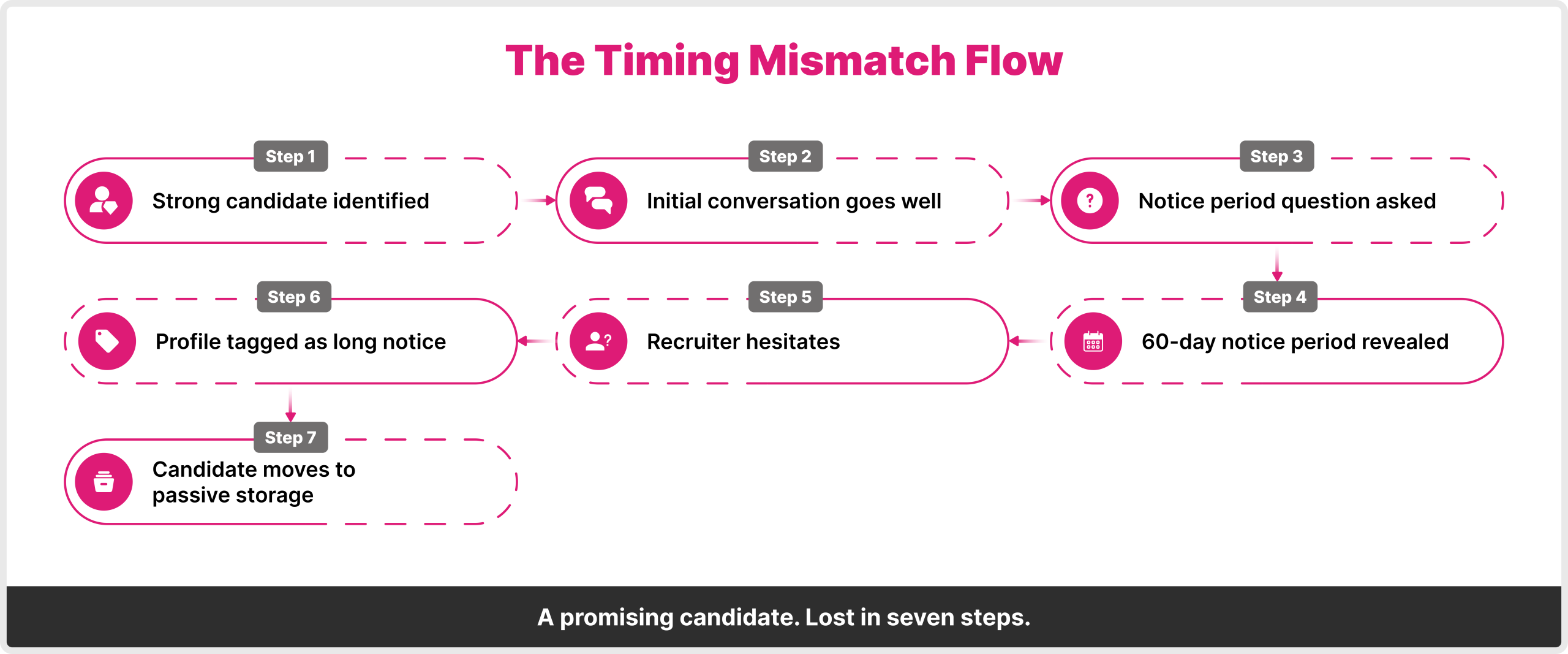
This problem becomes particularly visible when notice periods enter the equation. A recruiter discovers a highly qualified professional. The candidate has the required technical expertise, relevant industry experience, cultural fit, and compensation alignment. The initial conversation is promising. Both sides express interest in moving forward.
Then comes one question that instantly changes the direction of the discussion: "What is your notice period?"
The candidate replies — "Sixty days" or perhaps "Ninety days."
Within seconds, the entire dynamic shifts. The hiring manager needs someone immediately. The role has already remained vacant for weeks. Business teams are under pressure. Project timelines are slipping. Consequently, even though the candidate may be one of the strongest profiles identified during the search, the long notice period creates hesitation. The recruiter thanks the candidate, updates the notes, and moves on to sourcing other profiles.
From a hiring perspective, the decision appears rational. From a systems perspective, however, it is profoundly inefficient.
Why the Search Starts Over — and Over Again
Six or eight weeks later, the same vacancy often remains open. Candidates who were shortlisted may have accepted competing offers. Some may have failed background verification. Others may have withdrawn midway or declined the final offer. Suddenly, a candidate who can join in two weeks becomes highly attractive.
Ironically, the ideal candidate was already identified months earlier. Yet by this stage, that individual has effectively disappeared from recruiter visibility. No system automatically resurfaces them. No workflow reactivates the profile. No intelligence layer identifies that the candidate who once had a sixty-day notice period now has only fifteen days remaining.
The recruiter begins sourcing again. The search starts from scratch. Consequently, the organisation spends money rediscovering talent it already found.
This phenomenon is the Notice Period Timing Mismatch Problem — and it represents one of the most overlooked inefficiencies in modern recruitment.
The Hiring Market Has Become Obsessed with Speed
To understand why this problem has intensified, it is important to understand how dramatically hiring expectations have changed over the last decade. Businesses today operate in environments defined by rapid market shifts, aggressive growth targets, digital transformation initiatives, and constant pressure to deliver outcomes faster than competitors. As a result, hiring speed has evolved from a recruitment metric into a business imperative.
Organisations increasingly view vacancies as operational risks. Every unfilled role can impact productivity, customer service, project delivery, revenue generation, or team performance. Consequently, hiring managers place greater emphasis on immediate availability than ever before.
Recent research illustrates the scale of this shift. According to a Foundit study highlighted by the Times of India, nearly 58% of employers now prioritise immediate joiners — reflecting a growing preference for candidates who can begin work with minimal delay. The report also notes that traditional notice periods of sixty to ninety days are increasingly viewed as obstacles in industries where speed has become a competitive advantage.
This trend is not isolated. Additional hiring data suggests that nearly one-third of job postings now explicitly mention urgency-related hiring requirements such as "Immediate Joiner" or "Short Notice Period." Employer demand for quick joiners has risen significantly faster than the availability of such candidates — creating a widening gap between organisational expectations and labour market realities.
From a business standpoint, the preference is understandable. Faster onboarding means faster productivity. However, the unintended consequence is that organisations increasingly filter candidates based on timing rather than capability.
A candidate with exceptional skills but a sixty-day notice period becomes less attractive than a moderately qualified candidate who can join immediately. The problem is not that organisations prefer speed. The problem, instead, is that recruitment systems treat temporary unavailability as permanent irrelevance.
Recruitment Systems Are Built Around Now — Not Later
One of the most fundamental limitations of traditional recruitment technology is that it primarily manages current-state information. Applicant Tracking Systems were designed to organise applications, document interview feedback, track hiring stages, and manage compliance processes. They excel at recording what is happening now. What they do not do particularly well, however, is manage future opportunity.
When a candidate enters a recruitment workflow, the system captures their present status. These data points store effectively. However, the moment a candidate becomes unsuitable for the current hiring timeline, their profile often transitions into passive storage.
A recruiter may tag the candidate as "Long Notice Period." Another may mark them as "Future Opportunity." Someone else may move them into a talent pool folder. In theory, this preserves future value. In practice, however, it rarely does.
The system stores information without activating it. The candidate remains inside the database, but nothing systematically brings them back into consideration when circumstances change. A ninety-day notice period gradually becomes sixty days. Sixty becomes thirty. Thirty becomes fifteen. Yet the candidate's visibility often remains unchanged.
The recruitment database remembers the profile. The workflow, however, forgets the person. This distinction explains why so many organisations repeatedly source candidates they have already identified before.
The Hidden Financial Cost of Starting Over
The Notice Period Timing Mismatch creates costs that extend far beyond recruiter frustration. Every time an organisation restarts a search rather than reactivating previously identified candidates, new recruitment expenses generate.
Job boards consume credits. Database licences get utilised again. Recruiters invest additional sourcing hours. Furthermore, screening conversations repeat, interview coordination increases, and hiring managers spend more time reviewing profiles.
According to SHRM benchmarking data, the average cost-per-hire exceeds $4,000 in many organisations. Broader analyses of recruitment spending show that vacancy costs, productivity losses, and hiring-related operational expenses often extend far beyond direct recruiting budgets.
The impact becomes even more significant when considering time-to-fill metrics. Recruitment experts consistently identify prolonged hiring cycles as major contributors to increased hiring costs and lost business opportunities. Recent benchmark reports place average time-to-fill periods around forty to forty-four days across many industries — meaning vacancies often remain open for extended periods even after substantial sourcing efforts begin.
What makes the Notice Period Timing Mismatch particularly wasteful is that many of these costs are avoidable. The candidate who becomes relevant in April may have already been sourced in February. The organisation already invested resources identifying them. The challenge is not talent discovery. The challenge, instead, is talent resurfacing.
The Notice Period Paradox Is Largely Self-Created
Perhaps the most ironic aspect of this problem is that organisations frequently create the very conditions they later struggle against.
Many companies enforce notice periods of sixty to ninety days to protect operational continuity, facilitate knowledge transfer, and ensure sufficient transition planning. These policies reduce disruption when employees leave. Yet the same organisations often seek candidates who can join immediately when hiring externally.
This creates what many recruiters informally describe as the "Notice Period Paradox." Companies expect their own employees to remain available for extended transition periods. At the same time, however, they prefer candidates from other organisations who can join almost instantly.
The contradiction creates structural friction throughout the labour market. Professionals serving legitimate notice periods find themselves excluded from opportunities despite being highly qualified. Recruiters face increasing difficulty locating immediate joiners. Consequently, hiring managers grow frustrated with hiring delays while organisations continue expanding sourcing efforts and simultaneously narrowing candidate accessibility.
The result is a hiring ecosystem where timing often outweighs capability — not because organisations consciously prioritise weaker talent, but because recruitment systems lack mechanisms to manage availability over time.
Why Human Memory Cannot Solve This Problem
Some organisations assume recruiters can address this issue manually. After all, a recruiter can simply create a reminder, update a spreadsheet, or revisit the candidate later. The reality, however, is far more complicated.
Modern recruiters operate in environments characterised by extreme information volume. Industry research consistently highlights increasing recruiter workloads and growing pressure to maintain hiring speed despite leaner team structures. High-volume recruiting teams often manage dozens of open requisitions simultaneously while handling sourcing, screening, interview scheduling, stakeholder communication, offer management, and reporting requirements.
Within such environments, expecting recruiters to manually track hundreds or thousands of notice-period timelines becomes unrealistic. The issue is not recruiter discipline. The issue, instead, is scale.
Human memory does not function as a dynamic candidate availability engine. Even highly organised recruiters cannot consistently monitor every future opportunity across every open role while simultaneously managing present hiring demands. The burden simply exceeds human capacity. Consequently, this is why the problem persists across organisations of every size.
It is not a people problem. It is, therefore, a systems problem.
The Future of Recruitment: Talent Timing Intelligence
Recruitment technology has spent years improving candidate sourcing, applicant tracking, assessment workflows, and hiring analytics. The next major frontier, however, is likely to be talent timing intelligence.
Organisations no longer need systems that simply identify qualified people. They need systems that understand when those people become relevant.
A candidate serving a ninety-day notice period should not disappear from visibility. Instead, they should remain part of an active talent ecosystem. Their availability should continuously evolve inside the system. Furthermore, their relevance should increase as their joining date approaches. Their profile should re-enter recruiter workflows automatically when timing aligns with business requirements.
This transforms recruitment from a search-driven function into a readiness-driven function. Instead of repeatedly hunting for talent, organisations can continuously activate talent they already know. Instead of treating notice periods as barriers, they can treat them as timelines. Consequently, instead of discarding candidates because they are unavailable today, organisations can prepare for when those candidates become available tomorrow.
How Qallify Solves the Notice Period Timing Mismatch
Qallify was built around a simple observation: great candidates often get lost not because they are unsuitable, but because recruitment systems fail to reconnect with them when timing changes.
Rather than allowing candidates to disappear into databases once they get categorised as "long notice period," Qallify keeps talent journeys active. The platform continuously tracks candidate progression, engagement status, and availability timelines — ensuring that strong candidates remain visible throughout their notice-period lifecycle.
A candidate who can join in ninety days does not get forgotten. A candidate who becomes available in six weeks does not disappear into archived recruiter notes. Furthermore, a candidate whose notice period is approaching completion automatically regains relevance when hiring requirements align.
This transforms recruitment from a reactive sourcing process into a dynamic talent-readiness process. Instead of spending resources repeatedly searching for new candidates, recruiters can maximise the value of talent they have already identified. Organisations gain better returns on sourcing investments, reduce repetitive hiring effort, shorten vacancy cycles, and improve the likelihood of connecting with high-quality candidates at precisely the right moment.
Because in modern recruitment, one of the biggest inefficiencies is not failing to find great talent. It is, ultimately, forgetting exactly when that talent becomes available.
To know about The CV Graveyard Problem Costing Agencies Millions, click here.