

The CV Graveyard Problem Costing Agencies Millions
The recruitment industry has spent decades solving one problem after another. Applicant Tracking Systems streamlined candidate management. Job boards made talent discovery easier. AI-powered sourcing tools accelerated profile matching. Communication platforms improved recruiter productivity.
Yet despite all these advances, one of the biggest leaks in the recruitment funnel remains largely invisible. It is a problem so common that most recruiters have accepted it as part of the job.
How Good Candidates Simply Disappear
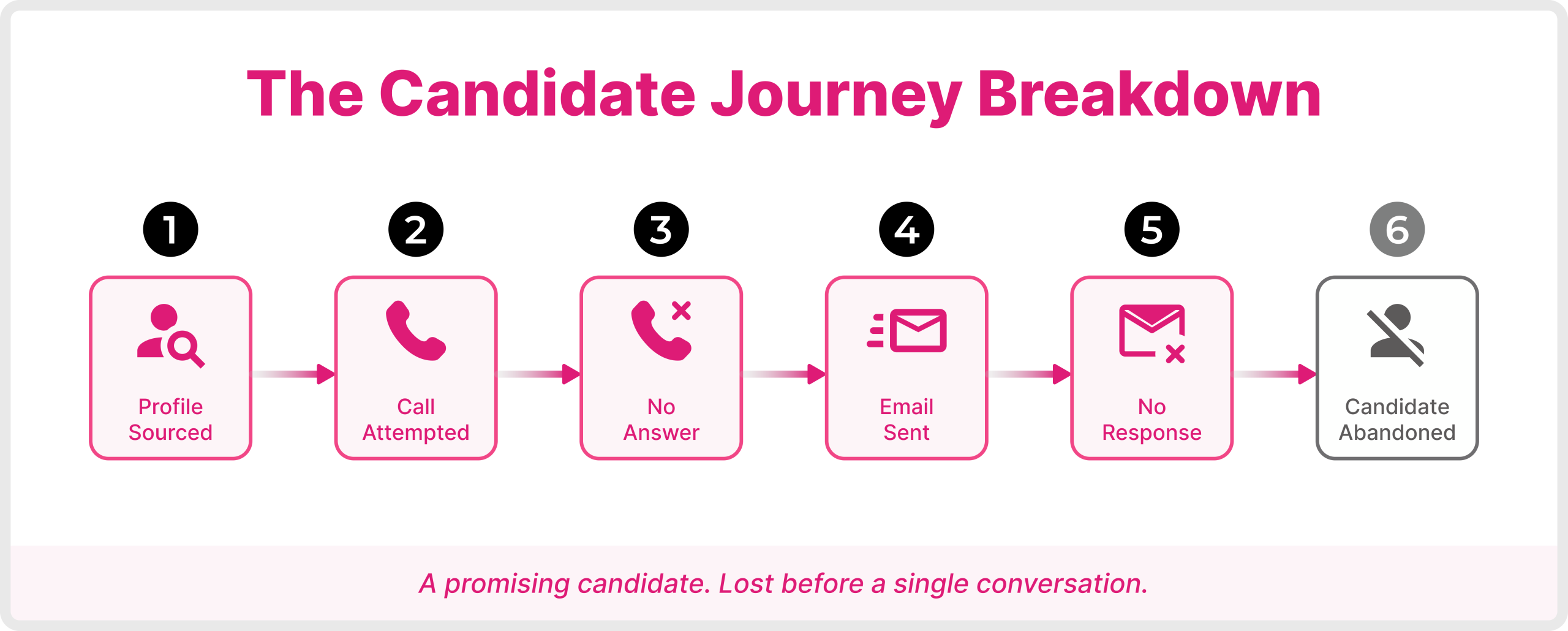
A recruiter identifies a strong candidate on a job board. The profile looks relevant, the experience aligns with the role, and the candidate seems worth pursuing. The recruiter makes a call. There is no answer. A second call follows. Still no response. An email goes out. Perhaps a WhatsApp message follows. Days pass without engagement. The recruiter, under pressure to fill positions quickly, moves on to other profiles.
What happens next is surprisingly important.
The candidate is neither rejected nor disqualified. They have not explicitly declined the opportunity. They may not even know that someone tried to contact them. Yet from an operational perspective, they effectively disappear. The profile remains in the recruiter's database, but active engagement stops. Consequently, the candidate is lost in a growing repository of sourced talent that nobody is systematically pursuing anymore.
This phenomenon is the CV Graveyard Problem — the accumulation of potentially valuable candidates who were never successfully connected with, never properly qualified, and never moved toward a definitive outcome.
Recruitment agencies continue paying substantial amounts for access to these profiles through sourcing platforms. However, because there is no structured mechanism to keep engagement alive, many of these candidates become dormant assets. They are technically available — but functionally forgotten.
The irony is stark. Organisations spend enormous sums acquiring access to talent, only to lose that talent before a meaningful conversation even takes place.
Recruitment's Most Expensive Blind Spot
Most recruitment leaders are familiar with metrics such as cost-per-hire, time-to-fill, offer acceptance rates, and source effectiveness. These measurements help organisations understand the efficiency of their hiring processes. However, there is a less visible metric that rarely appears on executive dashboards — the number of qualified candidates who were sourced but never successfully contacted.
This blind spot carries significant financial implications.
Recruitment agencies purchase database subscriptions, recruiter licences, job board access, and sourcing credits with the expectation that these investments translate into placements. Every profile accessed from a paid database carries an acquisition cost. Yet once a recruiter makes a few unsuccessful contact attempts and moves on, that investment begins to lose value.
In many agencies — particularly those involved in high-volume hiring — recruiters operate under intense pressure. They may process hundreds of profiles every week while simultaneously managing interviews, client communication, reporting requirements, and offer negotiations. Under such circumstances, therefore, it is understandable that recruiters prioritise speed. If one candidate does not respond quickly, attention shifts to the next available profile.
The result is a silent but costly form of wastage. Organisations continue purchasing access to more candidates while failing to fully utilise the candidates they have already paid to find.
Research into recruitment inefficiencies consistently highlights fragmented candidate journeys and disconnected hiring workflows as major contributors to poor hiring outcomes. According to industry analyses, communication breakdowns throughout the hiring process frequently create situations where promising candidates fall out of the funnel before recruiters can properly assess them. This not only impacts hiring speed — it also reduces the return on recruitment investments.
The CV graveyard is, consequently, the manifestation of this communication gap at scale.
Why Unanswered Calls Do Not Equal Rejection
One of the fundamental assumptions embedded in traditional recruitment workflows is that a lack of response signals a lack of interest. While this assumption helps recruiters prioritise their time, it is often inaccurate.
Modern professionals live in an environment saturated with communication. They receive calls, emails, messages, notifications, and meeting invitations throughout the day. Unknown numbers get frequently ignored. Work commitments prevent many candidates from answering calls during business hours. Furthermore, some professionals work night shifts, travel frequently, or operate in environments where personal communication is restricted.
In such situations, an unanswered call reveals very little about a candidate's actual interest level.
A software engineer may miss a recruiter's call because they are attending a sprint review. A customer support executive may be handling peak-hour operations. A sales professional may be meeting clients throughout the day. Meanwhile, a healthcare worker may be on duty. A senior manager may simply ignore unknown numbers as a matter of habit.
None of these scenarios indicate disinterest.
Yet traditional recruitment workflows often treat them as barriers significant enough to move on from. This creates a disconnect between candidate availability and candidate intent. A person who appears unreachable on Monday may be highly responsive on Thursday. Someone who ignores a phone call may immediately respond to a message later that evening.
Human circumstances change constantly. Recruitment systems, however, frequently make decisions based on a single snapshot in time.
What the BPO Industry Can Teach Recruitment
Interestingly, other industries solved this challenge years ago.
The business process outsourcing (BPO) sector faced a remarkably similar problem in the early days of outbound calling operations. Agents manually dialled prospects, and unanswered calls resulted in significant productivity losses. Organisations quickly realised that a prospect who did not answer was not necessarily a lost opportunity. They simply had not been reached yet.
This understanding led to the rise of predictive dialers and automated calling systems.
Rather than abandoning prospects after one failed attempt, these systems continuously recycled leads until meaningful contact was established. The objective was not to maximise call volume. Instead, it was to maximise actual conversations. The system recognised that people were often unavailable for reasons unrelated to interest.
Recruitment has not fully embraced this mindset.
Most recruiting operations still function as though every contact attempt exists in isolation. A recruiter calls, receives no answer, and moves forward. The workflow, consequently, optimises for activity rather than connection.
Yet hiring outcomes depend on conversations — not attempts.
The candidate who eventually becomes a successful placement may be the one who answered on the fifth outreach effort rather than the first. Unfortunately, many recruitment systems are not designed to support that level of persistence.
The Growing Cost of Candidate Ghosting
The conversation around candidate ghosting has become increasingly prominent in recent years. Recruiters frequently report frustration when candidates stop responding during the hiring process. Industry research indicates that candidate ghosting has become one of the most commonly cited recruitment challenges globally.
However, focusing exclusively on candidate behaviour risks overlooking an equally important issue. Sometimes candidates are not ghosting recruiters. Instead, recruiters are ghosting candidates.
Not intentionally, of course. Rather, organisational workflows force recruiters to prioritise new sourcing over continued engagement. Once a candidate falls outside the immediate focus of a recruiter's workload, follow-up efforts become inconsistent. Profiles that once appeared highly promising slowly drift into inactivity.
This creates a cycle where agencies continuously search for fresh candidates despite already possessing extensive databases of potentially viable talent. Consequently, recruitment databases become larger while their effective utility becomes smaller.
The database grows. The opportunity shrinks. And the CV graveyard expands.
Why Traditional ATS Platforms Are Not Built to Solve This
Applicant Tracking Systems have transformed recruitment administration. They excel at organising applications, tracking interview stages, documenting feedback, managing offers, and generating reports. However, they were not originally designed to solve the problem of candidate recovery.
An ATS records what happened. It does not necessarily ensure that engagement continues until a meaningful outcome is reached.
As a result, candidates who fail to respond early in the process often get tagged, archived, or deprioritised. The system captures the status but rarely initiates a strategy to re-engage the individual over time.
This distinction is critical. A candidate who has explicitly declined an opportunity should indeed get categorised appropriately. However, a candidate who simply has not responded yet represents an entirely different situation. The first candidate has provided an outcome. The second has not.
Yet many systems treat both scenarios similarly. Consequently, this creates a gap between sourcing and conversion — a gap where substantial value gets lost.
The Future of Recruitment Is Persistent Engagement
As recruitment becomes increasingly competitive, organisations are beginning to recognise that sourcing more candidates is not always the answer. In many cases, the better strategy is maximising engagement with the candidates already available.
The future of recruitment will likely mirror the evolution of modern sales and customer success functions. Sales teams do not abandon prospects after a missed call. Marketing teams continue nurturing leads through multiple touchpoints. Furthermore, customer success teams maintain ongoing engagement until a clear outcome is achieved.
Recruitment can benefit from adopting the same philosophy.
The goal should not be endless outreach. Nor should it involve overwhelming candidates with repetitive communication. Instead, the objective should be structured persistence that continues until the candidate reaches a clearly defined status:
● Interested
● Not interested
● Call back later
● Open after notice period
● Exploring opportunities after appraisal season
● Considering relocation
● Unavailable currently but willing to reconnect in the future
● Not interested
● Call back later
● Open after notice period
● Exploring opportunities after appraisal season
● Considering relocation
● Unavailable currently but willing to reconnect in the future
Only when a candidate reaches one of these outcomes should engagement truly stop. Anything else, therefore, creates unnecessary loss.
How Qallify Solves the CV Graveyard Problem
Qallify was built around a simple observation: recruitment teams spend enormous amounts of money finding candidates, but far too many of those candidates disappear before meaningful engagement occurs.
Rather than treating outreach as a one-time event, Qallify approaches candidate engagement as a continuous journey. The platform ensures that valuable profiles do not fall into inactivity simply because they missed a call, ignored an email, or were unavailable during a particular moment in time.
Much like the predictive dialers that transformed outbound BPO operations, Qallify creates a structured mechanism for maintaining candidate engagement until a definitive outcome is achieved. Instead of allowing recruiters to lose visibility into promising talent, the system continuously works toward establishing whether a candidate is interested, unavailable, needs follow-up, or should be excluded from future outreach.
This approach, consequently, fundamentally changes the economics of recruitment. Agencies maximise the value of every sourced profile. Recruiters spend less time repeatedly searching for new candidates and more time speaking with people who are genuinely qualified. Furthermore, paid database access generates greater returns because profiles remain active assets rather than forgotten records.
The recruitment industry does not necessarily need more CVs. It needs, instead, a better way to ensure that the good ones never get buried.
That is the problem Qallify was designed to solve.
Too many tools. Too little clarity. Here's how to fix that.