

Too Many AI Hiring Tools? Here's How to Cut Through
The Paradox of Choice in AI Hiring
The talent acquisition (TA) ecosystem is in the middle of an unprecedented surge of AI-led innovation. Over the past few years, hundreds of platforms have entered the market. Each promises to solve hiring inefficiencies through automation, intelligence, and predictive insights.
From sourcing tools powered by generative AI to interview bots, assessment engines, and analytics dashboards, the category has exploded into a dense and often indistinguishable landscape. What began as a welcome evolution is now, however, becoming a source of friction.
TA leaders — who once struggled with a lack of tools — are now grappling with too many. Every vendor claims superior accuracy, better candidate experience, reduced bias, and faster hiring cycles. The result, consequently, is decision paralysis.
A 2024 industry analysis by HR tech research firms noted that over 65% of TA leaders feel overwhelmed by the number of AI vendors in the hiring space. Furthermore, nearly 48% admitted they are unsure how to evaluate the real impact of these tools beyond surface-level metrics like time-to-hire.
The irony is stark. In trying to simplify hiring, the market has made it more complex.
The Rise of Feature Fatigue in Hiring Tech
One of the core challenges driving confusion is what we can call feature fatigue. Most AI hiring platforms today try to be everything at once — sourcing engine, CRM, assessment tool, interview platform, analytics suite, and more.
On paper, this sounds efficient. In reality, however, it often leads to shallow capabilities across multiple functions, lack of depth in critical decision-making areas, overlapping features with existing HR tech stacks, poor integration with legacy systems, and inflated pricing for bundled features that go unused.
TA leaders are increasingly realising that "all-in-one" platforms rarely excel in any one thing. Instead, they create bloated ecosystems where the signal-to-noise ratio is low.
This is especially problematic in hiring, where precision matters. A sourcing tool needs to deeply understand talent pools. An assessment engine must accurately measure competencies. Furthermore, a prediction engine should reliably forecast outcomes like performance and attrition. When one platform attempts all of this, trade-offs are, consequently, inevitable.
The Illusion of Intelligence: When AI Sounds Smarter Than It Is
Another layer of complexity comes from how vendors market AI. Terms like "predictive hiring," "deep learning assessments," and "behavioural intelligence" get used loosely — without clarity on what data models underpin them.
Many platforms rely on relatively small datasets, limited contextual training, or proxy indicators that may not translate into real-world hiring outcomes. For example:
● Resume parsing algorithms that infer skills without validation
● Keyword-based scoring systems disguised as AI
● Video interview tools analysing facial expressions without proven correlation to job performance
● Keyword-based scoring systems disguised as AI
● Video interview tools analysing facial expressions without proven correlation to job performance
This creates a dangerous illusion. Tools appear intelligent but may not materially improve hiring quality. Consequently, TA leaders are left asking critical questions — what data trains this AI, how does it adapt across geographies and roles, and can it predict outcomes beyond surface-level metrics? In many cases, clear answers are hard to find.
The Real Problem: Hiring Is Not One Problem — It's Many
At its core, the confusion stems from a flawed assumption — that hiring can be solved by a single platform. Hiring is not a monolithic process. Instead, it is a sequence of distinct, high-stakes decisions:
1. Who should we reach out to? (Sourcing)
2. Who is worth engaging? (Screening and scoring)
3. Who will actually join? (Joining probability)
4. Who will perform and stay? (Post-hire outcomes)
2. Who is worth engaging? (Screening and scoring)
3. Who will actually join? (Joining probability)
4. Who will perform and stay? (Post-hire outcomes)
Each of these requires different data, different models, and different expertise. Trying to solve all of them with one tool is like expecting a single medical device to diagnose, treat, and monitor every condition. It is, therefore, inefficient and often inaccurate.
From Platform Thinking to Precision Stacking
Forward-thinking TA leaders are beginning to move away from platform-centric thinking. Instead, they are moving toward what we can call precision stacking.
Rather than buying one large system, they curate a stack of best-in-class tools — each deeply specialised in its domain — and integrate them into a cohesive workflow. This approach is gaining traction for several reasons:
● Depth over breadth: Each tool excels in its specific function
● Flexibility: Components can swap as needs evolve
● Better ROI: Pay only for capabilities that deliver value
● Higher accuracy: Specialised models outperform generalised ones
● Flexibility: Components can swap as needs evolve
● Better ROI: Pay only for capabilities that deliver value
● Higher accuracy: Specialised models outperform generalised ones
Think of it as assembling a high-performance team rather than hiring a generalist for every role.
What a Modern AI Hiring Stack Looks Like
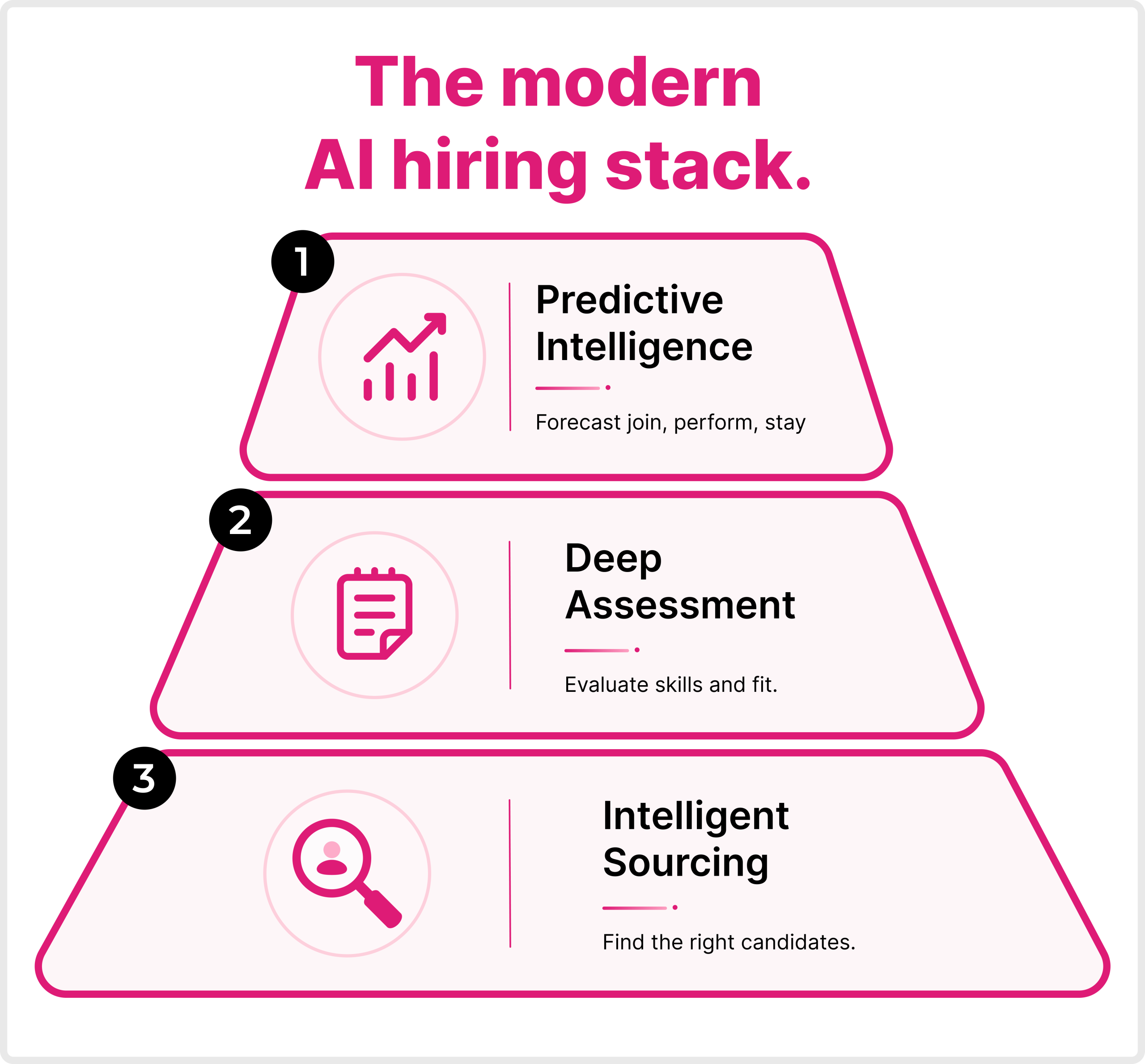
A well-structured AI hiring stack typically includes three core layers.
Intelligent sourcing engines focus purely on identifying and engaging the right candidates. They leverage large talent datasets, behavioural signals, and AI-driven outreach optimisation. Their goal is not just volume — but relevance.
Deep assessment and scoring systems evaluate candidates on skills, competencies, and role fit. The best tools here go beyond resumes and incorporate simulations, structured interviews, and contextual scoring.
Predictive intelligence for outcomes is where real differentiation begins. Instead of evaluating candidates only in the present, this layer answers forward-looking questions — will this candidate join, perform, and stay? This is, furthermore, where most platforms fall short — because prediction requires longitudinal data, not just snapshots.
Predictive Hiring Intelligence: The Missing Layer
While sourcing and assessment have seen significant innovation, predictive intelligence remains underdeveloped across much of the market. Most tools can tell you who looks good on paper. Very few, however, can tell you who is likely to accept your offer, who aligns with your work environment, who will sustain performance over time, or who might drop off before joining.
This gap is where advanced platforms like Qallify are building strong differentiation.
The Power of Behavioural Signals and Longitudinal Data
What sets predictive systems apart is not just AI capability. It is, instead, the quality and scale of data they train on.
Qallify, for instance, leverages behavioural signals derived from over 14 million interview interactions. This creates a unique data advantage that is difficult to replicate. Rather than relying solely on static inputs like resumes or test scores, the system captures response patterns during interviews, decision-making cues, consistency of answers, engagement levels, and behavioural tendencies under different scenarios.
These signals then map to real-world outcomes — consequently enabling highly accurate predictions.
JPS: Moving from Assessment to Outcome Prediction
A key innovation in this space is the concept of JPS — Join, Perform, Stay predictions.
Traditional hiring tools stop at evaluating whether a candidate is qualified. JPS, in contrast, goes further by forecasting:
● Join: The likelihood of offer acceptance
● Perform: Expected on-the-job performance
● Stay: Probability of retention over time
● Perform: Expected on-the-job performance
● Stay: Probability of retention over time
This shifts hiring from a reactive process to a proactive, outcome-driven strategy. For TA leaders, therefore, this is a game-changer. Instead of asking "Is this candidate good?" the question becomes "Is this the right investment for the organisation?"
Why TA Leaders Must Rethink Evaluation Criteria
Given the crowded market, the way TA leaders evaluate AI hiring tools needs to evolve. Instead of focusing on features, the emphasis should shift to:
● Depth of data: How large and relevant is the dataset?
● Outcome linkage: Does the tool connect inputs to real hiring outcomes?
● Specialisation: Is the platform best-in-class in its domain?
● Interoperability: Can it integrate seamlessly into a broader stack?
● Explainability: Are the predictions transparent and actionable?
● Outcome linkage: Does the tool connect inputs to real hiring outcomes?
● Specialisation: Is the platform best-in-class in its domain?
● Interoperability: Can it integrate seamlessly into a broader stack?
● Explainability: Are the predictions transparent and actionable?
This shift in evaluation mindset is, consequently, critical to cutting through vendor noise.
The Cost of Getting It Wrong
In a crowded market, the biggest risk is not choosing the wrong tool. It is, instead, choosing too many mediocre ones.
The hidden costs include fragmented candidate experience, conflicting data signals across platforms, increased operational complexity, lower recruiter productivity, and poor hiring outcomes despite heavy investment.
More importantly, as AI becomes central to hiring decisions, the cost of a mis-hire becomes more measurable — and more expensive. Organisations that fail to optimise their hiring stack risk falling behind not just in efficiency, but in talent quality.
Building a Cohesive, High-Impact Hiring Ecosystem
The way forward is not simplification. It is, instead, intentional composition.
TA leaders need to think like system architects. They must identify the most critical decision points in hiring, choose best-in-class tools for each stage, ensure seamless data flow between systems, and layer predictive intelligence on top.
In this model, platforms like Qallify don't replace existing tools. Rather, they enhance them by adding a powerful predictive layer. This is what transforms a hiring process into a hiring engine.
From Tool Adoption to Strategic Advantage
The ultimate goal of AI in hiring is not automation. It is, ultimately, advantage.
In a world where every company has access to similar tools, differentiation comes from how intelligently those tools combine and leverage. Organisations that succeed will be those that move beyond feature comparisons, prioritise outcome-driven intelligence, invest in high-quality data ecosystems, and embrace modular, flexible architectures.
The crowded AI hiring market is not a problem to solve. It is, therefore, an opportunity to navigate.
Clarity in the Chaos
The explosion of AI hiring platforms has created a paradox — more innovation, but less clarity.
For TA leaders, the answer does not lie in finding the "perfect platform." It lies, instead, in recognising that no single tool can solve the complexity of hiring.
The future belongs to those who can stitch together precision — combining best-in-class sourcing, deep assessment, and predictive intelligence into a unified system. In that system, behavioural data, outcome prediction, and long-term signals — like those enabled by Qallify's JPS framework — become the true differentiators.
Because in the end, hiring is not about filling roles. It is about making the right bets on people. And in a world overflowing with options, clarity is, ultimately, the most valuable intelligence of all.You said: Give info to generate an image appropriate for this blog and let me know where should we put it?
To know about Join, Perform, Stay: The New Metrics for TA Success, click here.