

Join, Perform, Stay: The New Metrics for TA Success
For decades, Talent Acquisition (TA) measured success on a narrow, almost mechanical set of metrics: time-to-fill, cost-per-hire, and offer acceptance rate. Speed was king. Volume was validation. And once a candidate signed the offer letter, the TA function considered its job done.
That model is no longer just outdated. It is, instead, risky.
Today, organisations operate in a labour market defined by volatility, candidate scepticism, and rising attrition costs. According to LinkedIn's Global Talent Trends research, nearly 1 in 4 new hires leave within the first year. Furthermore, Gallup estimates that employee disengagement costs the global economy over $8 trillion annually. These aren't just HR problems. They are, consequently, business performance risks.
In this context, a fundamental shift is underway. Talent Acquisition is no longer just about hiring people. It is about ensuring that people:
● Join the organisation with clarity and conviction
● Perform effectively in their roles
● Stay long enough to create meaningful value
● Perform effectively in their roles
● Stay long enough to create meaningful value
"Join, Perform, Stay" is emerging as the new KRA framework for modern TA teams — one that aligns hiring with long-term organisational outcomes.
Why Traditional TA Metrics Are Failing
The obsession with speed has created unintended consequences. When organisations optimise hiring purely for velocity, they often compromise on fit — leading to poor performance and early exits.
Research by SHRM suggests that the cost of a bad hire can range from 30% to 200% of the employee's annual salary, depending on role complexity. Meanwhile, studies from Harvard Business Review highlight that up to 80% of employee turnover stems from bad hiring decisions or mismatched expectations.
These numbers reveal a deeper truth. TA has been measuring inputs, not outcomes.
● Time-to-fill measures speed, not quality
● Cost-per-hire measures efficiency, not impact
● Offer acceptance measures persuasion, not alignment
● Cost-per-hire measures efficiency, not impact
● Offer acceptance measures persuasion, not alignment
In a world where workforce productivity and retention directly tie to business growth, these metrics fall short. Organisations need TA to influence what happens after the hire — not just before it.
Introducing the "Join, Perform, Stay" Framework
The "Join, Perform, Stay" model reframes Talent Acquisition as a lifecycle function rather than a transactional one. It expands the scope of TA from candidate acquisition to workforce effectiveness.
1. Join: Hiring with Clarity, Not Just Conversion
The first KRA — Join — goes beyond offer acceptance. It focuses on ensuring that candidates enter the organisation with clear expectations, strong alignment, and informed intent.
The Problem with "Joining" Today
Many candidates accept offers based on incomplete or overly polished information. Job descriptions are often generic, interviews are inconsistent, and employer branding sometimes prioritises attraction over authenticity.
The result is a mismatch between expectation and reality. According to Glassdoor, 48% of employees say their job differed from what the hiring process described. This gap is, consequently, one of the biggest drivers of early attrition.
What "Join" as a KRA Means
For TA teams, "Join" should measure not just acceptance rate, but:
● Expectation alignment scores (pre- vs post-joining feedback)
● Candidate experience quality
● Drop-off rates post-offer but pre-joining
● Early engagement indicators (first 30 days)
● Candidate experience quality
● Drop-off rates post-offer but pre-joining
● Early engagement indicators (first 30 days)
How Leading Organisations Are Responding
Progressive TA teams are investing in Realistic Job Previews (RJPs) that show the true nature of the role. Additionally, they are building structured, bias-reduced interviews aligned to actual job competencies. Furthermore, AI-driven candidate engagement tools ensure consistent communication throughout.
By doing so, they are not just increasing joining rates. They are improving, therefore, quality of joining.
2. Perform: Hiring for Outcomes, Not Just Skills
The second KRA — Perform — is where Talent Acquisition begins to intersect directly with business productivity.
Traditionally, performance has been the responsibility of L&D or business leaders. However, this separation is increasingly being questioned.
The Link Between Hiring and Performance
Research from McKinsey & Company indicates that top performers are up to 400% more productive than average performers in complex roles. This means hiring decisions carry an outsized impact on organisational output.
If TA brings talent into the organisation, therefore, it must also be accountable for the quality of that talent's performance.
Redefining TA's Role in Performance
"Perform" as a KRA requires TA teams to align hiring criteria with actual performance drivers. Additionally, they need to use data to identify traits of high-performing employees. Consequently, they must continuously refine hiring models based on performance feedback.
This is where the integration of People Analytics becomes critical.
The Rise of Predictive Hiring
Organisations are increasingly using predictive models to assess not just whether a candidate can do the job — but whether they will succeed in that specific environment.
This includes evaluating behavioural traits, cognitive abilities, cultural alignment, and work style preferences. Studies from Deloitte show that companies leveraging advanced people analytics are 2.5 times more likely to outperform their peers in talent outcomes.
The TA–L&D Feedback Loop
To truly own "Perform," TA must collaborate closely with Learning & Development teams, hiring managers, and business leaders. Performance feedback should flow back into hiring frameworks — creating a closed-loop system that continuously improves talent quality.
3. Stay: Hiring for Retention, Not Just Entry
The third KRA — Stay — addresses one of the most pressing challenges organisations face today: attrition.
The Cost of Not Staying
Employee turnover is not just expensive. It is, furthermore, deeply disruptive.
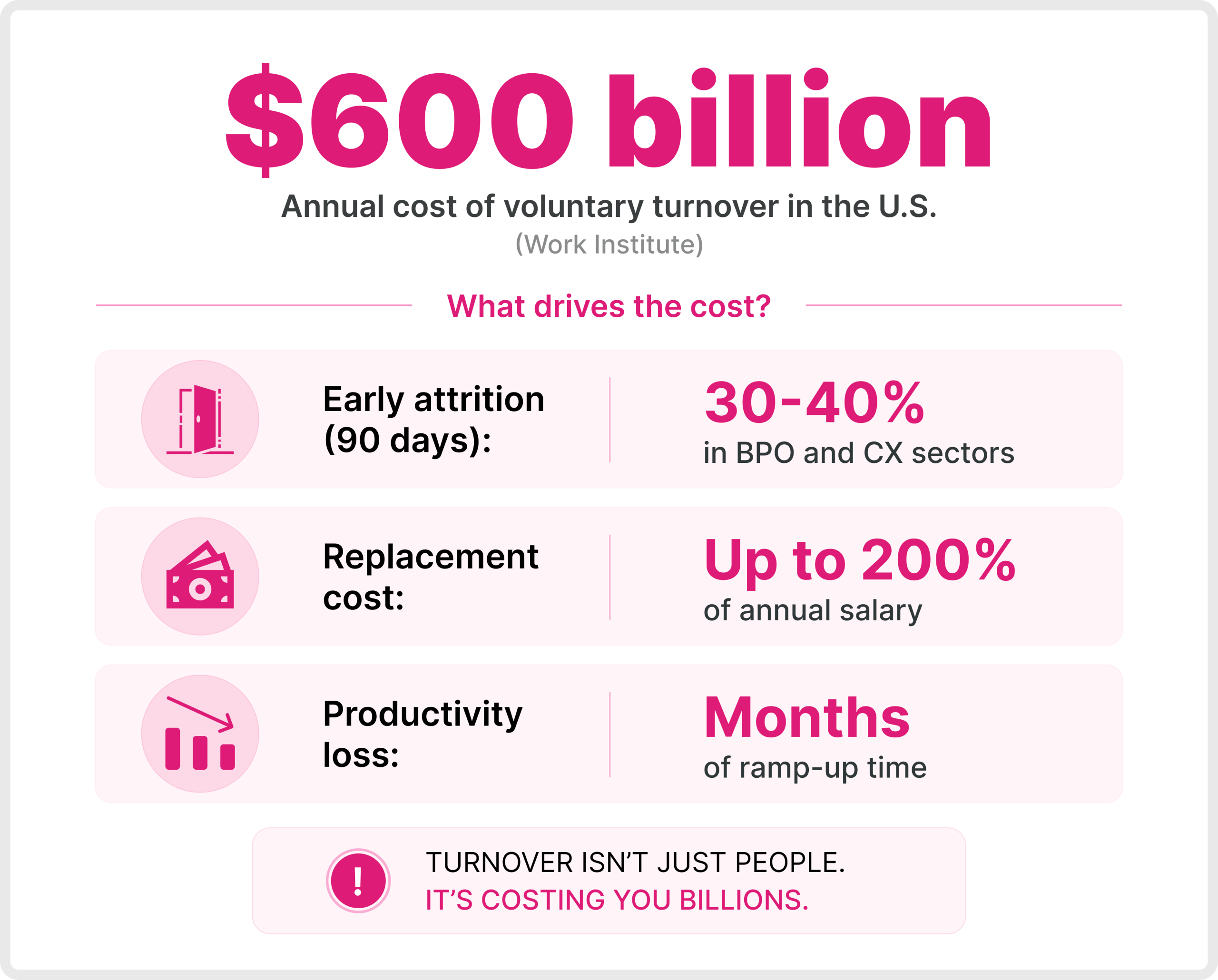
According to Work Institute, voluntary turnover costs U.S. businesses over $600 billion annually — with a significant portion attributable to preventable causes. In high-volume hiring sectors like customer support, retail, and BPO, early attrition within 90 days can exceed 30–40% — creating a constant cycle of hiring and replacement.
Why TA Must Own Retention Signals
While retention draws influence from multiple factors — manager quality, culture, and compensation — hiring plays a foundational role. When organisations mismatch candidates to roles, environments, or expectations, attrition becomes inevitable.
"Stay" as a KRA, therefore, requires TA to focus on:
● Attrition prediction at the hiring stage
● Role-person fit beyond technical skills
● Expectation management during recruitment
● Role-person fit beyond technical skills
● Expectation management during recruitment
Data Signals That Matter
Modern TA platforms are beginning to capture signals that correlate strongly with retention — such as commitment indicators, job-switching patterns, response consistency, and motivation drivers. By integrating these signals into hiring decisions, consequently, organisations can significantly reduce early exits.
The Psychological Contract
At its core, "Stay" is about honouring the psychological contract between employer and employee. When candidates feel that what they were promised aligns with what they experience, they are far more likely to stay and grow.
The Technology Enabler: AI in the Join–Perform–Stay Model
The evolution of TA KRAs is accelerating — driven by technology, and particularly by AI.
AI enables TA teams to move from reactive hiring to predictive talent strategy. Key capabilities include standardised, bias-reduced interviews, behavioural and intent analysis at scale, real-time candidate insights, and predictive attrition modelling.
According to PwC, 72% of business leaders believe AI will be a business advantage in HR and talent management within the next few years. However, the real value of AI lies not in automation. It lies, instead, in decision intelligence — helping TA teams make better, more informed hiring decisions.
From Recruiters to Strategic Talent Architects
As "Join, Perform, Stay" becomes the new KRA framework, the role of Talent Acquisition is undergoing a transformation. TA professionals are no longer just recruiters. They are becoming talent advisors to the business, custodians of workforce quality, and partners in organisational performance.
This shift requires new capabilities — data literacy, business acumen, understanding of human behaviour, and comfort with AI-driven tools. Consequently, organisations that invest in upskilling their TA teams will be better positioned to compete in the talent market.
The Business Case: Why This Matters to CXOs
For business leaders, the shift to "Join, Perform, Stay" is not just an HR evolution. It is, instead, a strategic imperative.
Better joining alignment reduces early attrition. Higher-performing hires increase productivity. Furthermore, stronger retention lowers hiring costs and preserves institutional knowledge.
Together, these outcomes directly influence revenue growth, customer experience, and operational efficiency. In a world where talent is a primary competitive advantage, optimising the full lifecycle of hiring is, therefore, essential.
The Future of TA: Integration Over Isolation
The future of Talent Acquisition will be defined by integration — of hiring with performance data, of candidate experience with employee experience, and of AI with human judgment.
We will see TA dashboards that don't just show hiring metrics — but business impact metrics: performance contribution of new hires, retention curves by hiring source, and predictive risk scores for incoming candidates.
In this future, therefore, success in TA will not measure how quickly roles get filled. It will measure how effectively talent drives outcomes.
Hiring That Actually Works
The era of transactional hiring is coming to an end.
Organisations can no longer afford to treat Talent Acquisition as a siloed function focused only on filling vacancies. The stakes are too high, the costs too visible, and the expectations too evolved.
"Join, Perform, Stay" is more than a framework. It is, ultimately, a mindset shift.
It challenges TA teams to take ownership of the entire talent lifecycle — from the moment a candidate engages with the organisation to the point where they become a high-performing, long-term contributor.
For companies willing to embrace this shift, the rewards are significant: stronger teams, better performance, and sustainable growth. And for Talent Acquisition, it marks the beginning of a new era — one where hiring is no longer just about bringing people in, but about making them count.You said: Give info to generate an image appropriate for this blog and let me know where should we put it?
To know about How AI Platforms Elevate Recruiters to Strategic Advisors, click here.