

Performance in LATAM: A Wider, Ongoing Challenge
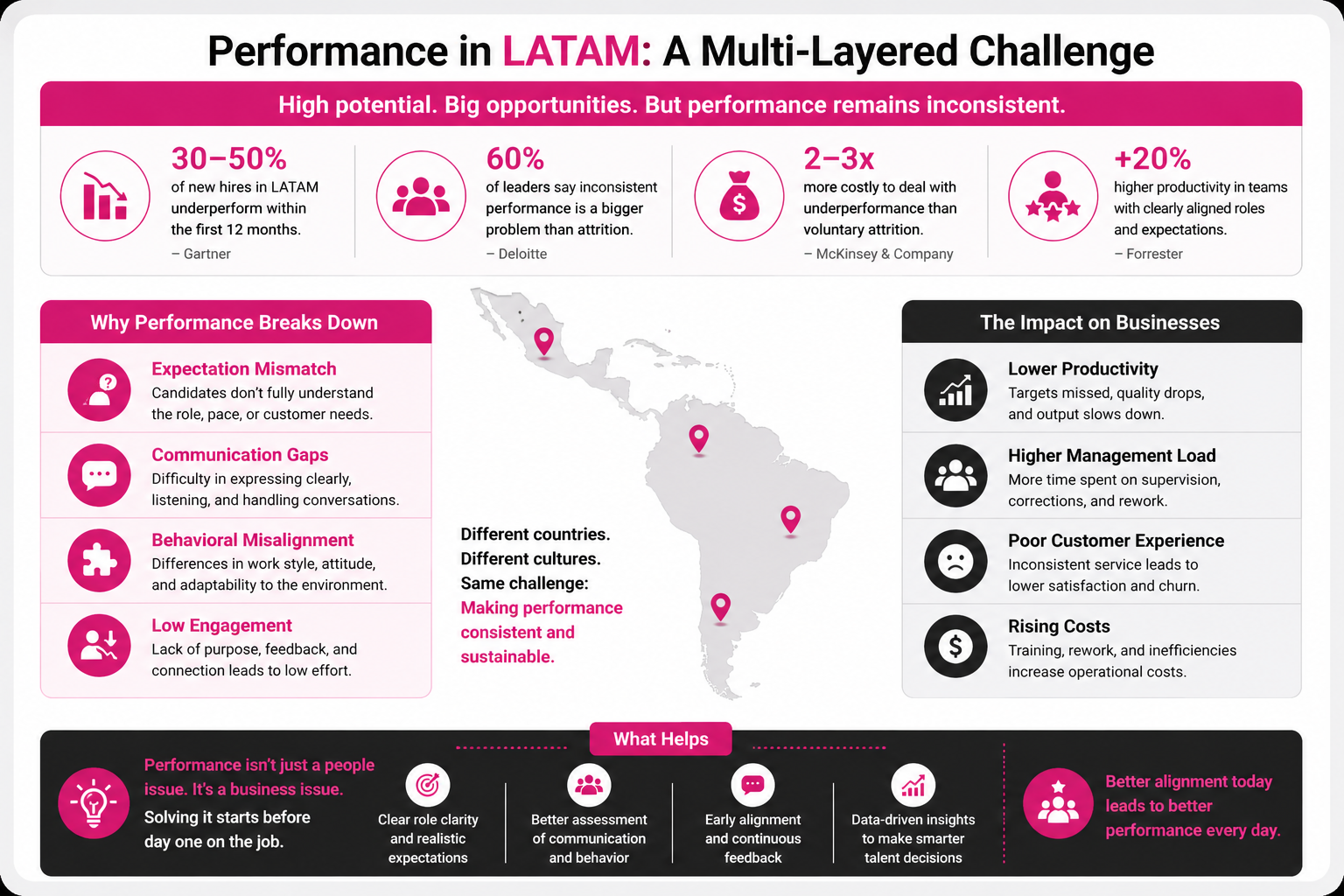
Across the LATAM region, many companies face a common issue — employees get hired, but job performance stays inconsistent. This is especially visible in roles like sales, customer support, and operations. Teams that look similar on paper, however, often deliver very different results in reality.
According to Gartner, performance gaps are often not about lack of talent. Instead, they stem from poor alignment — between what the role demands and what the employee naturally suits. McKinsey & Company also points out that in fast-growing markets, productivity issues often come from this mismatch rather than a shortage of skilled people.
In LATAM, where industries like BPO, nearshoring, and fintech are expanding quickly, even small performance gaps add up fast. Consequently, they impact business outcomes in ways that are hard to reverse.
Performance Is More Than Just Skills
Many organisations still hire mainly based on technical skills or past experience. However, real performance depends on much more than that.
For example, among customer support roles, how clearly someone speaks and handles pressure matters a lot. Inside sales, furthermore, persistence and confidence often matter as much as product knowledge. Inside operations, attention to detail and consistency are critical.
Research by Deloitte shows that soft skills and behavioural traits are becoming stronger indicators of performance than technical skills alone.
The challenge is that these qualities are harder to measure during interviews. As a result, companies may hire people who can do the job — but struggle to do it consistently in real situations.
The Hidden Cost of Underperformance
Performance issues are not always obvious at first. Unlike attrition — where someone leaves — underperformance stays within the system and slowly affects outcomes.
Forrester highlights that unclear expectations and low engagement are key reasons why employees don't perform well. In day-to-day work, this can look like:
● Lower sales conversions
● Longer customer handling times
● More errors in operations
● Longer customer handling times
● More errors in operations
Over time, furthermore, this creates pressure across the system. Managers spend more time correcting work. Strong performers take on extra load. Consequently, customer experience becomes inconsistent.
When this happens at scale, even small inefficiencies lead to large financial and operational impact.
Where the Problem Often Starts
One important point that often gets missed — performance problems usually don't start on the job. Instead, they often begin during hiring.
Most hiring processes focus on what is easy to check — resumes, experience, and availability. However, they don't always assess how a person communicates, how they respond under pressure, whether they truly understand the role, or whether they fit the work environment.
Gartner emphasises the need for more predictive and data-driven hiring — looking at how someone is likely to perform, not just what they've done before.
Another common issue is expectation mismatch. If candidates don't fully understand the role before joining, they may struggle to adjust later. This often shows up as performance issues rather than immediate exits.
Taking a More Complete View of Performance
To improve performance, organisations need to look at the full journey. This means examining not just what happens after hiring — but also what happens before it.
This includes setting clear expectations about the role, assessing candidates beyond just technical skills, giving candidates a realistic view of the job, and identifying early signs of performance gaps.
There is also a growing focus on using behavioural and communication insights to better understand candidates. These signals, furthermore, can give a clearer picture of how someone is likely to perform in real situations.
Tools like Qallify work in this space by helping organisations look at deeper indicators — such as communication patterns, behavioural signals, and engagement levels — during the hiring process itself. This doesn't replace traditional hiring methods. Instead, it adds another layer of understanding.
The goal is simple. Reduce guesswork and improve alignment between the role and the person.
In a region like LATAM, where scale and speed matter, performance cannot be left to chance. It needs, therefore, to be built early — starting from how hiring decisions are made.
To know about rethinking attrition in the Philippines, click here.