

Beyond Hiring: Rethinking Attrition in the Philippines
Attrition in the Philippines — especially across BPO, customer support, and frontline roles — has long been treated as an inevitable cost of doing business. However, the scale and persistence of churn suggest something deeper. What appears as a retention issue is often the outcome of misalignment across hiring, onboarding, and early employee experience.
Insights from Gartner indicate that high-turnover environments consistently underperform due to repeated disruption in team productivity and cohesion. Similarly, Forrester highlights that employee experience gaps — particularly in the early stages of employment — are among the strongest predictors of attrition. In markets like the Philippines, where opportunities are abundant and mobility is high, these gaps become, consequently, even more consequential.
The Layers Beneath High Attrition
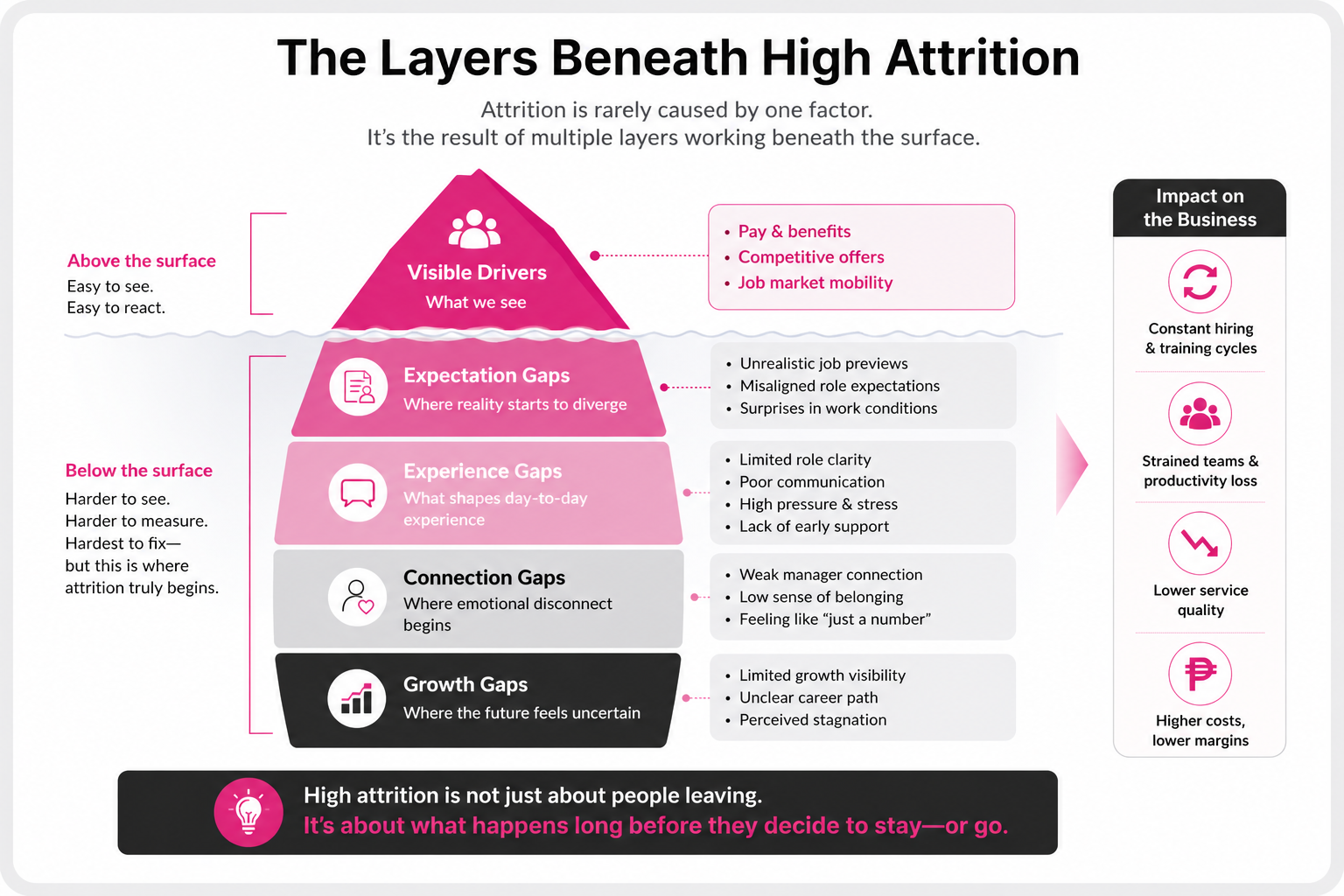
Compensation and competitive offers are visible drivers. However, they rarely tell the full story. Attrition in the Philippines is often rooted in less visible factors — misaligned expectations, limited role clarity, communication challenges, and the emotional demands of customer-facing work.
Many candidates enter roles without a realistic preview of job conditions — especially in high-pressure or voice-intensive environments. When day-to-day realities diverge from expectations, furthermore, disengagement can begin early.
Research by Deloitte points to purpose, growth visibility, and manager connection as central to retention. When organisations do not establish these elements early, the employee-employer relationship remains transactional and fragile. Over time, therefore, even small stressors can trigger exits.
The Compounding Cost of Churn
The cost of attrition extends far beyond replacement hiring. Each exit sets off a chain reaction — vacancies strain existing teams, training cycles restart, and new hires take time to reach productivity. According to SHRM, the cost of replacing an employee can reach up to several months of their salary, depending on the complexity of the role.
In high-volume hiring environments, this becomes a continuous loop rather than a one-time cost. The organisation keeps hiring yet rarely stabilises. Over time, furthermore, this affects not just efficiency — but also service quality and employee morale.
Where Attrition Quietly Begins
One of the more understated aspects of attrition is that it often begins well before an employee decides to leave. Early signals — uncertainty during the hiring process, weak engagement before joining, or a lack of clarity around expectations — can set the stage for eventual disengagement.
Gartner has increasingly emphasised the role of predictive insights in talent decisions. Their research suggests that hiring processes need to move beyond evaluating capability alone. Factors like intent, behavioural alignment, and communication readiness are harder to measure. However, they are critical in determining whether someone stays.
A More Continuous View of Hiring and Retention
Addressing attrition — particularly in markets like the Philippines — may require a shift in how organisations view the hiring lifecycle. Instead of treating hiring and retention as separate stages, there is growing recognition that they are, in fact, deeply connected.
Approaches that incorporate behavioural insights, continuous engagement, and better visibility into candidate intent can help reduce some of the uncertainty that leads to early exits. Consequently, organisations that invest in these approaches are better positioned to predict and prevent attrition before it happens.
Solutions like Qallify operate within this space — focusing on understanding candidate behaviour, communication patterns, and engagement levels across the hiring journey. This includes, furthermore, the often-overlooked notice period.
Closing the Gap Between Hiring and Staying
No single approach can eliminate attrition entirely. However, strengthening the connection between how organisations hire and how employees experience their early days can make attrition more predictable — and, in many cases, more preventable.
In a market like the Philippines, where mobility is high and expectations evolve quickly, this connection is not optional. It is, ultimately, the foundation of a more stable and effective workforce.
To know about the most expensive silence in hiring, click here.