

The Most Expensive Silence in Hiring: The Notice Period Gap
The hiring journey doesn't end with an offer letter. Instead, it enters its most fragile phase. The notice period — often treated as a passive waiting window — is in reality a high-risk zone. In this zone, candidate intent is fluid, external influences peak, and organisational visibility sharply declines. From a talent acquisition standpoint, therefore, this is where drop-offs are not just likely — they are structurally enabled.
Research consistently reinforces this. Gartner highlights that a significant proportion of candidates reconsider their decision post-offer — particularly when engagement from the hiring organisation drops. In parallel, Forrester emphasises that candidate experience is not a moment but a continuum — one that extends beyond selection into onboarding readiness. When this continuum breaks during the notice period, consequently, so does candidate commitment.
The Hidden Economics of Drop-Offs
Drop-offs are often misclassified as an unavoidable cost of hiring. In reality, however, they are a direct outcome of how organisations manage — or fail to manage — the post-offer phase. The financial implications are layered and compounding.
At the surface level, there are direct costs — sourcing expenses, recruiter time, interview coordination, and assessment investments. Beneath that, however, lies a deeper economic impact. Each drop-off resets the hiring cycle, often under tighter timelines. This urgency can lead to higher cost-per-hire, increased reliance on external agencies, and even sign-on bonuses to secure quicker closures.
Beyond this, there are opportunity costs. Unfilled roles delay team productivity, stretch existing employees, and can directly impact customer delivery and revenue timelines. In high-dependency functions like sales or operations, furthermore, even a 30-day delay can ripple into missed targets and reduced business momentum.
There is also a reputational cost. Candidates who disengage during the notice period often carry fragmented or negative perceptions of the hiring organisation. In an era of transparent employer branding — shaped by platforms, peer networks, and word-of-mouth — these perceptions scale faster than ever.
Why the Notice Period Is a Decision Window, Not a Waiting Period
Organisations often assume that once a candidate accepts an offer, the decision is final. Behavioural science, however, suggests otherwise. Decision-making is not a single event. Rather, it is a dynamic process influenced by evolving contexts.
During the notice period, candidates face multiple competing forces — counter-offers from current employers, new opportunities from the market, personal doubts, and social inputs from peers and family. In this phase, therefore, the "decision" to join is continuously being re-evaluated.
Gartner research indicates that counter-offers alone significantly increase the likelihood of offer reneging — especially when the new employer fails to maintain consistent engagement. Meanwhile, Forrester underscores that emotional connection with the future employer is a critical driver of follow-through behaviour.
In essence, the notice period is not a passive gap. It is an active decision window. And in this window, absence is a signal. When organisations go silent, candidates fill that silence with alternative narratives — often favouring familiarity over uncertainty.
The Psychology of Candidate Drift
To understand notice period drop-offs, it is important to understand candidate psychology. Most candidates enter the notice period with a mix of excitement and anxiety. The new role represents growth. At the same time, however, it introduces uncertainty — new environments, expectations, and social dynamics.
In contrast, the current organisation offers familiarity. Even if the candidate has chosen to leave, emotional ties and comfort zones remain strong. Counter-offers leverage this psychology by combining financial incentives with emotional reassurance.
Without consistent engagement from the new employer, therefore, the balance begins to shift. Doubt creeps in. Questions remain unanswered. The initial excitement fades, replaced by ambiguity.
This phenomenon — candidate drift — is rarely abrupt. It is gradual, marked by subtle behavioural changes:
● Delayed responses to communication
● Reduced enthusiasm in interactions
● Lower engagement with onboarding materials
● Increased hesitation in sharing joining confirmations
● Reduced enthusiasm in interactions
● Lower engagement with onboarding materials
● Increased hesitation in sharing joining confirmations
These are not random signals. They are, instead, early indicators of disengagement. Organisations that fail to capture and interpret these signals often realise the risk only when the candidate formally declines.
Engagement Is Not Follow-Up — It Is Experience Design
One of the most common misconceptions is equating engagement with periodic follow-ups. A weekly "checking in" email or a standard HR call does little to influence candidate commitment. Furthermore, it can feel impersonal and transactional.
True engagement is about designing an experience that sustains interest, builds trust, and reinforces the candidate's decision.
This includes:
● Contextual communication: Sharing role-specific insights, team introductions, and business updates that make the future role tangible
● Emotional connection: Creating touchpoints with hiring managers, future peers, and leadership to humanise the organisation
● Progressive onboarding: Gradually integrating candidates into the company ecosystem even before Day 1
● Clarity and reassurance: Addressing concerns proactively — role expectations, career path, and transition logistics
● Emotional connection: Creating touchpoints with hiring managers, future peers, and leadership to humanise the organisation
● Progressive onboarding: Gradually integrating candidates into the company ecosystem even before Day 1
● Clarity and reassurance: Addressing concerns proactively — role expectations, career path, and transition logistics
Forrester research suggests that organisations that invest in continuous candidate experience see significantly higher conversion rates from offer to joining. In short, therefore, engagement is not about frequency — it is about relevance and depth.
The Limits of Traditional Approaches
Despite recognising the importance of notice period engagement, many organisations struggle to execute it effectively. The reasons are structural.
Recruiters are often bandwidth-constrained — managing multiple open roles and candidates simultaneously. As a result, manual follow-ups become inconsistent, reactive, and difficult to scale.
Moreover, traditional systems lack visibility into candidate behaviour during the notice period. Communication happens across fragmented channels — emails, calls, messages — without a unified view of engagement or sentiment. Consequently, this results in a reactive model where interventions happen too late. By the time a recruiter senses disengagement, the candidate has often already made an alternative decision.
From Intuition to Intelligence: The Role of Behavioural Signals
The shift required is from intuition-driven engagement to intelligence-driven engagement.
Behavioural signals — micro-actions that reflect candidate intent — offer a powerful lens into what candidates are thinking and feeling. These include:
● Response time and consistency
● Tone and sentiment in communication
● Participation in engagement activities
● Interaction with company content or onboarding materials
● Tone and sentiment in communication
● Participation in engagement activities
● Interaction with company content or onboarding materials
When aggregated and analysed, furthermore, these signals can indicate the likelihood of a candidate joining — or dropping off.
Gartner points toward the growing role of predictive analytics in talent acquisition — particularly in improving hiring outcomes and reducing uncertainty.
The ability to detect risk early transforms the entire engagement strategy. Instead of generic follow-ups, therefore, organisations can deploy targeted interventions — timely conversations, personalised reassurance, or even strategic escalations.
Reframing the Notice Period as a Conversion Funnel
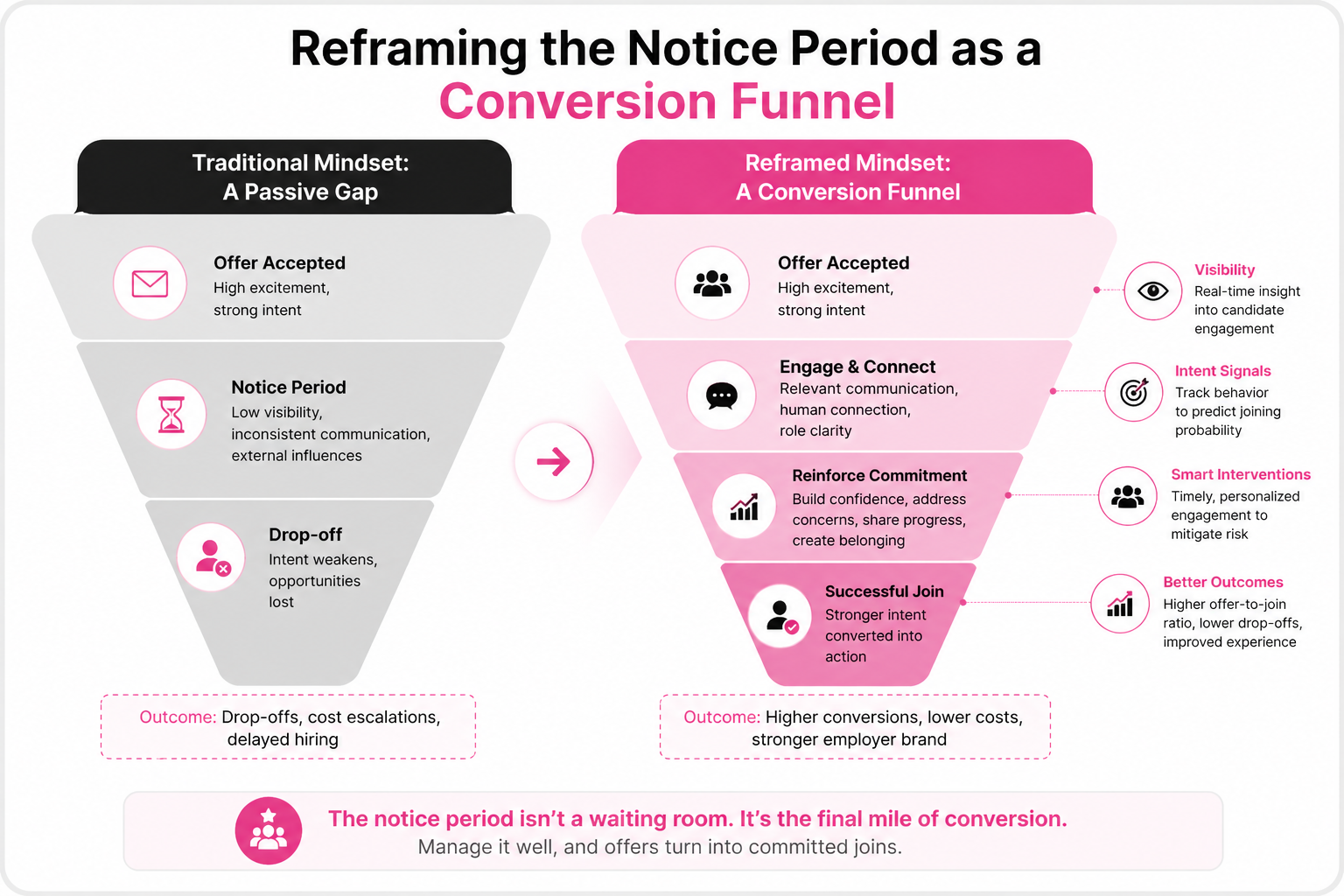
If the hiring process is a funnel, the notice period is its final and most critical stage of conversion. Yet it is, consequently, often the least optimised.
Organisations invest heavily in sourcing, screening, and interviewing — but treat the last mile as an administrative phase. This imbalance is where the highest leakage occurs.
Reframing the notice period as a conversion funnel changes priorities:
● Engagement becomes structured, not incidental
● Metrics shift from activity to outcomes — joining probability and engagement scores
● Accountability extends beyond offer rollout to actual joining
● Metrics shift from activity to outcomes — joining probability and engagement scores
● Accountability extends beyond offer rollout to actual joining
This reframing, therefore, aligns talent acquisition with business outcomes — ensuring that hiring success is measured not by offers made, but by employees onboarded.
How Qallify Transforms Notice Period Engagement
From a Qallify perspective, notice period engagement is not an add-on. Rather, it is a predictive, data-driven layer embedded within the hiring lifecycle.
Qallify addresses this challenge through three key capabilities:
1. Behavioural Signal Tracking
Qallify captures and analyses candidate interactions across touchpoints — identifying patterns that indicate engagement, hesitation, or risk. This provides real-time visibility into candidate intent.
2. Joining Probability Prediction
By combining behavioural data with role, market, and candidate-specific variables, Qallify assigns a dynamic joining probability score. As a result, recruiters can prioritise efforts where they matter most.
3. Conversational Engagement at Scale
Through structured, intelligent interactions — including voice-led engagement — Qallify ensures that candidates remain connected throughout the notice period. These interactions are not generic. Instead, they are contextual, timely, and aligned with candidate needs.
The result, therefore, is a shift from reactive hiring to proactive conversion management.
The Business Impact: Beyond Reduced Drop-Offs
Effective notice period engagement does more than reduce drop-offs. It fundamentally improves hiring efficiency and business performance.
Organisations leveraging structured engagement models see:
● Higher offer-to-join ratios
● Reduced time-to-fill for critical roles
● Lower dependency on replacement hiring cycles
● Improved candidate experience and employer brand perception
● Reduced time-to-fill for critical roles
● Lower dependency on replacement hiring cycles
● Improved candidate experience and employer brand perception
More importantly, furthermore, it brings predictability into hiring — a function traditionally marked by uncertainty.
Closing the Gap Between Offer and Joining
The notice period is often invisible in hiring dashboards. Its impact, however, is anything but invisible. It is the phase where decisions reverse, costs escalate, and hiring outcomes are determined.
Ignoring this phase is not a neutral choice. It is, instead, an expensive one.
As Gartner and Forrester research consistently shows, candidate experience and engagement must extend beyond the offer to ensure successful outcomes.
Qallify closes this critical gap. By transforming the notice period into a measurable, intelligent, and actively managed phase, it ensures that hiring doesn't just end with an offer — it converts into a successful join.
Because in today's hiring landscape, the real win is not the offer you make. It is, ultimately, the candidate who actually walks through the door.
To know more about Beyond Skills: What Really Predicts Hiring Success, click here.