

Beyond Skills: What Really Predicts Hiring Success
In hiring, "skills" have long been treated as the currency of competence. Job descriptions list them, resumes showcase them, and interviews attempt to validate them. Yet, if the last decade of workplace research has taught us anything, it is this: skills alone are weak predictors of long-term success.
Skills tell us what someone can do — not how they will do it, when it matters, or under pressure. The real predictors of performance lie in what we call invisible data: behavioural patterns, cognitive tendencies, emotional responses, and decision-making signatures that rarely show up on a CV.
The Gap Between Credentials and Outcomes
This gap between visible credentials and actual outcomes is not anecdotal. It is, in fact, extensively documented. Gartner has repeatedly highlighted that traditional hiring methods are poor predictors of future performance. In one study, they found that only 26% of new hires are fully successful in their roles — despite having the "right" qualifications.
The implication is stark. Hiring systems optimise for assessing the visible. Success, however, is driven by the invisible.
Behavioral Consistency: Patterns Over Profiles
At the heart of this invisible layer lies behavioural consistency. Unlike skills — which can be learned, updated, or even overstated — behavioural tendencies tend to be stable over time. How a person responds to ambiguity, navigates conflict, prioritises tasks, or adapts to change forms a pattern. And patterns, consequently, are predictive.
AIHR emphasises that behavioural competencies account for up to 80% of workplace success — especially in roles requiring collaboration, leadership, and problem-solving. Yet most hiring processes allocate less than 30% of their evaluation rigor to these dimensions.
Traditional hiring captures fragments — answers, impressions, isolated anecdotes. Success, however, is rarely determined by isolated moments. Instead, it is determined by consistency across situations. And consistency cannot be inferred from a single interview or a polished resume.
Decision-Making: The Hidden Engine of Performance
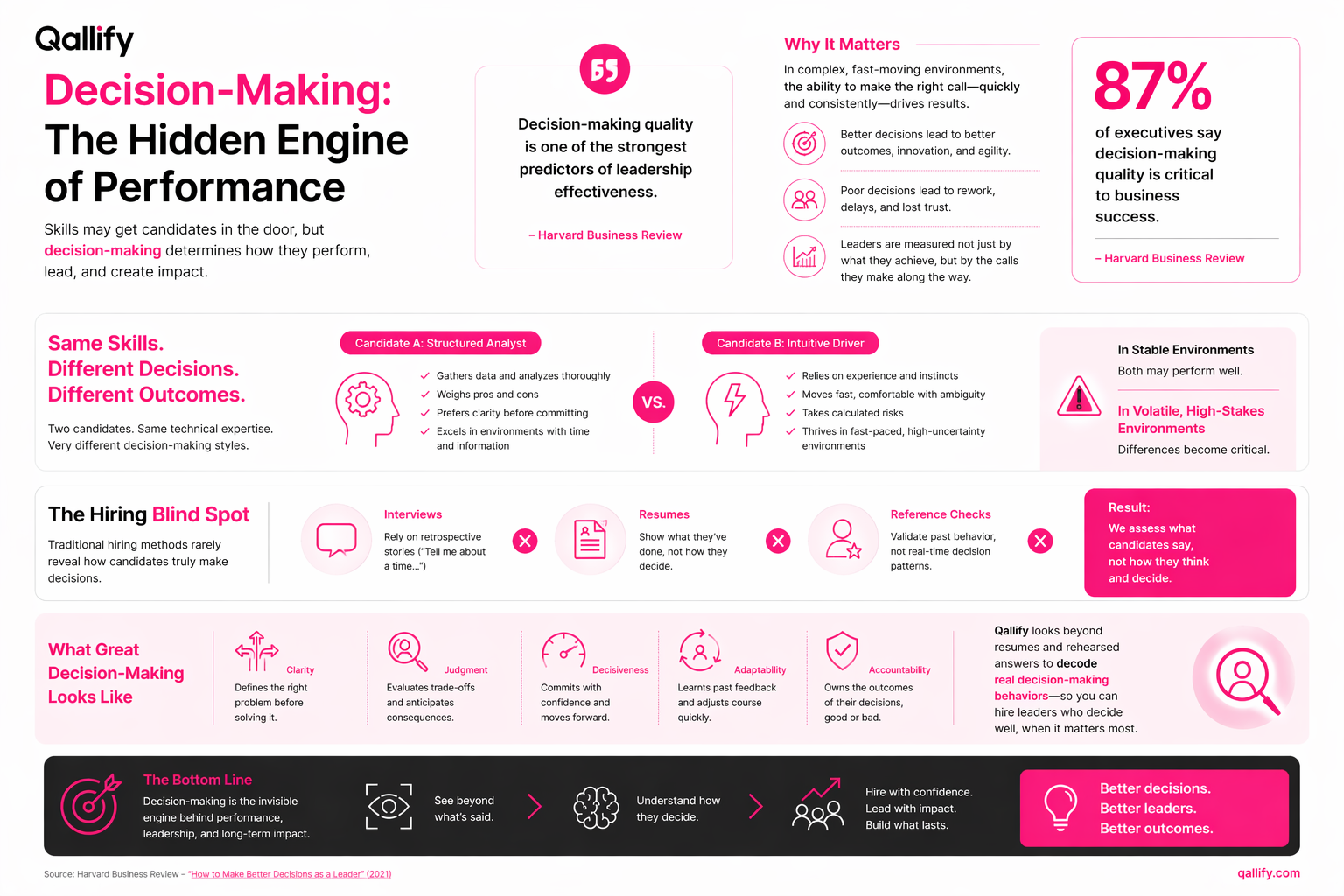
One of the most overlooked forms of invisible data is decision-making style. Two candidates may possess identical technical skills — but differ radically in how they make decisions. One may rely on structured analysis, while the other leans on intuition. In stable environments, both may perform adequately. In volatile, high-stakes contexts, however, these differences become critical.
Research from Harvard Business Review suggests that decision-making quality is one of the strongest predictors of leadership effectiveness. Yet hiring rarely assesses it explicitly. Interviews tend to capture retrospective narratives — "Tell me about a time…" — which are often rehearsed and optimised, rather than reflecting real-time decision behaviour.
Learning Velocity: The New Competitive Advantage
Another layer of invisible data is learning velocity — the ability to acquire, apply, and adapt knowledge quickly. In a world where job roles evolve faster than job descriptions can keep up, learning agility has become more valuable than static expertise.
According to LinkedIn's Workplace Learning Report, 94% of employees say they would stay longer at a company that invests in their learning. Furthermore, organisations that prioritise learning agility in hiring outperform their peers in innovation and adaptability. Yet learning velocity is rarely measured directly. Instead, proxies like degrees, certifications, or years of experience get used — none of which reliably indicate how quickly someone can grow.
Emotional Intelligence: The Cost of What We Don't Measure
Then there is emotional regulation and interpersonal behaviour — arguably the most consequential invisible data in team environments. A high-performing individual contributor can become a liability if they disrupt team dynamics, mishandle feedback, or escalate conflict.
McKinsey & Company has noted that toxic behaviours can cost organisations significantly more than low productivity — not just in output, but in attrition, morale, and cultural erosion. Despite this, however, emotional intelligence gets assessed informally — if at all — during hiring.
Why Invisible Data Is Still Ignored
Why does invisible data remain underutilised? The primary reason is that it is harder to capture. Skills can be tested with assignments, credentials can be verified, and experience can be quantified. Behavioural patterns, in contrast, require longitudinal observation or sophisticated inference.
Traditional hiring tools — resumes, interviews, reference checks — are not designed for this. They provide snapshots, not patterns. And snapshots, consequently, are inherently limited. They reward articulation over authenticity and performance over predictability.
The Role of AI and Behavioral Data
This is where data and technology become transformative. With the rise of AI and large-scale behavioural datasets, it is now possible to infer patterns that were previously invisible. Subtle signals — such as response times, consistency in communication, adaptability across interactions, and micro-behaviours in digital environments — can aggregate to form a behavioural profile.
IBM has explored similar approaches in their talent analytics initiatives, demonstrating that data-driven behavioural insights can improve hiring accuracy by up to 40%. The key, therefore, is not just collecting more data — but collecting the right kind of data. The kind that reflects how people actually behave, not just how they present themselves.
Contextual Fit: Success Is Environment-Specific
Another critical dimension is contextual adaptability. Success is not absolute — it is context-dependent. A candidate who thrives in a structured, hierarchical environment may struggle in a fast-moving startup, and vice versa.
Deloitte has emphasised the importance of adaptability in its Human Capital Trends reports, noting that organisations need to move beyond static role-fit models to dynamic, context-aware talent strategies. Invisible data, therefore, helps bridge this gap — capturing not just who the candidate is, but how they interact with different contexts.
Reducing Bias Through Deeper Signals
Interestingly, the shift toward invisible data also challenges deeply ingrained biases in hiring. Traditional signals — such as pedigree, brand-name employers, or polished communication — often serve as proxies for competence. However, these signals are heavily influenced by access and privilege.
By focusing on behavioural patterns and decision-making tendencies, organisations can move toward a more equitable evaluation framework. The World Economic Forum has advocated for this shift, highlighting that skills-based and behaviour-based hiring can significantly improve diversity and inclusion outcomes.
The Ethical Imperative: Invisible, Not Opaque
However, this transition is not without its challenges. Ethical considerations around data privacy, transparency, and algorithmic bias must be addressed. Invisible data should not become opaque data. Candidates need to understand how they are being evaluated. Furthermore, organisations must ensure that their models are fair, explainable, and accountable.
The goal is not to replace human judgment. Rather, it is to augment it with deeper, more reliable insights.
From Hiring to Predictive Talent Intelligence
Ultimately, the future of hiring lies in integrating the visible with the invisible. Skills will always matter — they are the foundation. However, they are not the full story. The real differentiators — the factors that determine whether someone will thrive, grow, and contribute meaningfully — exist beneath the surface.
For organisations willing to look beyond the obvious, this presents a powerful opportunity. By investing in systems that capture and interpret invisible data, they can move from reactive hiring to predictive talent intelligence.
How Qallify Bridges the Invisible Gap
This is precisely the gap that Qallify is built to address.
While traditional hiring systems focus on what candidates say or show, Qallify focuses on what candidates signal through behaviour. It moves beyond static evaluation to dynamic inference — capturing patterns across interactions rather than relying on isolated touchpoints.
Instead of evaluating candidates only through resumes and interviews, Qallify decodes:
● Behavioural consistency across time
● Response patterns and intent signals
● Decision-making tendencies in real contexts
● Engagement reliability and follow-through behaviour
● Response patterns and intent signals
● Decision-making tendencies in real contexts
● Engagement reliability and follow-through behaviour
In essence, therefore, Qallify transforms fragmented hiring signals into structured behavioural intelligence.
This allows organisations to answer deeper, more consequential questions:
● Will this candidate stay engaged — not just join?
● Will they adapt — not just perform initially?
● Will they align with the pace and culture — not just the role?
● Will they adapt — not just perform initially?
● Will they align with the pace and culture — not just the role?
By converting invisible behavioural data into measurable insights, Qallify enables a shift from evaluation to prediction — from hiring based on potential fit to hiring based on probable success.
Because the future of hiring isn't about collecting more data. It is, ultimately, about understanding the data that was always there — just never seen.
To know about why your best candidate didn't get the job, click here.