

Your Best Candidate Probably Didn't Get the Job
There's a quiet, uncomfortable truth in hiring that most organisations don't confront. The person who got the offer is often not the best person for the role. Not the most capable. Not the most aligned. Not the one most likely to succeed long-term. Instead, they are simply the one who performed best within the constraints of your hiring process.
That distinction matters more than most leaders realise.
The Illusion of "Best" in Hiring
Hiring processes create a sense of objectivity — structured interviews, competency frameworks, scorecards, and panel evaluations. On paper, it feels rigorous. In reality, however, it often measures a very narrow slice of human capability: communication under pressure, rehearsed narratives, and the ability to align with interviewer expectations in a short window.
Research from Gartner shows that traditional interviews predict only about 26% of on-the-job performance. That means nearly three-quarters of what actually determines success is either missed or misread during hiring.
Yet organisations continue to operate with high confidence in these systems. Why? Because the process feels structured. And structure, consequently, creates an illusion of accuracy.
Interviews Reward Performance, Not Potential
Interviews are not neutral environments. Rather, they are high-stakes social performances.
Candidates who are articulate, confident, and experienced in navigating interviews tend to outperform — even when those traits are not critical for the role itself. Meanwhile, candidates who may be more thoughtful, unconventional, or context-driven often underperform in these settings.
According to insights from Forrester, hiring decisions are heavily influenced by first impressions, confirmation bias, and perceived "culture fit" within the first few minutes. In fact, multiple studies suggest that interviewers form initial judgments within the first 5–10 minutes — and then spend the rest of the interview subconsciously validating them.
This creates a systemic problem. You're not selecting the best candidate. Instead, you're selecting the candidate who best fits your mental model of success.
The Signal vs. Noise Problem
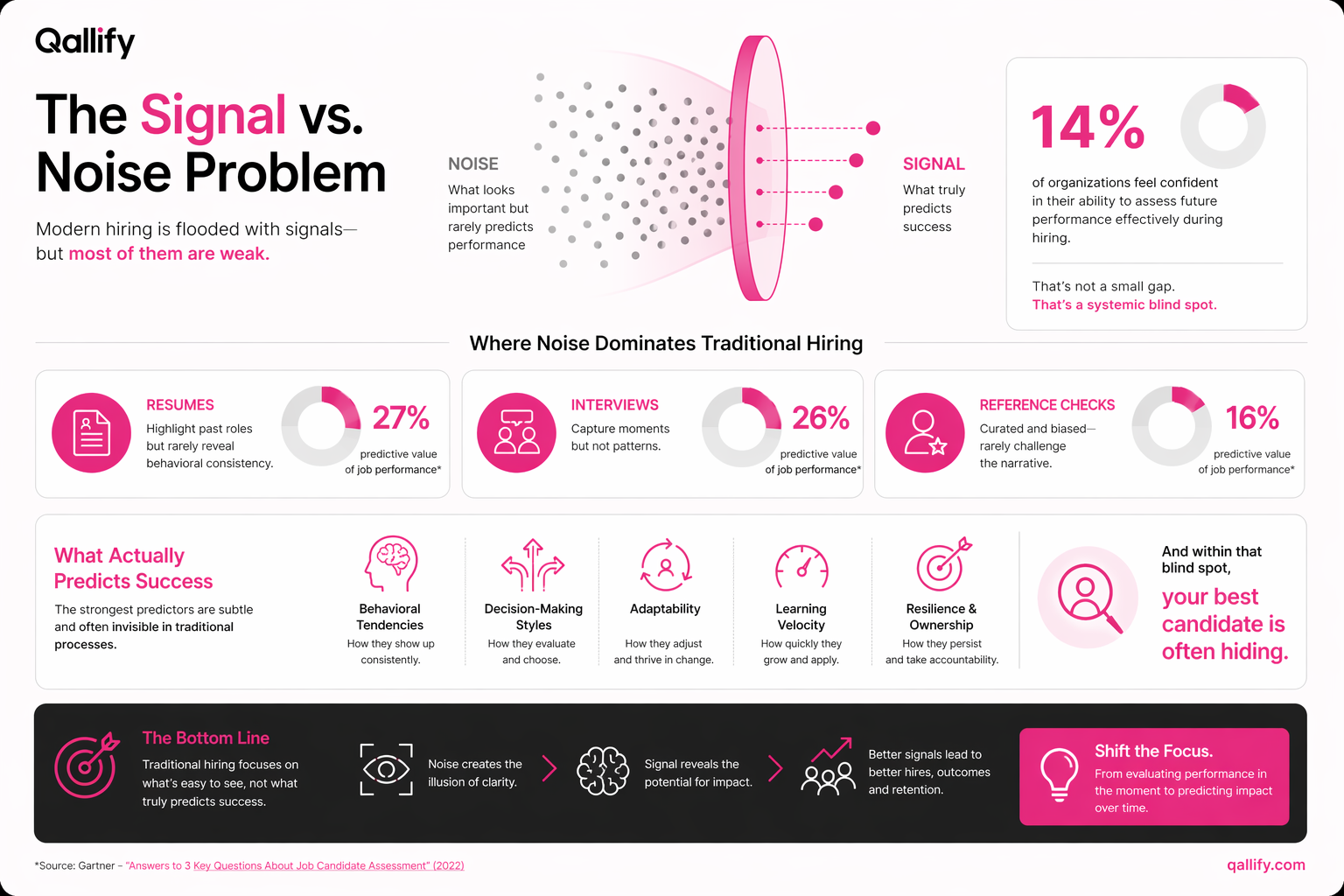
Modern hiring is flooded with signals — but most of them are weak.
Resumes highlight past roles but rarely reveal behavioural consistency. Interviews capture moments but not patterns. Reference checks, furthermore, are curated and biased.
The strongest predictors of success — behavioural tendencies, decision-making styles, adaptability, and learning velocity — are subtle and often invisible in traditional processes.
Gartner highlights that only 14% of organisations feel confident in their ability to assess future performance effectively during hiring. That's not a small gap. That's, consequently, a systemic blind spot.
And within that blind spot, your best candidate is often hiding.
Why the Best Candidate Gets Missed
There are four recurring reasons why high-potential candidates slip through.
1. They don't "interview well"
Some of the most capable individuals are not built for high-pressure, performative environments. They think deeply, respond carefully, and may not package their experiences into crisp, compelling narratives on demand. As a result, they get passed over.
2. They don't match expected patterns
Hiring managers unconsciously look for familiarity — career paths, companies, communication styles. Candidates who deviate from these patterns often appear "risky" — even when they bring stronger capabilities. Furthermore, this pattern-matching happens without conscious awareness.
3. They signal differently
Behavioural signals — like consistency, ownership, or resilience — often appear in subtle ways. If your process isn't designed to detect them, they go unnoticed. Consequently, the wrong candidate moves forward.
4. They're evaluated in isolation
Most hiring decisions rely on snapshots, not longitudinal patterns. A single interview becomes disproportionately influential. In contrast, a pattern-based approach would reveal far more about long-term potential.
The Cost of Getting It Wrong
Mis-hiring isn't just a cost problem. It is, instead, a compounding performance problem.
According to Gartner, the average cost of a wrong hire can reach up to 3x the employee's salary — factoring in lost productivity, team disruption, and rehiring costs. But beyond financial loss, there is a deeper impact:
● Teams lose trust in hiring decisions
● High performers compensate for underperformance
● Culture shifts subtly toward mediocrity
● Leadership pipelines weaken over time
● High performers compensate for underperformance
● Culture shifts subtly toward mediocrity
● Leadership pipelines weaken over time
And perhaps most critically, the truly high-potential candidates who were rejected go on to join your competitors.
The Overconfidence Trap
Despite all this, most hiring managers remain highly confident in their decisions. This is what behavioural scientists call the overconfidence bias — the tendency to overestimate the accuracy of our judgments, especially in human evaluation.
Forrester notes that organisations often rely on "experience-based intuition" rather than data-backed insights — even when evidence shows that intuition alone is unreliable.
In hiring, therefore, this manifests as statements like:
● "I have a good gut feel about this candidate."
● "They seem like a strong cultural fit."
● "I can tell they'll do well."
● "They seem like a strong cultural fit."
● "I can tell they'll do well."
These are not insights. They are interpretations — and they are often formed under cognitive bias.
Rethinking What "Best" Actually Means
The problem isn't that organisations don't want to hire the best candidate. Rather, it's that they're not equipped to identify them accurately.
To move forward, therefore, hiring needs to shift from evaluation to inference.
Instead of asking "Did they answer well?" — ask "What does their response reveal about how they think?"
Then instead of "Do they seem confident?" — ask "How do they behave across different contexts?"
And then instead of "Do they fit our expectations?" — ask "What signals indicate long-term success in this role?"
This requires a fundamentally different approach — one that prioritises behavioural data, pattern recognition, and predictive insight over surface-level performance.
The Rise of Predictive Hiring
This is where hiring is beginning to evolve. Leading organisations are moving toward predictive hiring models — systems that analyse multiple behavioural signals across interactions to infer future outcomes.
Gartner emphasises that organisations leveraging advanced analytics in hiring improve quality-of-hire by up to 25%. These systems don't replace human judgment. Instead, they augment it with structured, evidence-based insights.
Rather than relying on a few subjective impressions, they analyse:
● Communication patterns
● Response consistency
● Decision-making indicators
● Engagement behaviour over time
● Response consistency
● Decision-making indicators
● Engagement behaviour over time
The goal is not to find the best interview performer. It is, instead, to identify the best future contributor.
A Hard Truth for Leaders
If your hiring process feels comfortable, familiar, and intuitive — there's a good chance it's flawed. Accurately evaluating humans is inherently complex. And furthermore, any system that makes it feel simple is likely oversimplifying.
The uncomfortable reality is this: your best candidate doesn't always stand out in the room.
They might be the one who:
● Took a pause before answering
● Asked unexpected questions
● Didn't follow the "perfect" narrative
● Felt slightly unconventional
● Asked unexpected questions
● Didn't follow the "perfect" narrative
● Felt slightly unconventional
But beneath that, they carry the exact traits your organisation needs. Consequently, missing them is a cost most organisations don't even measure.
The Question That Changes Everything
Instead of asking "Who performed best in this process?" — start asking "Who is most likely to succeed in this role, over time?"
That shift — from performance to prediction — is where hiring transforms.
And until that shift happens consistently, your best candidate will continue to walk away — unnoticed, unselected, and ultimately, unmatched.
To know why hiring platforms are becoming obsolete, click here.