

The top reason strong candidates fail after final rounds
By the time a candidate reaches the final round, most hiring teams share a simple assumption: the hard part is done. They have checked skills, reviewed experience, and agreed that this person can do the job. Yet, paradoxically, this is also the stage where some of the strongest candidates fail.
Not because they lack ability. Not because they perform poorly. Rather, something subtler — harder to name and often invisible in traditional hiring — goes unnoticed until it is too late.
The top reason strong candidates fail after final rounds is not a skill gap. Instead, it is a mismatch between how they behave and what the role actually needs — often hidden behind strong interview performance.
This gap rarely shows up in resumes, structured interviews, or panel discussions. In fact, it only appears when the decision moves from evaluation to prediction.
The Illusion of the “Strong Candidate”
Most organisations define a "strong candidate" through past experience, communication ability, and interview performance. These signals are useful. Useful, however, only to a point — because they remain incomplete.
Research from the Harvard Business Review shows that structured interviews improve hiring accuracy. Even so, the best processes rarely exceed 60–70% predictive validity for actual job performance. Similarly, Schmidt and Hunter's meta-analysis shows that cognitive ability and structured interviews are strong predictors — yet they still leave a large gap in explaining performance outcomes.
As a result, this gap is where strong candidates fall through.
Interviews reward clarity, coherence, and confidence. Roles, in contrast, demand adaptability, consistency under pressure, and alignment with unspoken team rhythms. Ultimately, the difference between these two environments is where most hiring decisions break down.
Final Rounds Are About Fit Under Complexity — Not Just Skills
By the final round, the evaluation goal quietly shifts — even if the process does not say so. The question is no longer "Can this person do the job?" but rather, "Will this person succeed here, in this system, under these conditions?"
However, most hiring frameworks keep using the same measures as earlier stages. Therefore, this creates a structural mismatch.
Final rounds often rely heavily on gut feel. For instance, hiring managers look for "confidence," "clarity," or "executive presence." Similarly, panels discuss whether the candidate "felt right." These are rough proxies for something deeper — but not precise enough to capture it.
What interviewers actually assess — often without realising it — is how candidates behave under pressure, make decisions, handle vague questions, and fit the team's working style.
Because hiring teams do not measure these signals in a structured way, they interpret them subjectively. As a result, even strong candidates get misjudged — or worse, hired for the wrong reasons.
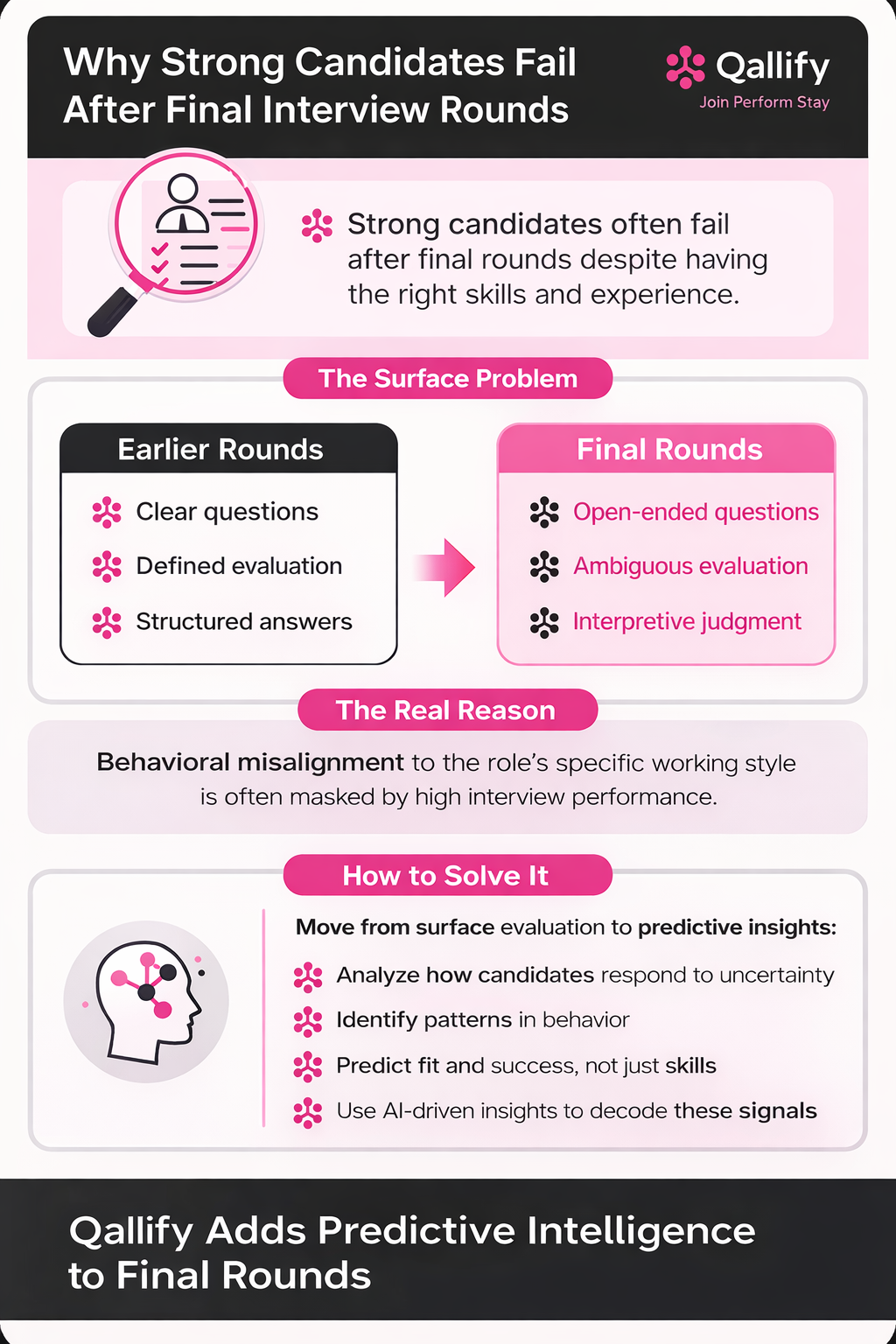
The Behavioral Signature Gap
Every candidate brings a behavioural signature into an interview. This includes how they organise thoughts, how quickly they respond, how they handle interruptions, how they deal with vague questions, and how consistently they stay on point.
These patterns are not random. In fact, they are reliable signs of how a person will work in real environments. Yet traditional hiring treats interviews as simple conversations rather than rich data sources. Teams notice signals but rarely decode them. Furthermore, patterns emerge but rarely get structured.
As a result, hiring teams focus too much on what is most visible: articulation, fluency, and confidence. Psychologists call this the "fluency bias" — where people who communicate smoothly appear more capable, even when their actual reasoning may not suit the role.
In high-stakes final rounds, moreover, this bias grows stronger. Candidates who tell good stories and stay calm often appear "stronger" — even if their behavioural patterns suggest a poor fit for the role's real demands.
When Strong Performance Masks Future Misalignment
One of the most overlooked facts in hiring is that interview performance is a different skill from job performance.
Interviews are structured, time-bound, and predictable. Roles, in contrast, are dynamic, unclear, and always changing.
A candidate who does well in structured settings may therefore struggle in roles that need fast context switching or decisions with limited information. Conversely, a candidate who seems less polished in interviews may thrive in complex, open-ended environments.
Final rounds rarely catch this difference. Instead, they amplify performance signals. Hiring teams treat candidates who stay consistent across rounds as "safe bets." However, consistency in interviews does not always mean consistency in the actual job.
This is ultimately where organisations face the post-hire reality: the candidate was strong, but not right.
The Cost of Misjudgment at the Final Stage
Failures at the final stage are not just missed hires. Rather, they are missed chances to improve hiring accuracy.
When hiring teams reject strong candidates based on subjective impressions, organisations risk losing high-potential talent. When they hire despite a poor fit, furthermore, the cost is even higher.
Studies estimate that a bad hire can cost between 30% to 200% of the employee's annual salary, depending on the role. Additionally, beyond the financial hit, there are hidden costs: team disruption, slower results, and a loss of trust in the hiring process.
For talent acquisition leaders, therefore, the challenge is not just improving funnel speed. It is improving decision quality at the point where it matters most.
Why Traditional Hiring Systems Plateau
Most hiring systems are built for screening, not prediction. Specifically, they filter candidates efficiently, assess skills reliably, and create structured evaluation steps. These are necessary — but not enough.
The final decision — whether a candidate will succeed in a specific role at a specific organisation — needs a different kind of intelligence. It needs the ability to move from evaluating single responses to spotting patterns across interactions. It also needs an understanding of not just what a candidate says, but how they consistently behave across different situations.
Without this layer, consequently, hiring systems plateau. They get faster but not more accurate.
From Signals to Foresight
This is where the move from traditional hiring to smarter hiring becomes critical. Instead of treating interviews as conversations, hiring teams need to treat them as data environments. Every response, pause, interruption, and shift in tone carries useful information.
When teams capture and sort these signals — language patterns, behavioural responses, contextual anchoring — they start forming a clearer picture of the candidate. Over time, furthermore, these patterns can point to outcomes: likelihood of joining, expected performance, and retention risk.
This is not about replacing human judgment. Rather, it is about supporting it with pattern-based foresight.
The Role of Qallify
Dr. Chetan Indap, Founder & CEO of Qallify, built the platform precisely at this intersection — where hiring decisions move from evaluation to prediction.
Rather than focusing only on what candidates say, Qallify analyses how they communicate, how they build responses, how they handle unclear questions, and how their behavioural patterns shift across interactions.
By sorting interviews into signal categories — language, behaviour, and context — it therefore creates a rich, multi-layered profile of each candidate.
This allows talent acquisition leaders to move beyond gut feel and access clear insights on:
● Likelihood of joining
● Expected performance consistency
● Alignment with role complexity
● Behavioral stability across scenarios
● Expected performance consistency
● Alignment with role complexity
● Behavioral stability across scenarios
The value is not in replacing existing hiring steps. Instead, it lies in adding a layer of intelligence that becomes most critical in final rounds.
When decisions are close, when candidates are equally qualified, and when stakes are highest, this added clarity consequently becomes decisive.
Rethinking Final Round Decisions
If behavioural mismatch hidden behind strong interview performance is the top reason strong candidates fail, then the solution is not to rebuild interviews from scratch.
It is, instead, to change how interviews are interpreted.
Final rounds should not rest solely on panel discussions or gut feel. Instead, structured insights into behavioural patterns and predicted outcomes should support them.
This requires a shift in thinking:
● From evaluating answers to decoding patterns.
● Then, from assessing performance to predicting success
● And ultimately, from gut-driven decisions to intelligence-supported judgment.
● Then, from assessing performance to predicting success
● And ultimately, from gut-driven decisions to intelligence-supported judgment.
The Future of Hiring Accuracy
As hiring grows more competitive and roles grow more complex, the room for error in final decisions keeps shrinking. Consequently, organisations that keep relying on traditional methods will make consistent but poor decisions.
Those that invest in reading behavioural signals and using predictive intelligence, however, will move closer to a core goal: not just hiring faster, but hiring better.
Because at the end of the funnel, where the strongest candidates compete, the difference is rarely about skill. Ultimately, it is about alignment.
And alignment is not visible unless you know where — and how — to look.
To know about The Thinking Style Bias Hiding in Every Interview, click here.