

The Fluency Bias: Why Smooth Talkers Get The Job
One of the most consistent distortions in interview evaluation is overvaluing fluency.
Large-scale interview datasets show a clear pattern. Candidates who speak smoothly, confidently, and without interruption receive disproportionately higher ratings — even when their responses are comparable in quality, or sometimes lower.
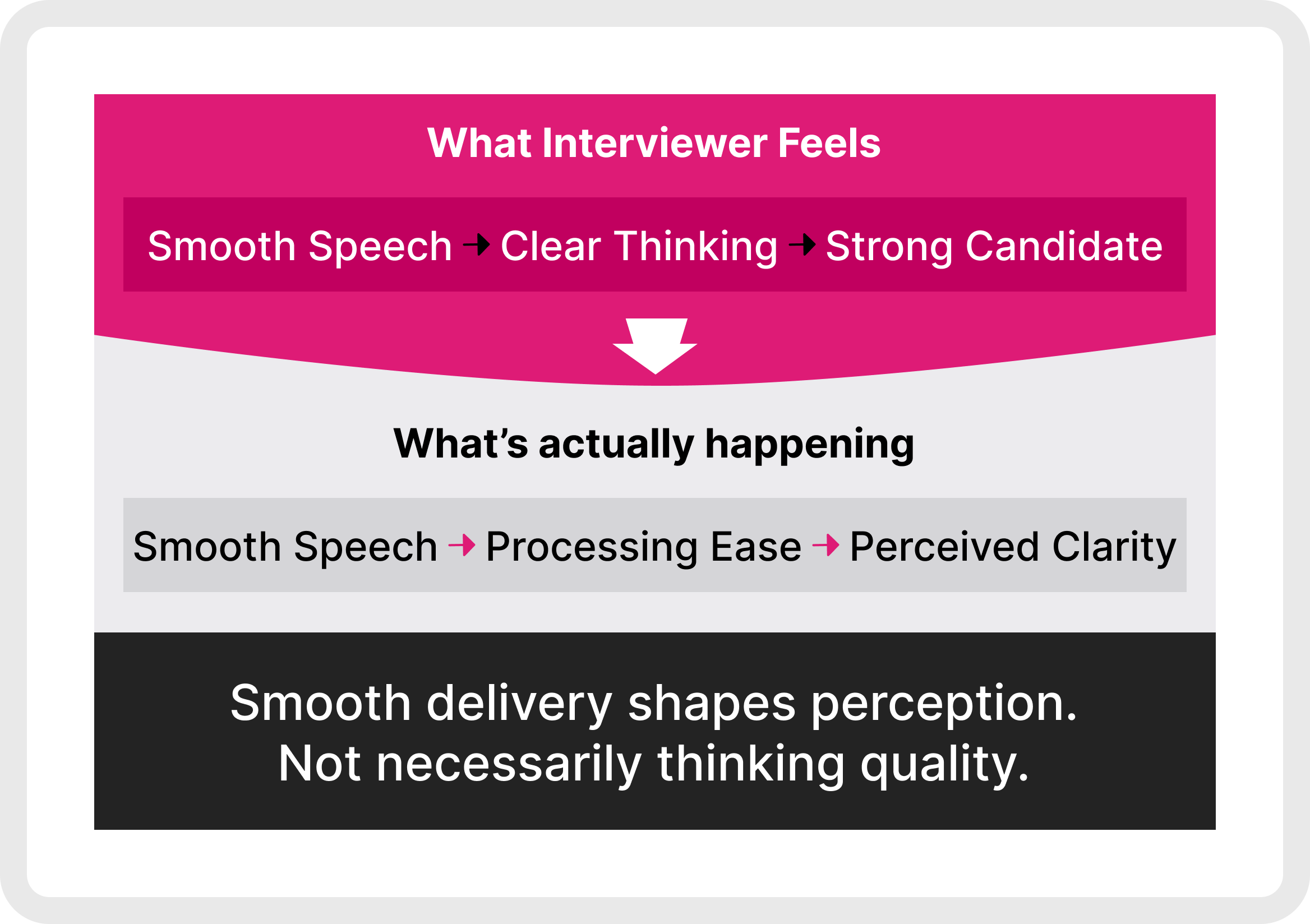
Interviewers, like all humans, respond to processing ease. Clear, effortless delivery feels more credible, more intelligent, and more complete. Psychologists call this the fluency effect — we equate ease of understanding with quality of thought.
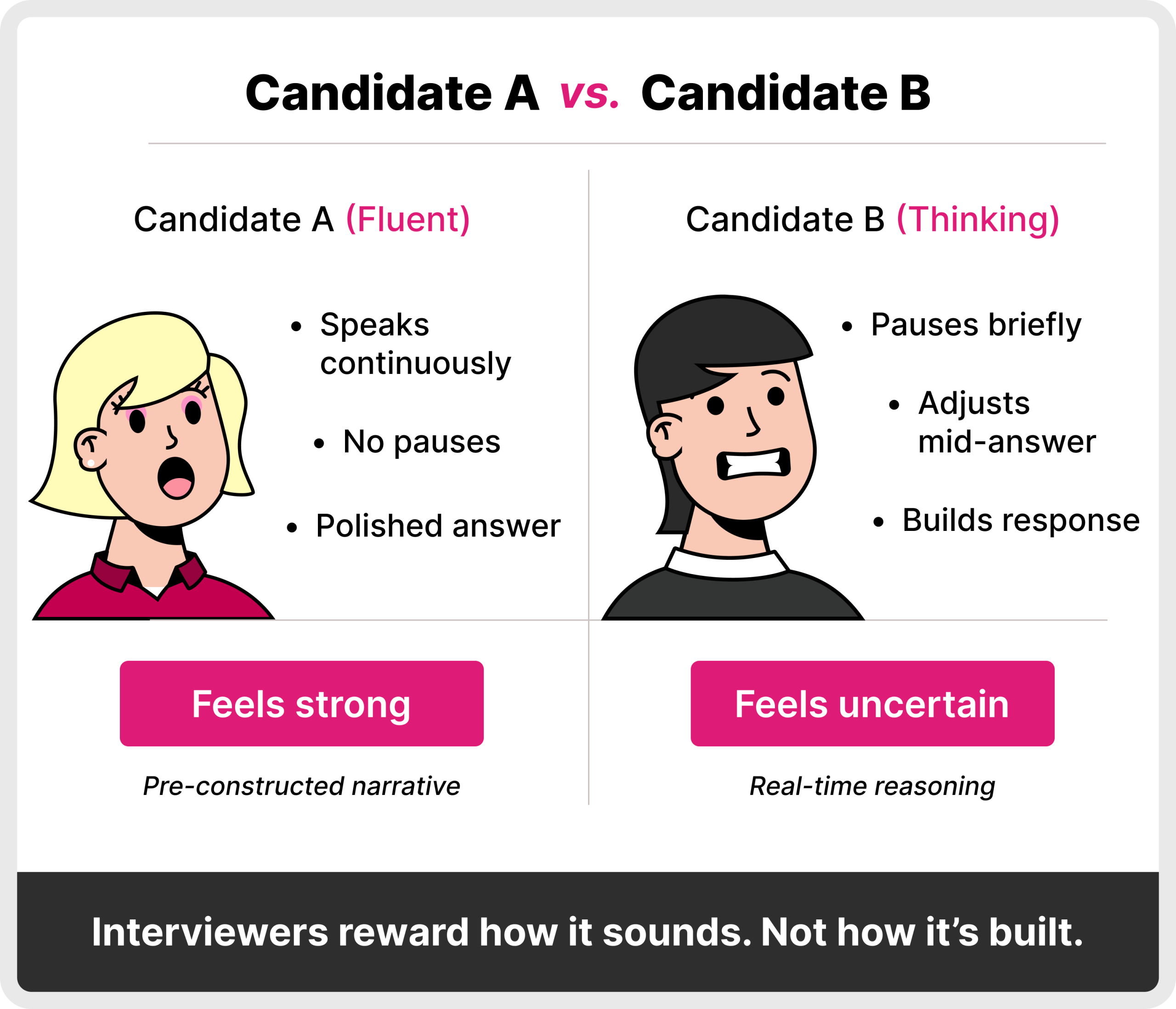
Candidates who speak in continuous, well-structured sentences create momentum. Their answers feel finished. Fewer breaks, fewer hesitations, fewer moments where the interviewer has to wait or interpret.
Their thinking is not just heard — it is experienced as smooth. And that experience gets mistaken for competence.
As Dr. Chetan Indap, Founder & CEO of Qallify, has consistently observed across large-scale hiring data, fluency creates a perception of competence that often has little to do with actual thinking quality.
What the Data Actually Shows
When we isolate response quality from delivery style, a different pattern emerges. Highly fluent candidates rely more heavily on pre-constructed narratives. Their answers are rehearsed, optimized for clarity and confidence, with minimal deviation. This creates strong first impressions — but it often reduces evidence of real-time problem solving.
The Candidates We Underrate
Candidates with deeper cognitive engagement tend to show visible processing:
● They pause before answering.
● They reframe questions mid-response.
● They occasionally restart or refine their thoughts.
● They reframe questions mid-response.
● They occasionally restart or refine their thoughts.
These behaviours introduce friction. The answer feels less polished and less immediate. But cognitively, they signal something important — the candidate is not retrieving an answer. They are constructing one.
Performance Tells a Different Story
Performance data mapped against interview behaviour reveals something striking. Candidates who show measured pacing and mid-response adjustments often deliver stronger outcomes in roles requiring problem-solving, decision-making, and adaptability. Yet interviews consistently underrate them.
This bias grows sharper in roles where communication is visible but thinking is critical — strategy, product, leadership, consulting. In these roles, fluency creates an illusion of readiness, even when depth is limited.
Silence adds another layer to this pattern. Short pauses are frequently read as hesitation or lack of confidence. In reality, they often signal cognitive load being actively managed — the candidate is organizing information, evaluating options, or simulating scenarios before responding.
Controlled analysis shows that response latency — when not excessive — positively associates with answer complexity and depth. Candidates who take a moment before speaking are more likely to incorporate multiple variables, acknowledge trade-offs, and avoid oversimplification.
Despite this, traditional interview scoring frameworks rarely account for timing patterns. Evaluation still focuses on articulation, structure, and confidence — all immediately observable, but not always predictive.
This creates a systematic skew. Candidates who optimize for delivery outperform candidates who optimize for thinking — at least in the interview room. Over time, organizations unintentionally favour individuals who can present clarity, rather than those who can generate it under uncertainty.
Fluency Is a Surface Signal, Not the Full Picture
Communication skill matters — in many roles, it is essential. But fluency alone is an incomplete signal. It tells us how easily someone expresses a thought. It does not tell us how well they formed that thought. The distinction matters.
In real-world environments — especially those shaped by ambiguity and evolving constraints — the ability to think through complexity consistently outperforms the ability to speak through simplicity.
And yet, in interviews, we continue to reward the latter.
How Qallify Approaches This
At Qallify, fluency is a surface signal, not a decision driver.
Our models separate how something is said from how it is being thought through — by analyzing response latency, mid-answer restructuring, semantic depth, and cognitive transitions within answers.
This allows us to distinguish between:
● Rehearsed articulation and real-time reasoning
● Delivery confidence and cognitive clarity
● Narrative smoothness and problem-solving depth
● Delivery confidence and cognitive clarity
● Narrative smoothness and problem-solving depth
According to Neha Valecha, Chief Business Officer at Qallify, organizations that reduce over-indexing on fluency see measurable improvements in hiring outcomes — particularly in roles requiring adaptability and complex decision-making.
These signals are not evaluated in isolation. We map them against outcomes across millions of interview interactions to identify which behaviours actually correlate with on-the-job performance, adaptability, and retention.
The result is a more calibrated view of candidates — one that reduces over-indexing on fluency and surfaces individuals who demonstrate stronger thinking, even when their delivery is less polished.
In practice, hiring decisions are no longer driven by what sounds impressive, but by what is predictively meaningful.
To know more about The Hiring Velocity Equation, click here.
To know more about The Hiring Velocity Equation, click here.