

The Hiring Velocity Equation: What Actually Drives Time-to-Hire
Time-to-Hire = f(Role Complexity, Decision Speed, Candidate Availability)
Formulated through large-scale analysis of 14 million interviews, uncovering consistent patterns in hiring velocity
Introduction: Rethinking Time-to-Hire
Time-to-hire is one of the most frequently discussed metrics in talent acquisition, yet it remains one of the least understood. Organisations track it diligently, benchmark it across teams, and often set aggressive targets to reduce it. Despite these efforts, improvements are inconsistent and often short-lived.
Part of the challenge lies in how the metric itself is interpreted.
Time-to-hire is typically defined as the number of days between a candidate entering the hiring pipeline and accepting an offer—a definition widely used across recruitment analytics frameworks to assess both operational efficiency and candidate experience. Research from AIHR positions time-to-hire as a core indicator of how effectively organisations convert talent opportunities into hires.
At the same time, industry benchmarks highlight the growing complexity of this metric. Studies referenced by SHRM and other recruitment research bodies suggest that the average time-to-hire across industries ranges between 36 to 44 days, with significant variation depending on role type, industry, and geography. In high-skill or competitive roles, this timeline can extend considerably, increasing both vacancy costs and the risk of losing top candidates.
However, treating time-to-hire purely as an outcome to optimise often leads to surface-level interventions—adding more sourcing channels, introducing new tools, or compressing interview timelines—without addressing the deeper structural factors that shape hiring outcomes.
This limitation is reflected in broader industry observations. Recruitment research consistently shows that prolonged hiring cycles are rarely caused by a single bottleneck; instead, they emerge from a combination of process inefficiencies, decision delays, and market constraints acting together. Analysis from Gartner, for instance, has repeatedly highlighted that hiring performance is influenced by interconnected factors across the recruitment life cycle rather than isolated stages.
This limitation is reflected in broader industry observations. Recruitment research consistently shows that prolonged hiring cycles are rarely caused by a single bottleneck; instead, they emerge from a combination of process inefficiencies, decision delays, and market constraints acting together. Analysis from Gartner, for instance, has repeatedly highlighted that hiring performance is influenced by interconnected factors across the recruitment life cycle rather than isolated stages.
A more useful way to understand time-to-hire, therefore, is to view it not as a standalone number, but as the output of an interconnected system. When examined through this lens, hiring timelines begin to reveal patterns rather than anomalies.
One way to capture this system is through a simple formulation:
The Hiring Velocity Equation
Time-to-Hire = f(Role Complexity, Decision Speed, CandidateAvailability)
Role Complexity: Defining theNature of the Problem
Role complexity is often assumed to be a functionof seniority or skill scarcity. While these factors doplay a role, they do not fully explain why somepositions take disproportionately longer to fill.
A closer look reveals that complexity is frequentlyintroduced not by the role itself, but by how it isarticulated and understood within theorganisation. When expectations are ambiguous,requirements are overly broad, or stakeholders are misaligned, the hiringprocess becomes less about evaluation and more about exploration.
This observation is consistent with broader industry findings. Research on recruitment processes shows that unclear job descriptions and poorly defined requirements significantly delay hiring by increasing screening effort and evaluation inconsistency.
In such cases, each stage of the process adds new information, but not necessarily clarity. Interviewers may assess candidates against different criteria, feedback may conflict, and decisions may be revisited multiple times.
What appears as “difficulty in finding the right candidate” is often, in reality, a difficulty in defining what the right candidate looks like.
Decision Speed: The Rate of Resolution
If role complexity defines the nature of the problem, decision speed determines how quickly that problem is resolved.
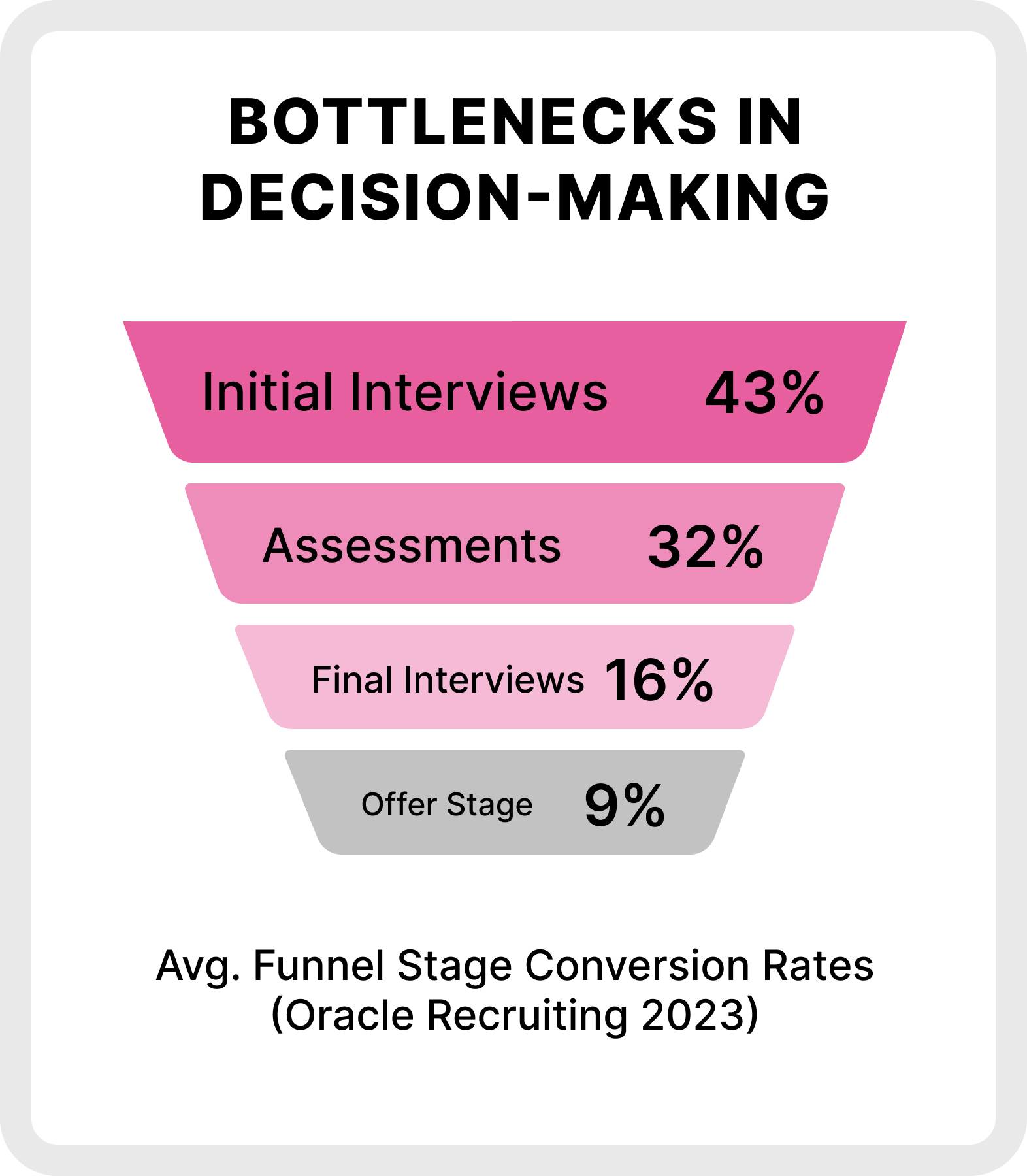 In many hiring systems, delays are attributed to external factors such as candidate availability. However, evidence suggests that a significant portion of hiring time is shaped by internal inefficiencies in evaluation and decision-making.
Industry analyses of recruitment metrics indicate that time-to-hire is fundamentally a measure of how quickly organisations can assess candidates and make decisions within the hiring funnel.
This means that delays are often not due to lack of candidates, but due to:
● slow feedback cycles
● fragmented evaluation criteria
● extended approval chains
● fragmented evaluation criteria
● extended approval chains
Further, recruitment research consistently highlights that bottlenecks in interviewing, feedback, and approvals are among the primary drivers of prolonged hiring timelines.
When decisions are delayed, the impact is not merely operational. It directly affects candidate experience and engagement. Faster hiring processes are associated with better candidate experience and higher conversion rates, while slower ones introduce friction and drop-offs.
In this sense, hiring speed is less about processing candidates and more about reducing decision latency.
Candidate Availability: The Window of Opportunity
While role complexity and decision speed are internal, candidate availability introduces an external constraint shaped by market dynamics .Time-to-hire is not just a reflection of internal efficiency; it is also a measure of how effectively an organisation competes for talent within a limited window of opportunity.
Research indicates that top candidates are often off the market within a very short period, and prolonged hiring processes significantly increase the risk of losing them to faster competitors. Moreover, candidate behaviour is highly sensitive to hiring timelines. A majority of candidates expect timely decisions, and delays can lead to disengagement even among otherwise strong applicants.
This reinforces an important point:
Candidate availability is not static, it is influenced by the speed and responsiveness of the hiring process itself. In other words, organisations do not just operate within market constraints; they actively shape them through their hiring behaviour.
The System Effect: Why These Factors Interact
Individually, each of these variables—role complexity, decision speed, and candidate availability—offers a partial explanation for hiring timelines. However, the most meaningful insights emerge when they are considered together.
These factors do not operate independently. They interact in ways that can either amplify delays or mitigate them.
A highly complex role may still be filled quickly if decision-making is fast and candidates are readily available. Conversely, even a relatively straightforward role can experience delays if decision processes are slow or if candidates disengage due to lack of momentum.
The interdependence of these variables is also supported by how recruitment metrics are structured. Time-to-hire, as defined in industry frameworks, reflects the cumulative efficiency of sourcing, evaluation, and decision-making stages combined.
This reinforces the idea that hiring timelines are not driven by a
single bottleneck, but by the interaction of multiple stages across the recruitment funnel.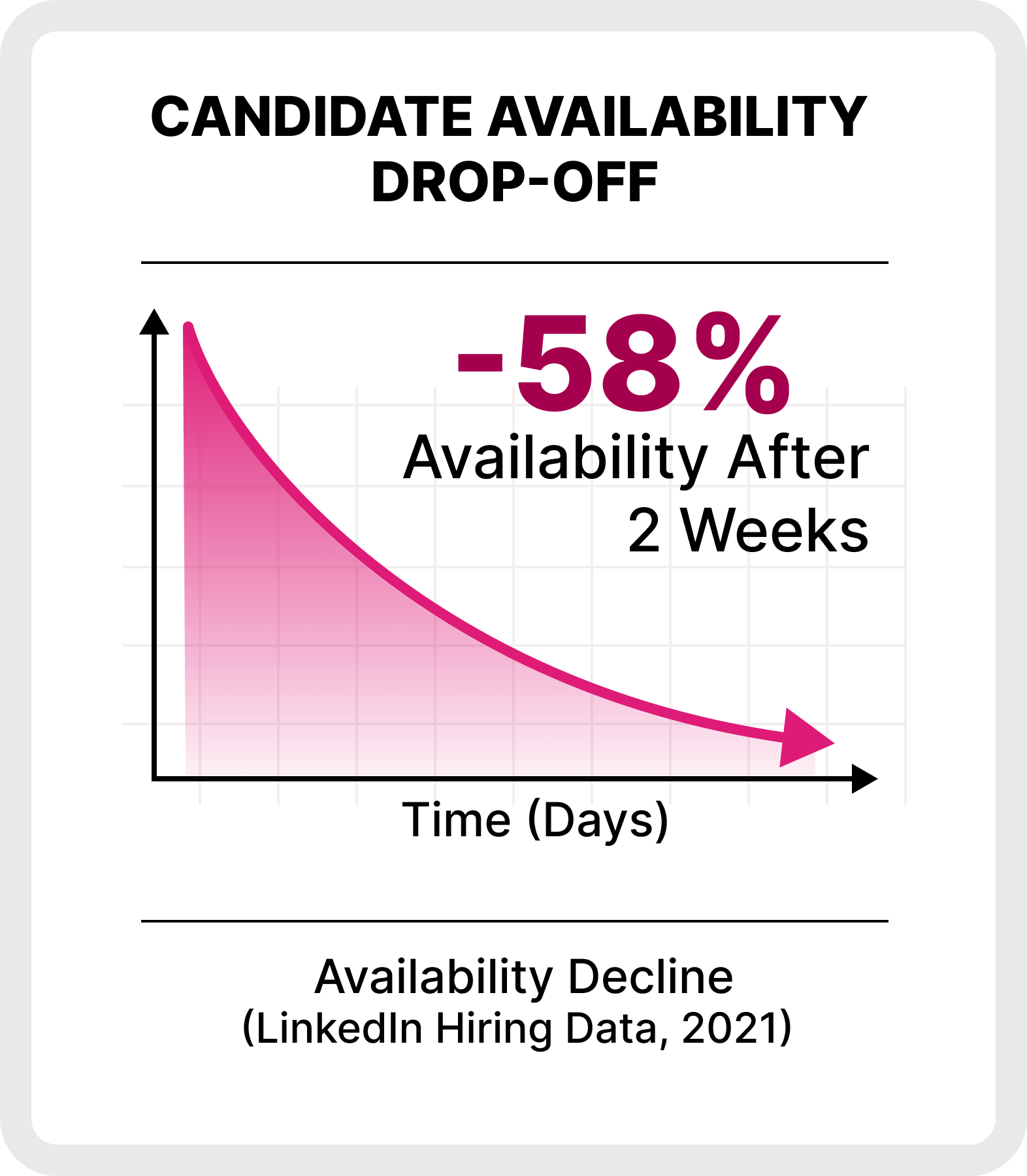
This reinforces the idea that hiring timelines are not driven by a
single bottleneck, but by the interaction of multiple stages across the recruitment funnel.
The Role of Technology
Advancements in hiring technology have made it easier to manage and track recruitment processes. More recently, the focus has begun to shift toward enabling better decisions and improving predictability.
Technology can play a role in reducing perceived complexity by structuring data, accelerating decisions through insights, and improving candidate engagement through automation. However, its effectiveness depends on how it is integrated into the broader hiring system.
Tools can support decision-making, but they cannot replace the need for clarity, alignment, and accountability. Without these foundations, even the most advanced systems will struggle to deliver meaningful improvements in hiring velocity.
From Measurement to Understanding
Perhaps the most important shift organisations can make is to move from measuring time-to-hire to understanding what drives it.
Traditional hiring systems are designed to track outcomes after they occur. They provide visibility into timelines, conversion rates, and funnel stages, but offer limited insight into why those outcomes take shape in the first place.
Emerging approaches are beginning to address this gap by focusing on prediction and interpretation rather than retrospective analysis.
Instead of asking how long hiring took, these systems attempt to answer more forward-looking questions:
Where are delays likely to occur? Which candidates are most likely to progress? When is a decision sufficiently confident to act on?
This shift is increasingly being enabled by large-scale data analysis across hiring interactions. By examining patterns across interviews, decision points, and candidate behaviour, it becomes possible to identify consistent drivers of hiring outcomes.
Platforms such as Qallify, for example, have explored these patterns across millions of interview data points to better understand how variables like role definition, decision timing, and candidate intent influence hiring velocity.
Such approaches illustrate how hiring can move from being a reactive process to a more predictable system. Importantly, the value of these systems lies not just in automation, but in their ability to bring structure and visibility to previously opaque decision-making processes.
Such approaches illustrate how hiring can move from being a reactive process to a more predictable system. Importantly, the value of these systems lies not just in automation, but in their ability to bring structure and visibility to previously opaque decision-making processes.
Organisations that consistently achieve better hiring outcomes are not necessarily those that move faster at every step. They are the ones that bring clarity to roles, discipline to decisions, and alignment to the way they engage with the talent market.
Our research shows, in doing so, they move beyond managing hiring processes. They begin to understand—and ultimately engineer—the dynamics that drive hiring velocity.
To know more about Qallify’s Predictive Intelligence Model, click here.
To know more about Qallify’s Predictive Intelligence Model, click here.